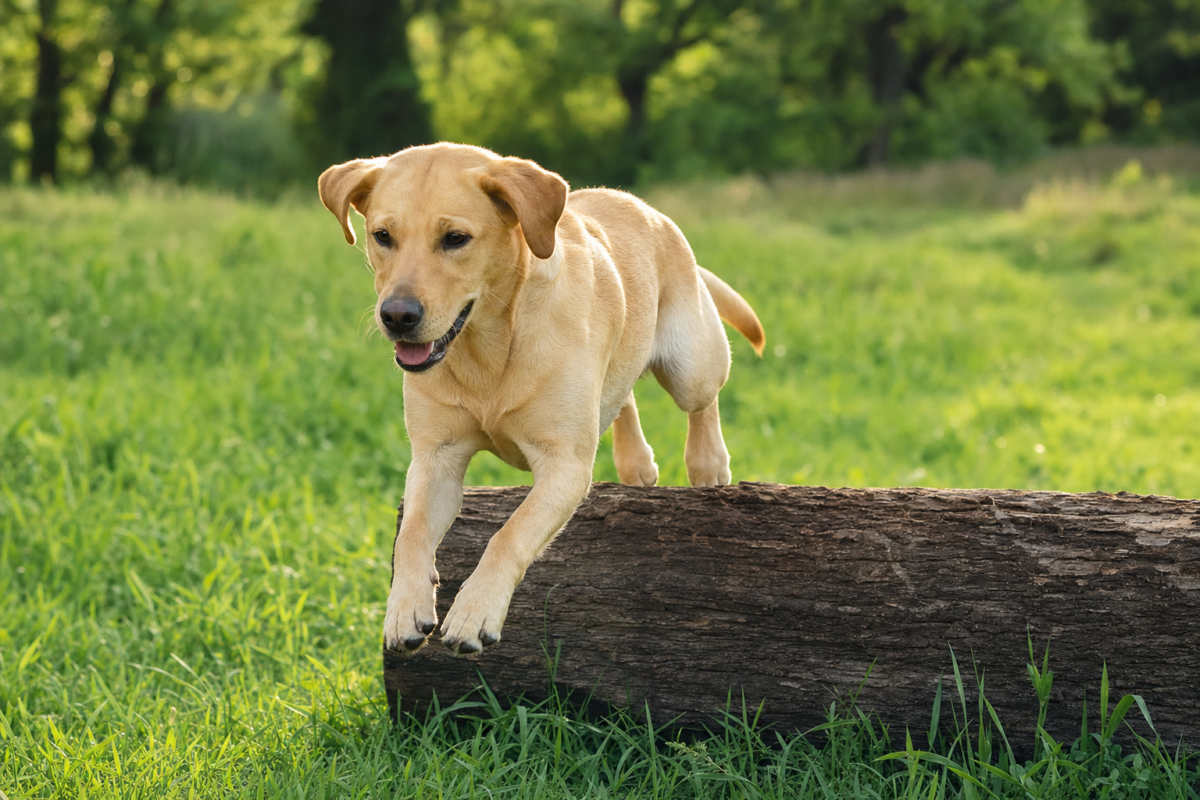
Most large breed puppies can begin controlled, low jumping once their growth plates have closed, usually between 12 and 18 months for large breeds and 18 to 24 months or later for giant breeds. Before that, keep jumps low, soft and occasional. Casual play jumps a puppy chooses alone are normal. Repeated, forced or high jumping onto hard surfaces is the part worth delaying until the frame has finished forming.
If your big puppy has just cleared the couch in one bound and landed with a thud that shook the room, you are probably wondering what is safe and what is asking too much. The answer is more encouraging than most Dog Parents expect. You do not need to wrap a growing dog in cotton wool. You need to know which jumps load a developing frame and roughly when that changes. This guide gives you clear jumping rules by age and the daily habits that help a big dog land softly for years.
When is it safe for a large breed puppy to start jumping?
It is generally safe to start structured, low jumping once the growth plates at the ends of the long bones have closed. For most large breeds that happens between 12 and 18 months. For giant breeds it often runs to 18 to 24 months, and in the very largest dogs closer to 30 months. Until then, the rule of thumb is simple: low, soft and occasional is fine, while high, hard and repeated is best saved for later.
That distinction matters more than the calendar. A puppy hopping over a fallen branch and a puppy doing twenty repetitions off a tailgate onto concrete are not the same activity, even at the same age. Height, surface, repetition and body weight are what turn an ordinary movement into a heavy one, and all four are within your control.
What decides when a big dog can jump
Large and giant breeds grow for a long time. Their bones lengthen from soft zones near each end called growth plates, and those zones stay open while the dog is still adding height. A small dog passes through this stage quickly. A big dog spends a year and a half or more in it, carrying far more weight across the same young structures.
Landing is the part that counts. Going up is muscular work and relatively gentle. Coming down sends the dog body weight through the front legs and shoulders in a fraction of a second, and the bigger the dog, the bigger that load. None of this means a growing big dog should move less. Movement is what builds strong bone, dense muscle and confident coordination. The aim is to shape how your puppy moves during the growth years, not to reduce how much they move.
Jumping rules by age, month by month
Use this as a practical guide rather than a rulebook. A Great Dane sits at the far end of every range below while a Boxer sits at the near end.
| Age | What the frame is doing | Jumping guidance |
|---|---|---|
| 8 weeks to 4 months | Rapid early growth, very soft plates, poor coordination | No deliberate jumping. Lift into cars. Block sofa launching. |
| 4 to 6 months | Fast height gain, leggy and unbalanced | Self chosen play hops only. Nothing above elbow height. |
| 6 to 9 months | Peak growth speed for most large breeds | Keep jumps low and on grass. Ramps for the car. |
| 9 to 12 months | Height slowing, muscle beginning to fill | Occasional low jumps on soft ground are reasonable. |
| 12 to 15 months | Plates closing in many large breeds | Introduce controlled low obstacles if your vet agrees. |
| 15 to 18 months | Most large breeds near skeletal maturity | Build height gradually. Giant breeds still wait. |
| 18 to 24 months | Giant breeds finishing, muscle still arriving | Large breeds can train normally. Giants stay moderate. |
| 24 to 30 months | Final filling out in the largest breeds | Full jumping for nearly all dogs, built up over weeks. |
The American Kennel Club’s Chief Veterinary Officer, Dr. Jerry Klein, DVM, has written extensively on the slower growth and development timeline of large and giant breeds. Read more from the AKC’s guidance on caring for large-breed dogs.
When do growth plates actually close?
Growth plate closure is not a single event on a single day. The plates close in sequence, and the timing tracks adult size more than it tracks breed name. A dog with an expected adult weight of 50 to 65 pounds usually finishes around 16 to 18 months. At 65 to 80 pounds it is roughly 18 to 22 months. At 80 to 100 pounds, 20 to 24 months. At 100 to 130 pounds, 22 to 26 months. Above 130 pounds, 24 to 30 months or a little beyond.
If you want certainty rather than a range, your veterinarian can take a simple radiograph and tell you what the plates look like. That is the only way to know for an individual dog, and it is a reasonable thing to ask for before starting a jumping sport.
Why the growth window is the moment that matters
Across roughly 8 to 30 months, depending on adult size, your puppy is laying down the bone, cartilage and connective tissue that has to carry a heavy dog for a decade. Lean feeding, sensible surfaces, controlled landings and daily joint support all pull in the same direction, which is a frame that stays comfortable long after the growing has stopped.
Height Over Hips
A jump higher than the elbow asks the front end to absorb far more on landing. Keep obstacles low while young.
Hard Landings
Concrete, tile and packed gravel give nothing back. Grass, sand and rubber matting absorb a share of the impact.
Repetition
One jump is an event. Thirty jumps is a training load. Volume, not the single leap, is what accumulates.
Extra Weight
Every additional pound travels through the joints on every landing. A lean puppy lands lighter.
How feeding changes what a jump costs
Weight and jumping are the same conversation. A puppy carrying extra condition lands harder every time, and grows faster than is ideal on top of it. Steady, moderate growth is the goal for every big breed.
- Choose a complete food formulated for large breed puppies, which balances calories, calcium and phosphorus for slower, steadier growth.
- Split the daily amount into three meals while young, then two as an adult, so energy stays even through the day.
- Feed to a lean body condition rather than to the number on the bag. Portions on packaging are a starting point, not an instruction.
- Confirm the right daily amount with your veterinarian at every checkup, since the correct portion changes quickly.
How to check body condition in ten seconds
The scale tells you weight. Body condition tells you whether that weight suits your dog today.
- Ribs. Run your hands along the sides. You should feel each rib easily under a thin layer. If you have to press, ease back on food.
- Waist. Look down from above. You want a clear waist tucking in behind the ribs.
- Tuck. From the side, the belly should rise toward the back legs rather than running level.
Check every couple of weeks through the growth years and adjust portions gently with your veterinarian guiding you.
Growth safe alternatives while you wait
Delaying high jumping does not mean a bored puppy. Big dogs get plenty of outlet from activities that build the same strength and coordination without the landing load.
- Free play on grass, where your puppy chooses the pace and stops when tired.
- Walking over low poles laid flat on the ground, which builds awareness of where the back feet are.
- Gentle hill walking, which develops rear drive with no impact at all.
- Supervised swimming, which is close to a perfect growth stage exercise.
- Scent games and training, which tire a clever big dog as thoroughly as a long walk.
- Ramps for the car and a plan for stairs, so the daily repeated impacts get managed too.
Car exits deserve special attention. A puppy leaping down from a tailgate onto a driveway is doing a hard jump twice a day, every day, which quietly adds up to far more volume than the occasional garden hop. A ramp solves it.
Supporting the joints your dog jumps on
Every landing travels through cartilage, ligaments and joint fluid, and a big dog asks a lot of all three. Supporting healthy joint development while the frame is still forming is one of the simplest habits available to you.
Alongside lean feeding and sensible surfaces, many big dog parents add a daily joint support chew made for large and giant breeds. MoveGuard Growth is built for this stage. It combines nine actives, including New Zealand Green Lipped Mussel, glucosamine, chondroitin, MSM and hyaluronic acid, to support the developing joints of young large breed dogs across the roughly 8 to 30 month growth window. You dose by expected adult weight, so a dog heading for 50 to 80 pounds takes two chews a day and one heading for 80 pounds or more takes three. It ships as 90 chews, is made in the USA in an NSF facility, and is backed by a 60 day guarantee.
Support Every Landing
Give your growing big dog daily joint support built for large and giant breeds. Explore MoveGuard Growth.
Signs your puppy is handling activity well
You can read most of this from the sofa. A puppy coping well with their activity level moves smoothly, gets up easily after a nap, keeps a level topline at the trot, and settles happily once play is over. Muscle looks even on both sides and all four legs get used the same way.
Worth a conversation with your veterinarian: limping of any duration, stiffness after rest, a new reluctance to use stairs or get into the car, or sitting down mid play. None of these mean something is wrong, and all are easier to sort out early.
A simple jumping game plan, stage by stage
You do not need a program. You need the right emphasis at the right age.
8 weeks to 4 months. Foundation stage. Lift your puppy into the car, block sofa launching, and put a runner down on slippery floors. Teach four paws on the floor as a greeting now, because a Great Dane greeting guests at chest height is a habit best never started.
4 to 8 months. Growth is at its fastest and your puppy is leggy, keen and not especially coordinated. Keep everything low. This is the natural point to begin a daily joint routine and to introduce a car ramp before the lifting gets heavy.
8 to 18 months. Height slows and muscle starts to arrive. Large breeds can begin controlled low obstacles toward the end of this stage if your veterinarian agrees. Giant breeds keep waiting. Body condition matters more than ever, because appetite often outpaces need.
18 months to 3 years. The frame is finished or nearly so. Build jumping height gradually over weeks rather than starting where you hope to end. Many Dog Parents keep the joint routine going into adulthood, which is sensible for a dog that will spend the next decade landing on those legs.
Common jumping mistakes to avoid
Most of the trouble comes from a short list of habits, and every one is easy to change.
- Treating car exits as free. Twice a day onto a hard driveway is the highest volume jumping most puppies do. Use a ramp.
- Throwing a ball high. A puppy twisting in the air to catch lands unevenly on one front leg. Roll it along the ground instead.
- Confusing tired with sore. A puppy who lies down mid game may be uncomfortable rather than lazy. Look properly.
- Starting a jumping sport too early. Agility and flyball are wonderful for big dogs and worth waiting for. Foundation work without height fills the time perfectly.
- Letting weight creep up. Extra pounds change the cost of every landing. Feed lean and let size arrive on its own schedule.
- Waiting for a problem before supporting joints. The growth window is the ideal time to support developing joints, not the moment after something looks off.
The big dog personality and the jumping years
Large breeds are enthusiastic greeters, and the jumping question is often as much about manners as it is about bones. A 30 pound puppy putting both feet on a visitor is charming. The same dog at 130 pounds is not, and by then the habit has had two years of practice behind it.
Happily, the fix is the same one that protects the frame. Reward four paws on the floor from the first week home. Ask for a sit before greetings and before doors open. Give your puppy something to do with their mouth and mind when guests arrive. A big dog taught to keep their feet down is easier to live with and is also doing far fewer hard landings on hard floors every day.
Frequently asked questions
At what age can a large breed puppy jump safely?
Most large breeds can begin controlled, low jumping between 12 and 18 months, once growth plates have closed. Giant breeds usually wait until 18 to 24 months and sometimes closer to 30 months. Build height gradually rather than starting high.
Is it bad if my puppy jumps on the sofa?
An occasional self chosen hop onto a low sofa is not a crisis. Repeated launching on and off furniture all day is worth managing, especially onto hard floors. Block access or add a soft landing area while your puppy is growing.
Should my big puppy jump out of the car?
No. Jumping down from a tailgate onto a hard driveway is one of the heaviest landings a growing dog does, and it happens twice a day. Use a ramp or lift your puppy until the frame has finished forming.
When can I start agility with a large breed dog?
Foundation work without height can start young. Full height jumping usually waits until growth plates have closed, which most trainers and veterinarians place at 18 months or later for large breeds and later still for giants. Ask your veterinarian about your individual dog.
How do I stop my large dog jumping up on people?
Reward four paws on the floor from the first week, ask for a sit before every greeting, and make sure nobody rewards jumping with attention. Starting early is far easier than retraining a fully grown big dog later.
The bottom line
Jumping is not the enemy. Height, hard surfaces and repetition are what turn an ordinary movement into a heavy one for a growing big dog. Keep jumps low and soft through the first year, manage the daily repeats like car exits and stairs, feed for lean and steady growth, support the joints through the growth window, then build real height gradually once the frame is finished. Do that and you get a big dog who moves with joy and lands with comfort for years to come.
Want the Simple Roadmap in One Place?
Grab our free Big Dog Growth Blueprint for the growth window checklist, feeding framework and joint safe exercise limits, all written for large and giant breeds.
This article is for general educational purposes only and is not veterinary advice. It is not intended to diagnose, treat, cure or prevent any disease. Always consult your veterinarian about your dog’s individual health, nutrition and supplement needs. These statements have not been evaluated by the Food and Drug Administration.
Support Big Breed Joints from Day One
Large and giant breeds carry more load through every growth stage. MoveGuard Growth supports developing joints in young big dogs (8 to 30 months); MoveGuard Adult keeps grown big dogs moving comfortably.
Leave a Reply