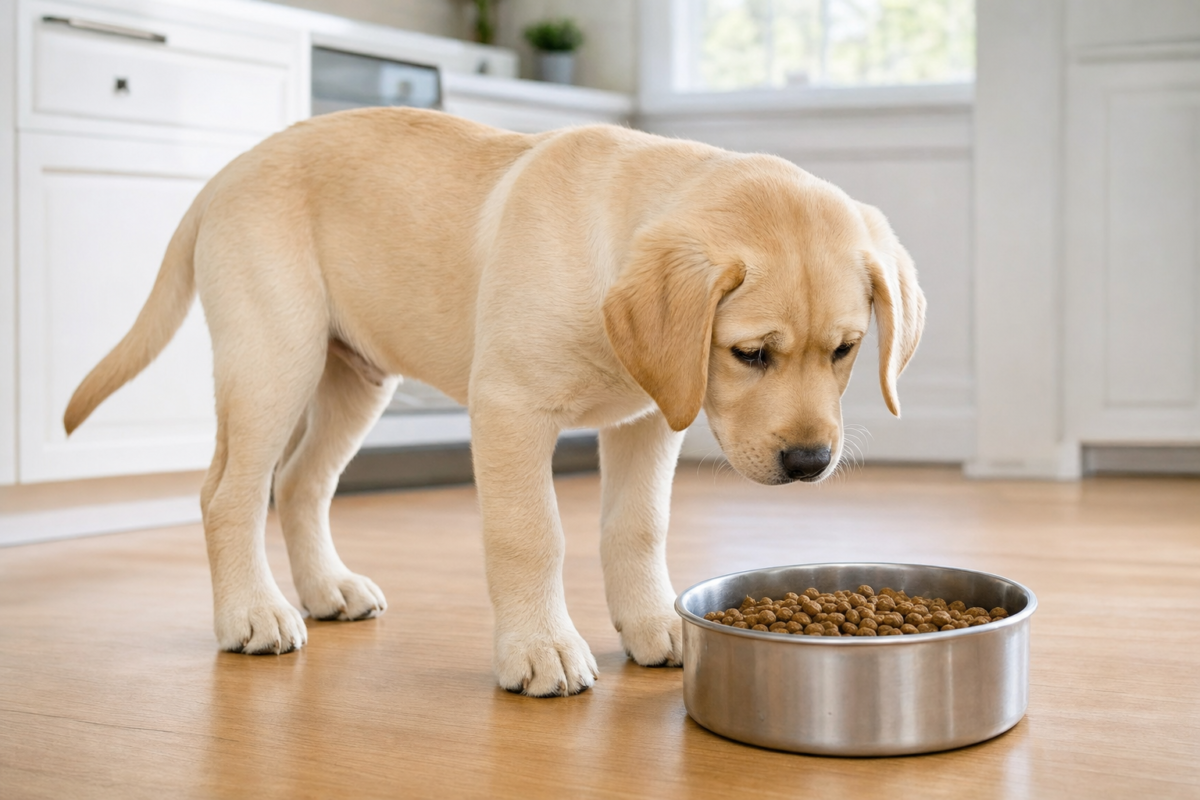
Feed a large breed puppy four small meals a day from 8 to 12 weeks, three meals a day from 3 to 6 months, and two or three meals a day from 6 to 12 months. Most large and giant breed puppies settle into two meals a day at around 12 months, and stay on two meals for life. Splitting the daily amount into more meals keeps energy steady, keeps the stomach comfortable, and makes it far easier to feed for slow, even growth.
Bringing home a large breed puppy comes with one question that arrives before almost any other. How often does this little one actually need to eat? The answer changes several times during the first year, and getting it right is one of the kindest things you can do for a growing frame. This guide gives you the meal schedule by age, a daily routine you can copy, the portion habits that keep growth steady, and the signs your puppy is thriving.
How often should I feed a large breed puppy by age?
A large breed puppy needs four meals a day from 8 to 12 weeks, three meals a day from 3 to 6 months, two or three meals a day from 6 to 12 months, and two meals a day from around 12 months onward. Giant breeds often hold three meals a day slightly longer, closer to 9 or 10 months, because they are still growing quickly and benefit from smaller amounts at a time.
The total food for the day is set by your puppy body weight, expected adult weight and the food you have chosen. The number of meals simply decides how that total is divided. More meals early on means smaller portions and steadier energy, which suits a young digestive system.
What makes a large breed puppy feeding schedule different
A big puppy is not simply a small puppy scaled up. A large or giant breed grows for far longer, adds far more weight, and does it on a skeleton that stays soft and developing for many months. That combination changes how you feed.
Small breed puppies finish growing in about ten months. A large breed puppy is still building bone and cartilage at 18 months, and a giant breed can still be filling out beyond two years. Stretching that much growth over that much time means the goal is never speed. It is a slow, even curve, because bone laid down calmly carries a heavy adult body comfortably for years.
Frequent, moderate meals help you deliver that. Several measured portions keep energy even and never overload a young stomach, which matters for a deep chested breed.
Large breed puppy feeding schedule, month by month
Use this schedule as a friendly framework rather than a rulebook. Your veterinarian and the label on your food set the daily amount. This tells you how to split it.
| Age | Meals per day | What the day looks like |
|---|---|---|
| 8 to 12 weeks | 4 meals | Roughly 7am, 11am, 3pm and 7pm, each about a quarter of the daily amount |
| 3 to 4 months | 3 meals | Morning, midday and early evening, each about a third of the daily amount |
| 4 to 6 months | 3 meals | Same three meals, larger portions as appetite and growth climb |
| 6 to 9 months | 2 to 3 meals | Large breeds may drop the midday meal here, giant breeds often keep it |
| 9 to 12 months | 2 meals | Morning and evening, roughly twelve hours apart |
| 12 months and beyond | 2 meals | Two adult meals a day, with the food transition timed to your breed |
The World Small Animal Veterinary Association’s Global Nutrition Committee publishes evidence-based guidance for evaluating dog food and feeding practices. Read more from the WSAVA Global Nutrition Guidelines.
Notice that the meals reduce while the food does not. Portions grow as meals get fewer, so the daily total keeps climbing through the fastest growth months even as the bowl appears less often.
When can a large breed puppy move to two meals a day?
Most large breed puppies are ready for two meals a day between 6 and 12 months. The signal is behavioural. A puppy who leaves the midday bowl is telling you the third meal has done its job. Make the change gradually by shrinking the midday portion over a week and adding it to breakfast and dinner.
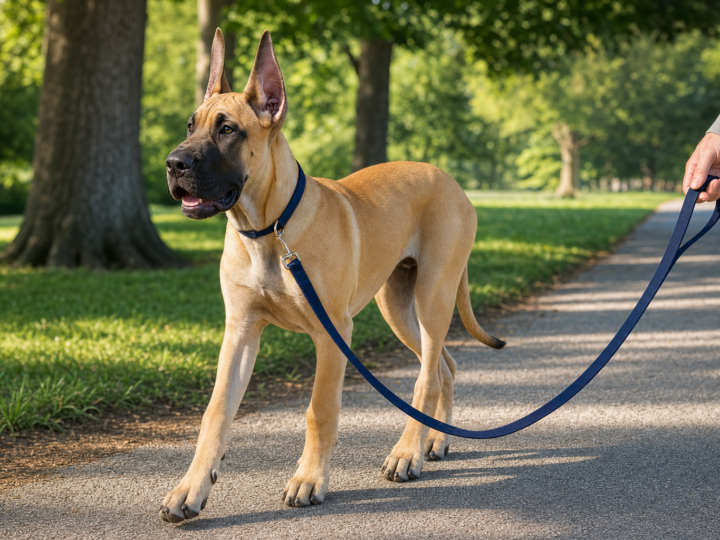
Giant breeds tend to hold three meals longer. A Great Dane at 8 months eats a very large daily volume, and dividing it three ways keeps each meal a comfortable size. There is no prize for dropping to two meals early, so let appetite and your veterinarian guide the timing.
Why the growth window shapes the schedule
Large and giant breeds grow across roughly an 8 to 30 month window depending on adult size, and the feeding schedule follows that arc. Dogs with an expected adult weight of 50 to 80 pounds usually finish the main growth phase between 16 and 22 months. Heavier breeds at 100 pounds and up keep developing well past two years.
Growth plates, the soft zones at the ends of the long bones, stay open through much of that period. While they are open, every extra pound of body weight is a bigger ask of a frame that is still forming. Feeding little and often is not just about comfort. It is one of your best levers for keeping the growth curve calm and the body lean while that skeleton finishes its work.
One Huge Meal
A single large daily bowl overloads a young stomach and spikes energy. Split the total across the day instead.
Free Feeding
Leaving food down all day makes portions impossible to track and encourages a puppy to grow faster than the frame prefers.
Feeding Around Exercise
Big meals immediately before or after hard activity are best avoided. Leave a quiet hour on either side.
Growing Too Fast
Extra calories load open growth plates. Aim for a steady curve rather than a quick one.
How much should go into each meal?
Start with the daily amount, then divide. A puppy eating four cups a day on three meals gets roughly one and a third cups per meal. Simple division is all the maths you need, and a proper measuring cup beats guessing by eye every single time. A few habits make the rest easy:
- Choose a complete food formulated for large breed puppies, which balances calories, calcium and phosphorus for slower, steadier growth.
- Measure every meal with the same cup or a kitchen scale so portions never creep up quietly.
- Recheck the daily total every two to four weeks. A four month old puppy outgrows a portion fast.
- Count treats and training rewards inside the daily total rather than on top of it.
- Ask your veterinarian to confirm the amount at each checkup, because the right portion changes quickly during the first year.
How to check body condition in ten seconds
The bowl tells you what went in. Body condition tells you whether it was right. You can check at home in seconds.
- Ribs. Run your hands along the sides. You should feel the ribs easily under a thin layer. If you have to press, ease back on food.
- Waist. Look down from above. You want a clear waist that tucks in behind the ribs.
- Tuck. From the side, the belly should rise toward the back legs rather than hanging level.
Check every couple of weeks through the growth years and adjust portions gently with your veterinarian guidance. A lean puppy is the goal, and a lean big dog moves more comfortably at every age.
Timing meals around play and rest
Meal timing and activity work together. Deep chested breeds are more comfortable when big meals and hard exercise are kept apart, and a calm hour on either side of a meal costs you nothing.
- Leave about an hour between a meal and energetic play, in both directions.
- Offer water freely all day rather than letting a puppy gulp a large volume straight after eating.
- Feed in a quiet spot away from foot traffic so meals stay unhurried.
- Use a slow feeder bowl if your puppy inhales food, which is common in fast growing breeds.
- Let your puppy settle for a proper rest after eating. Sleep is where growth actually happens.
Supporting the joints your schedule is protecting
Everything about a careful feeding schedule points in the same direction, which is a lean puppy growing at a calm pace on joints that are still forming. That is the whole reason big dog parents fuss over meal counts and measuring cups in the first place.
Alongside lean feeding and sensible exercise, many big dog parents add a daily joint support chew made for large and giant breeds. MoveGuard Growth is built for exactly this stage. It combines nine actives, including New Zealand Green Lipped Mussel, glucosamine, chondroitin, MSM and hyaluronic acid, to support the developing joints of young large breed dogs across the roughly 8 to 30 month growth window. You dose by expected adult weight, so a puppy heading for 50 to 80 pounds sits at two chews a day and a bigger dog at three. It ships as 90 chews, is made in the USA in an NSF facility, and is backed by a 60 day guarantee.
Support A Growing Frame
Give your growing puppy daily joint support built for large and giant breeds. Explore MoveGuard Growth.
Signs your feeding schedule is working
You do not need a spreadsheet to know things are going well. Look for a puppy who arrives hungry but not frantic, finishes the bowl in a few minutes, holds a lean waist you can see from above, and has ribs you can feel under light pressure. Firm stools and steady energy are two more quiet signs.
If your puppy regularly leaves food, seems uncomfortable after eating, gains weight quickly, or bloats visibly after a meal, speak with your veterinarian. Early adjustments to meal size and timing are far easier than late ones.
A simple feeding game plan, stage by stage
You do not need a complicated program. You need the right emphasis at the right time.
8 weeks to 4 months. Foundation stage. Four meals a day at first, moving to three at around three months. Keep the same food your breeder or shelter used at first, then transition slowly over a week. Measure everything and weigh your puppy regularly, because portions change fast at this age.
4 to 8 months. Growth is quick and appetite is enormous. Hold three meals a day, keep increasing the daily total as your veterinarian advises, and watch body condition rather than the bowl. This is a natural point to begin a daily joint support routine that carries through the whole growth window.
8 to 18 months. Most large breeds settle into two meals a day here, while giant breeds may take a little longer. Appetite can now outpace need, so match portions to a lean body condition rather than to enthusiasm. Discuss the timing of the move to adult food with your veterinarian, since it depends on adult size.
18 months to 3 years. Two adult meals a day, portions matched to activity level, body condition checked monthly. Many parents keep a joint support routine going into adulthood.
Common feeding schedule mistakes to avoid
Most feeding problems in big puppies come from a few avoidable habits. Steer clear of these and you are already ahead.
- Dropping to two meals too early. A twelve week old puppy fed twice a day gets meals that are too large and energy that swings. Keep the extra meals while they are small.
- Free feeding from a full bowl. It hides how much is eaten, makes portion control impossible and encourages fast growth.
- Adding calcium supplements. A complete large breed puppy food is already balanced. Extra minerals are not helpful and should only ever be given if your veterinarian asks for them.
- Feeding to the growth chart instead of the dog. Charts are averages. Your hands on the ribs are the better instrument.
- Forgetting treats count. Training rewards add up quickly in a puppy learning fast. Take them out of the daily total.
Building a routine the whole household can follow
A feeding schedule only works if everybody in the house is running the same one. The most common cause of a chubby puppy is not one big mistake. It is two people each giving a meal, or a family member topping up the bowl.
Write the schedule on the fridge. Note the daily amount, the number of meals, the times, and how much of the total each meal represents. Add a line for treats so everyone knows the daily allowance. If your puppy has learned to work a room for extra food, and most big breeds learn this quickly, a shared chart takes the negotiation out of it entirely.
Consistency helps your puppy settle too. Meals at predictable times build a rhythm for toilet trips, naps and training, and a feeding schedule is the easiest routine in the house to keep.
Frequently asked questions
How many times a day should a large breed puppy eat?
Four meals a day from 8 to 12 weeks, three meals from 3 to 6 months, two or three meals from 6 to 12 months, and two meals a day from around 12 months onward. Giant breeds often keep three meals a little longer.
When should I switch my large breed puppy to two meals a day?
Most large breed puppies are ready between 6 and 12 months, often when they start leaving the midday meal. Make the change gradually over about a week by shrinking the middle portion and adding it to breakfast and dinner.
Can I free feed a large breed puppy?
Free feeding is not recommended for large and giant breeds. Measured meals let you control the growth curve, spot appetite changes early and keep your puppy lean while the joints are still developing.
Should I feed my puppy before or after a walk?
Leave roughly an hour between a meal and energetic activity in both directions. A calm gap suits deep chested breeds and lets your puppy digest and rest comfortably after eating.
How much should each meal be?
Divide the daily amount from your food label by the number of meals. If your puppy eats four cups a day across three meals, each meal is roughly one and a third cups. Confirm the daily total with your veterinarian at every checkup.
The bottom line
A large breed puppy feeding schedule is simple once you see the shape of it. Four meals while tiny, three through the fastest growing months, then two meals for life from around a year old. The daily amount keeps rising even as the number of meals falls, so measure every portion, check body condition every couple of weeks, and let a lean, steadily growing puppy be your proof that the plan is working.
Want the Simple Roadmap in One Place?
Grab our free Big Dog Growth Blueprint for the growth window checklist, feeding framework and joint safe exercise limits, all written for large and giant breeds.
This article is for general educational purposes only and is not veterinary advice. It is not intended to diagnose, treat, cure or prevent any disease. Always consult your veterinarian about your dog’s individual health, nutrition and supplement needs. These statements have not been evaluated by the Food and Drug Administration.
Support Big Breed Joints from Day One
Large and giant breeds carry more load through every growth stage. MoveGuard Growth supports developing joints in young big dogs (8 to 30 months); MoveGuard Adult keeps grown big dogs moving comfortably.
Leave a Reply