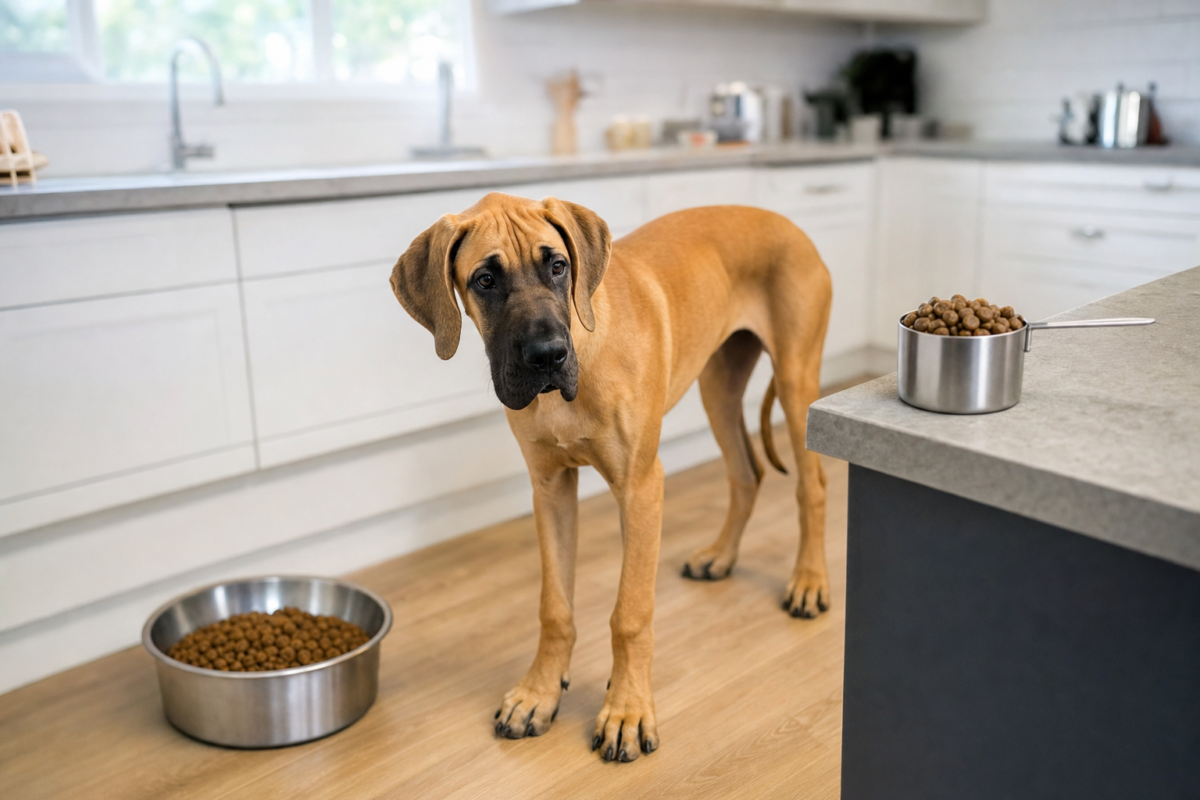
A large breed puppy needs roughly 3.0 to 4.5 grams of calcium per 1,000 calories of food, which on a typical dry food works out to about 1.0 to 1.5 percent on a dry matter basis. The safest way to hit that is to feed a complete food carrying the label statement for growth of large size dogs at 70 pounds or more as an adult, and to add nothing on top. Phosphorus should sit close behind, with a calcium to phosphorus ratio near 1.2 to 1.
Calcium is the one nutrient where big dogs genuinely are a special case, and it is the reason large breed puppy food exists as its own category. Get it roughly right and your puppy builds a sound frame without you thinking about it again. Get it badly wrong, usually by adding something helpful on top of a food that was already balanced, and you can work against the very thing you were trying to support. This guide explains what the numbers mean, how to find them on a bag you already own, and why more is not better.
How much calcium does a large breed puppy need?
A large breed puppy needs about 3.0 to 4.5 grams of calcium per 1,000 calories, or roughly 1.0 to 1.5 percent of the diet on a dry matter basis. Giant breeds are best served in the lower half of that range. Any complete food carrying the label statement for growth of large size dogs is formulated to land inside it, which is why the practical answer for almost every Dog Parent is simply to feed the right food and stop there.
The number that matters more than the minimum is the ceiling. Veterinary guidance is clear that calcium above roughly 3 percent on a dry matter basis is associated with more severe skeletal problems in young, rapidly growing large and giant breeds than diets in the 1 to 3 percent range. Small breed puppies do not show the same pattern. This is specifically a big dog issue.
Why big puppies are a special case
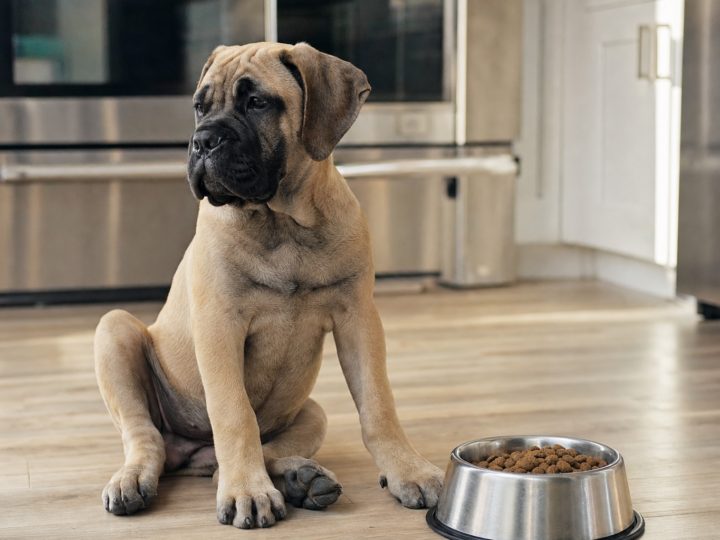
An adult dog regulates calcium well. When more arrives than the body needs, absorption dials down. A young puppy has far less of that protective control, so a good deal of what is in the bowl gets absorbed whether the body needs it or not. That matters most in the animal doing the most skeletal building, which is precisely a large or giant breed puppy adding weight month after month.
Excess calcium during that window interferes with the normal remodelling process that shapes bone as it grows. The result is a skeleton that can be larger but less well organised, carrying a body that is heavier than ideal. That is the whole reason controlled growth is such a consistent theme in big dog nutrition. It is also why the advice runs opposite to instinct: a growing giant breed does not need extra calcium, it needs calcium held steady inside a fairly narrow band.
The numbers, in one table
Here is what to look for. Exact figures vary between foods, so read the label in front of you and confirm with your veterinarian.
| Measure | Target for a large breed puppy | Why it matters |
|---|---|---|
| Calcium, grams per 1,000 calories | About 3.0 to 4.5 | The most useful unit, because it accounts for how calorie dense the food is |
| Calcium, percent dry matter | About 1.0 to 1.5 | The figure most often quoted. Above 3 percent is clearly excessive for a big puppy |
| Phosphorus, percent dry matter | About 0.8 to 1.2 | Works with calcium rather than against it. Both need to be in range |
| Calcium to phosphorus ratio | About 1.2 to 1, up to 1.4 to 1 | The wider allowed range runs from 1 to 1 up to 2 to 1, but the middle is where you want to sit |
| Label statement | Growth, including growth of large size dogs at 70 pounds or more as an adult | The manufacturer confirming the food was formulated for a dog like yours |
The World Small Animal Veterinary Association’s Global Nutrition Committee publishes evidence-based guidance for evaluating dog food and feeding practices. Read more from the WSAVA Global Nutrition Guidelines.
Notice that the ratio matters as much as the amounts. Two minerals in the right proportion behave very differently from the same two minerals where one has run ahead of the other, which is exactly what happens when a supplement is added to an already complete food.
How to find the numbers on a bag you already own
Most bags print calcium as a minimum percentage in the guaranteed analysis, on an as fed basis. That figure includes the water in the food, so it understates the real concentration. Converting it is straightforward.
- Find the moisture. The guaranteed analysis lists maximum moisture, typically around 10 percent for dry food.
- Work out the dry matter. Subtract moisture from 100. At 10 percent moisture the dry matter is 90 percent.
- Convert. Divide the calcium percentage by the dry matter and multiply by 100. A food listing 1.1 percent calcium at 10 percent moisture is 1.1 divided by 90, times 100, which is about 1.2 percent on a dry matter basis.
If you would rather skip the arithmetic, ring the number on the bag. Any manufacturer worth feeding will tell you the calcium content in grams per 1,000 calories, and a company that cannot answer that question has told you something useful as well.
When do these numbers stop mattering?
The tight control on calcium applies while your dog is actively building a skeleton. Once growth is finished, a mature dog regulates calcium far better and an adult maintenance food carries no growth specific ceiling, which is fine because the construction work is over. That transition is the practical reason to move from a puppy formula to an adult one, covered in detail in our guide to puppy food versus adult food for large breeds.
The growth window this all sits inside
For big dogs, the build runs roughly from 8 to 30 months, finishing near 24 months in large breeds and closer to 30 months in giants. Growth plates, the soft areas at the ends of the long bones, stay open through much of that stretch. Mineral control matters most in the first half of the window, when the growth rate is highest, but the habits of lean feeding and sensible movement carry all the way through it.
Adding A Supplement
Calcium, bone meal or a mineral topper on a complete food pushes a balanced formula out of range. This is the most common way it goes wrong.
The Wrong Puppy Food
A general puppy formula can carry more calcium per calorie than a giant breed needs. Look for the large size dogs wording.
Unbalanced Homemade Diets
Getting calcium and phosphorus right in a home cooked diet for a growing giant breed is genuinely difficult without professional help.
Too Little Counts Too
The problem runs both ways. An adult food or a meat heavy diet can leave a growing big dog short of what the skeleton is drawing on.
Where hidden calcium comes from
Dog Parents who have chosen the right food sometimes still push the total past where they meant to, because the bowl is not the only source. Worth knowing about:
- Calcium and joint supplements. Some contain calcium directly. Read the panel before adding anything alongside a complete food.
- Bones and antlers. Recreational chewing is one thing, but bone that is actually being consumed is a meaningful calcium source.
- Dairy toppers. Cheese and yoghurt used generously as toppers add up faster than most people expect.
- Home cooked toppers. Adding a large share of unbalanced food to a balanced diet dilutes and shifts the whole mineral profile, not just the calories.
- Treats. As a rule of thumb, treats are best kept under about 10 percent of daily calories, which keeps their mineral contribution small too.
None of this means a puppy can never have cheese. It means the total is what counts, and that the safest structure is one complete food doing the balancing while everything else stays occasional.
How to check body condition in ten seconds
Alongside the minerals, how much food arrives matters, because rate of growth is its own risk factor.
- Ribs. Run your hands along the sides. You should feel the ribs easily under a thin layer. If you have to press, ease back on food.
- Waist. Look down from above. You want a clear waist that tucks in behind the ribs.
- Tuck. From the side, the belly should rise toward the back legs rather than hanging level.
Our guide to complete food formulated for large breed puppies covers portioning in more detail.
Movement while the frame is forming
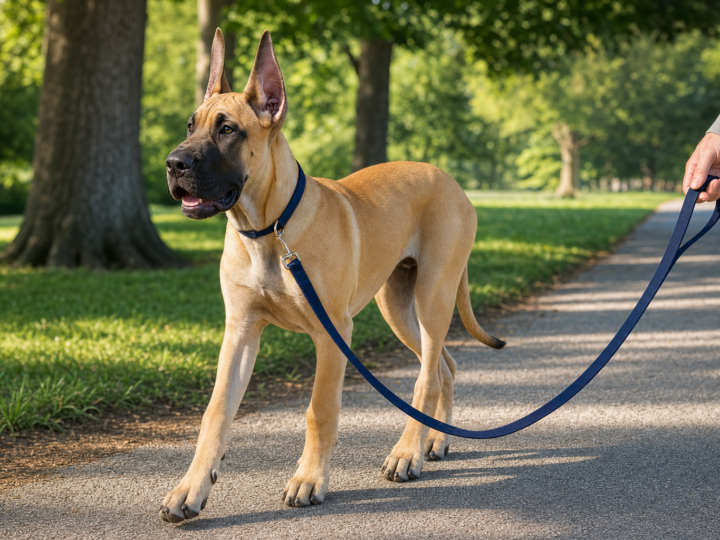
Nutrition and load work together. While your dog is growing, favour free play and steady walks on soft ground, keep repeated jumping and long runs moderate while the growth plates are open, and let your puppy rest fully between bursts of activity. Steady minerals, steady calories and steady movement all push in the same direction.
Supporting the joints the minerals are building
Calcium and phosphorus build the bone. Cartilage and connective tissue are a separate story, and they are being laid down across the same window. Many big dog parents pair a correctly formulated food with a daily joint support chew made for large and giant breeds. MoveGuard Growth is built for this stage, combining nine actives including New Zealand Green Lipped Mussel, glucosamine, chondroitin, MSM and hyaluronic acid to support the developing joints of young large breed dogs across the roughly 8 to 30 month growth window. It is dosed by expected adult weight, ships as 90 chews, and is backed by a 60 day guarantee. It is a joint support chew rather than a mineral supplement, so it does not change the calcium picture described above.
Support A Growing Frame
Give your growing big dog daily joint support built for large and giant breeds. Explore MoveGuard Growth.
Signs your puppy is building well
You will not see calcium status from across the room, and you do not need to. What you are looking for is a bright puppy with a lean waist visible from above, ribs you can feel under light pressure, smooth easy movement, straight comfortable limbs and steady rather than explosive weight gain.
If you notice limping, swelling around the joints, stiffness after rest, reluctance to move or a sudden change in gait, book a conversation with your veterinarian rather than adjusting the diet yourself. Skeletal questions in a growing big dog are worth looking at properly and early.
A simple mineral game plan, stage by stage
You need the right emphasis at the right time.
8 weeks to 4 months. Choose a complete food with the large size growth statement and let it do the balancing. Three measured meals a day. Add no calcium, no bone meal and no mineral toppers.
4 to 8 months. The fastest growth arrives. Keep the same food, keep portions matched to a lean body condition, and keep treats under roughly 10 percent of calories so they do not shift the balance.
8 to 18 months. Growth slows. Drop to two meals a day and hold the food steady. This is also when many parents begin a daily joint support routine for the rest of the growth window.
18 months onward. Once growth has finished, move to an adult maintenance food and recalculate portions. The calcium ceiling stops being the constraint it was.
Common mistakes to avoid
- Adding calcium to a complete food. The most frequent and most avoidable error. A balanced formula is balanced only if you leave it alone.
- Assuming more is better. For this nutrient in this animal at this age, more is not better. The ceiling matters more than the floor.
- Reading as fed figures as if they were dry matter. They are not the same number. Convert before comparing two foods.
- Comparing calcium without comparing calories. Grams per 1,000 calories is the honest comparison, because a calorie dense food delivers more of everything per meal.
- Improvising a home cooked diet. If you want to feed that way, work with a veterinary nutritionist rather than a recipe from the internet.
- Ignoring phosphorus. Calcium is only half the pair, and the ratio is what the body responds to.
Frequently asked questions
How much calcium does a large breed puppy need per day?
Rather than a fixed daily figure, aim for a food supplying about 3.0 to 4.5 grams of calcium per 1,000 calories, which is roughly 1.0 to 1.5 percent on a dry matter basis. A complete food carrying the growth of large size dogs statement is formulated to land in that range at whatever portion your puppy eats.
Should I give my large breed puppy a calcium supplement?
Not alongside a complete puppy food. The food is already balanced for calcium and phosphorus, and adding more pushes it out of range at the age a big dog is least able to regulate it. Always ask your veterinarian before adding any mineral supplement.
What is the ideal calcium to phosphorus ratio for a puppy?
Around 1.2 to 1, and up to about 1.4 to 1. The wider accepted range runs from 1 to 1 up to 2 to 1, but sitting near the middle is what a well formulated large breed puppy food is designed to do.
Can too much calcium harm a growing big dog?
Veterinary sources associate calcium above roughly 3 percent on a dry matter basis with more severe skeletal problems in young, rapidly growing large and giant breeds than lower intakes. This pattern is specific to big puppies. Speak with your veterinarian about your individual dog.
How do I convert the calcium on a bag to dry matter?
Subtract the maximum moisture from 100 to get the dry matter, then divide the calcium percentage by that figure and multiply by 100. A food listing 1.1 percent calcium at 10 percent moisture works out to about 1.2 percent on a dry matter basis.
The bottom line
Calcium for a large breed puppy is a narrow band rather than a target to maximise. Aim for roughly 3.0 to 4.5 grams per 1,000 calories, about 1.0 to 1.5 percent on a dry matter basis, with phosphorus close behind at a ratio near 1.2 to 1. In practice that means choosing a complete food with the growth of large size dogs statement, adding nothing on top of it, keeping treats modest, and feeding to a lean body condition. Do that and the minerals look after themselves while your dog builds the frame it will stand on for the next decade.
Want the Simple Roadmap in One Place?
Grab our free Big Dog Growth Blueprint for the growth window checklist, feeding framework and joint safe exercise limits, all written for large and giant breeds.
This article is for general educational purposes only and is not veterinary advice. It is not intended to diagnose, treat, cure or prevent any disease. Always consult your veterinarian about your dog’s individual health, nutrition and supplement needs. These statements have not been evaluated by the Food and Drug Administration.
Support Big Breed Joints from Day One
Large and giant breeds carry more load through every growth stage. MoveGuard Growth supports developing joints in young big dogs (8 to 30 months); MoveGuard Adult keeps grown big dogs moving comfortably.
Leave a Reply