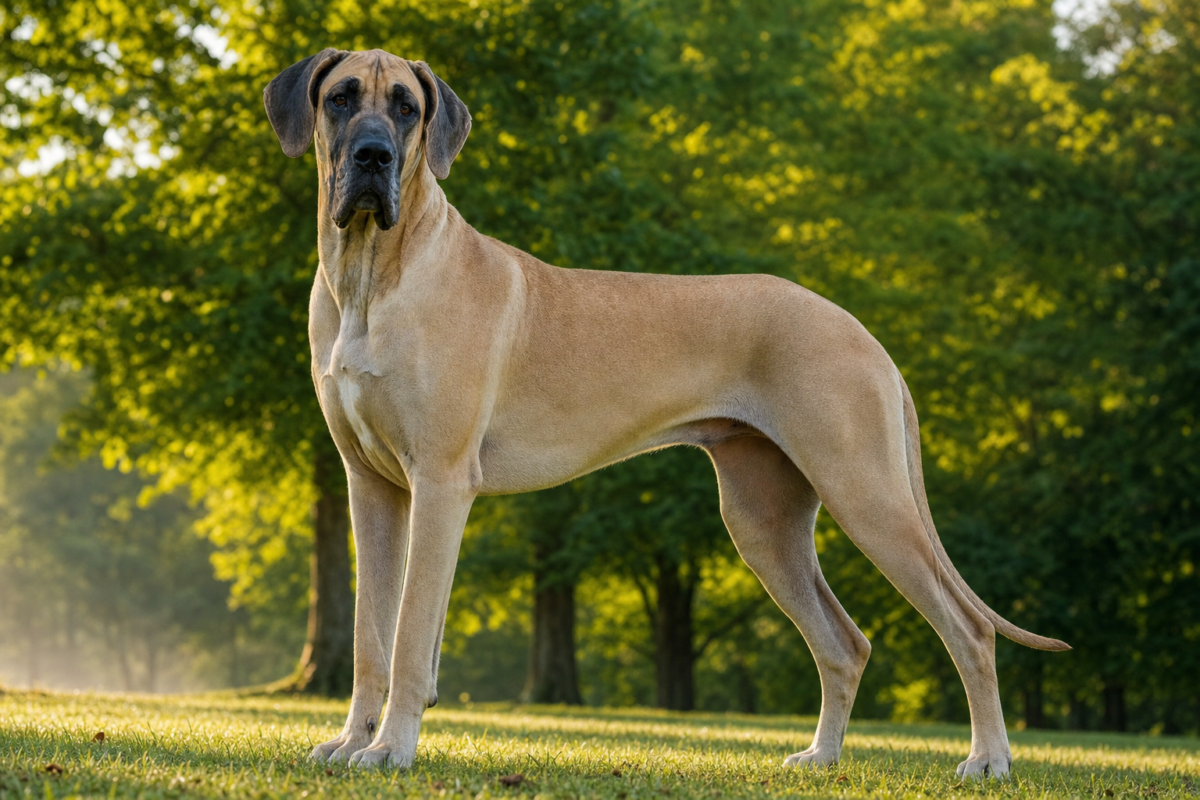
Giant breeds live shorter lives mainly because they grow enormously fast and then age faster than smaller dogs. Researchers have found that across breeds, life expectancy falls by roughly one month for every 4.4 pounds of adult body mass. Rapid early growth, high levels of growth signalling hormones and a heavier frame all add up to an earlier onset of age related change. A Great Dane is often considered a senior at 5 or 6 years old and typically lives 7 to 10 years, while many small dogs reach 14 or more.
If you love a giant breed, you have almost certainly felt the unfairness of it. The biggest hearts seem to get the shortest clocks. Once you understand why size and lifespan pull against each other, though, you can see which parts are fixed by biology and which are genuinely in your hands. This guide walks through the science in plain language, then turns it into the daily habits that help your big dog spend more of their years moving comfortably.
Why do giant breeds live shorter lives?
Giant breeds live shorter lives because large body size in dogs comes bundled with fast growth, elevated growth signalling and accelerated aging. An analysis of more than 50,000 dogs across 74 breeds found that life expectancy declines by about one month for every 2 kilograms, roughly 4.4 pounds, of additional adult body mass. Bigger dogs do not simply run out of time at the end. They start aging sooner and move through it at a quicker pace.
That single relationship explains most of the gap between a 12 pound terrier and a 150 pound Mastiff. It is not that giant dogs are fragile. It is that the biology which turns a 2 pound newborn into a 150 pound adult in under two years leaves a lasting mark on the body that does the growing.
What makes size and lifespan pull in opposite directions
Within a single species, bigger usually means shorter. That surprises people, because across species the opposite is true and elephants outlive mice by decades. Inside the dog family the trade off runs the other way, for four connected reasons.
Growth speed. A Great Dane puppy multiplies its birth weight around 100 times in its first year. That rate of cell division is metabolically expensive and leaves more opportunity for errors to accumulate in tissue over a lifetime.
Growth signalling. Large breeds carry higher circulating levels of insulin like growth factor 1, the hormone family that drives body size. Across many species, higher levels of that signalling are linked with faster aging, while lower levels track with longevity.
Cancer load. More cells dividing more quickly means more chances for something to go wrong. Veterinary studies consistently find higher rates of cancer in larger breeds, and bone cancer in particular is far more common in tall, heavy breeds.
Mechanical load. A frame carrying 140 pounds asks more of its joints, heart and ligaments with every stride, turn and stair than a frame carrying 25 pounds, which is why comfort and mobility become visible questions earlier in a giant breed.
None of this means a giant breed is destined for a difficult life. It means the calendar runs faster, so the habits that support healthy aging deserve to start earlier than most Dog Parents expect.
Average lifespan by size, a size by size comparison
Use this table as orientation rather than prediction. Individual dogs vary widely with genetics, body condition and veterinary care, and plenty of giant breeds comfortably outlive their averages.
| Size group | Typical adult weight | Typical life expectancy | Example breeds |
|---|---|---|---|
| Small | Under 25 lb | 12 to 16 years | Dachshund, Toy Poodle |
| Medium | 25 to 50 lb | 11 to 14 years | Border Collie, Beagle |
| Large | 50 to 80 lb | 10 to 13 years | Labrador, German Shepherd |
| Very large | 80 to 110 lb | 9 to 11 years | Rottweiler, Cane Corso |
| Giant | 110 to 150 lb | 7 to 10 years | Great Dane, Newfoundland |
| Extra giant | 150 lb and up | 6 to 10 years | English Mastiff, Irish Wolfhound |
The American Kennel Club’s Chief Veterinary Officer, Dr. Jerry Klein, DVM, has written extensively on the slower growth and development timeline of large and giant breeds. Read more from the AKC’s guidance on caring for large-breed dogs.
The pattern is consistent. Every step up the weight ladder costs roughly a year or two of average life expectancy, and the steepest part of the curve sits right where the giant breeds live. For the wider story of how these breeds came to be so large, our guide to why giant dog breeds exist fills in the history behind the numbers.
When is a giant breed considered senior?
Far earlier than most people expect. A Great Dane, Irish Wolfhound or Mastiff is generally treated as a senior from around 5 to 6 years of age. A Labrador reaches that stage closer to 8, and a small terrier often not until 10 or 11. The old idea that one human year equals seven dog years falls apart at this end of the scale.
Senior status is the point at which many veterinarians recommend twice yearly checkups, baseline bloodwork and a closer eye on weight, movement and comfort. Wait for the calendar to feel senior and a giant breed may already be years into that stage.
Why the aging window matters
For a giant breed, the productive middle of life is roughly 2 to 5 years old. That is a narrow window compared with a small dog, and it is where your habits compound. Lean feeding, sensible movement, weight monitoring and consistent joint support all have their largest effect when they start before anything looks wrong.
Excess Weight
Extra pounds are the single most controllable factor. Lean dogs stay comfortable longer and ask less of every joint.
Rushed Growth
Pushing a puppy to grow fast loads a frame that is still forming. Steady beats spectacular every time.
Late Veterinary Care
Giant breeds hit senior status years earlier, so annual checkups alone miss a lot of change.
Deep Chest Habits
Many giant breeds are deep chested. Ask your veterinarian about meal size, timing and rest.
How feeding shapes the years a big dog gets
Of everything on this page, body weight is the lever with the strongest evidence behind it. In a fourteen year study, forty eight Labradors were raised in pairs, with one of each pair fed about a quarter less food than the other. The leaner dogs lived a median of 13 years against 11.2 years for their littermates, and visible signs of age arrived later. They were simply kept lean for life.
- Start with a complete food formulated for large breed puppies, which balances calories, calcium and phosphorus for a steadier curve.
- Move to a measured adult portion rather than free feeding, and weigh the food rather than eyeballing a scoop.
- Count treats. On a big dog, scraps and training rewards add up faster than most parents realise.
- Feed to a lean body condition rather than a number on a chart, and confirm the daily amount with your veterinarian.
How to check body condition in ten seconds
The scale tells you weight, but body condition tells you whether that weight suits your dog. You can check it at home in seconds.
- Ribs. Run your hands along the sides. You should feel the ribs easily under a thin layer. If you have to press, ease back on food.
- Waist. Look down from above. You want a clear waist that tucks in behind the ribs.
- Tuck. From the side, the belly should rise toward the back legs rather than hanging level.
Check every few weeks across your dog’s whole life, not only during the puppy months, and adjust portions with your veterinarian’s guidance.
Movement that supports a longer, more comfortable life
Big dogs need activity, and they need the right kind at the right age. The aim is a lifetime of regular, moderate movement rather than bursts of hard impact separated by long quiet spells.
- Through the growth years, favour free play and short walks on soft ground while the growth plates are still open.
- In adulthood, aim for daily walks of a consistent length rather than a sedentary week followed by a long weekend hike.
- Protect the joints from repeated hard landings. Ramps for the car and rugs on slippery floors cost little and pay off for years.
- Keep swimming and gentle hill work in the mix, since both build muscle without pounding.
- As your dog ages, shorten and soften rather than stop. Muscle loss arrives quickly when a big dog stops moving.
Daily habits that support joint comfort at any age
A giant breed carries a lot of dog through every step it takes, and comfortable movement is what most Dog Parents want most from the years they get. Alongside lean feeding and steady activity, many add a daily joint support chew, and start it well before they think they need to.
MoveGuard Adult is built for adult medium and large breed dogs. It combines clinically studied eggshell membrane with New Zealand Green Lipped Mussel, glucosamine, chondroitin, MSM and hyaluronic acid, ingredients chosen to support cartilage, connective tissue and comfortable movement. It comes as 60 soft chews in a chicken liver flavour most dogs take like a treat, and is backed by a 60 day guarantee. Serving is based on body weight, so if your dog sits above the label range, confirm the right daily amount with your veterinarian.
Support Comfortable Movement
Give your adult big dog daily joint support built for large breeds. Explore MoveGuard Adult.
Signs your big dog is aging well
Look for a dog who rises from rest without hesitation, holds a clear waist you can see from above, moves with a smooth even gait and stays interested in the world. Steady weight across the seasons is one of the strongest quiet signals that things are on track.
If you notice stiffness after rest, reluctance on stairs, new lumps, sudden weight change or a drop in stamina, book a veterinary visit rather than waiting. In a breed that ages on a compressed timetable, early is the whole advantage.
A simple longevity game plan, stage by stage
You do not need a complicated program. You need the right emphasis at the right age.
Puppy to 18 months. Foundation stage. A complete large breed puppy food, measured meals, lean body condition and gentle movement on soft ground. This is where rushed growth does its damage, so resist any urge to make your puppy big quickly.
18 months to 4 years. Prime adulthood. Lock in a measured adult portion, a consistent daily walk and a monthly weight check. Ask your veterinarian to record a baseline while everything looks perfect, because a baseline taken in good health makes later change easy to spot.
4 to 7 years. The quiet turn. Many giant breeds begin the senior stage inside this window even though they still look and act young. Move to twice yearly checkups, add bloodwork and keep weight in check as activity naturally softens.
7 years and beyond. Comfort first. Shorter and more frequent walks, supportive bedding, traction on slippery floors and ramps instead of jumps. Our guide to caring for a senior large breed dog covers this stage in detail.
Common mistakes that cost big dogs good years
Most of what shortens a giant breed life happens slowly and quietly. These are the patterns worth avoiding.
- Letting weight creep. Five extra pounds on a Great Dane looks like nothing and is not. Weight gain is gradual, invisible day to day and the most reversible factor of all.
- Feeding for size. A heavier puppy is not a healthier one. Fast growth asks more of a developing frame and does not increase adult size.
- Treating age like a small dog timeline. Waiting until 9 or 10 to think about senior care means missing several years of the stage entirely.
- Annual checkups only. One visit a year on a compressed lifespan is like a small dog being seen every other year.
- Waiting for a problem before supporting joints. Daily habits work best started while everything still looks easy.
Living well with a shorter clock
There is an emotional side to this question that no table captures. Choosing a giant breed means signing up for a shorter chapter, and most people who have loved one will tell you they would do it again without pausing. Their years simply arrive at a different pace, and they ask you to be present sooner.
Practically, that changes a few things. It makes early habits worth more than late intervention, and it makes the middle years, the ones where your dog is strong and everything feels easy, the exact years to build the routine that carries into the senior stage. You cannot rewrite the biology of body size. What you can do is make sure the years your dog does get are spent moving comfortably, at a healthy weight, with a veterinary team who knows them well. That is a genuinely large amount of influence over the part that matters most.
Frequently asked questions
Why do big dogs die younger than small dogs?
Large dogs grow far faster, carry higher levels of growth signalling hormones and age at an accelerated pace. Research across dozens of breeds found life expectancy falls by roughly one month for every 4.4 pounds of adult body mass, and larger breeds also show higher rates of cancer.
What is the average lifespan of a Great Dane?
Most Great Danes live around 7 to 10 years. Giant breeds in general sit in the 6 to 10 year range, while large breeds such as Labradors and German Shepherds more often reach 10 to 13 years.
At what age is a giant breed dog considered senior?
Usually around 5 to 6 years of age, which is several years earlier than a medium breed. Many veterinarians recommend moving to twice yearly checkups and baseline bloodwork at that point rather than waiting for visible signs.
Does keeping a big dog lean really make a difference?
The evidence here is unusually strong. In a fourteen year study of forty eight Labradors, the dogs fed to a leaner body condition lived a median of 13 years compared with 11.2 years for their littermates, and visible signs of aging appeared later.
Do mixed breed giant dogs live longer than purebred ones?
Mixed breed dogs often show a modest lifespan advantage over purebreds of similar size, but body size remains the dominant factor by a wide margin. A giant mixed breed still ages on a giant breed timetable.
The bottom line
Giant breeds live shorter lives because growing very large very quickly comes with accelerated aging built in. Life expectancy drops by roughly one month for every 4.4 pounds of adult body mass, and senior status arrives around 5 or 6 years old. That part is fixed. How those years feel is not. Keep your big dog lean, keep them moving in a way that suits their age, see your veterinarian twice a year once the senior window opens, and support joint comfort as a daily habit rather than a reaction.
Want the simple roadmap in one place? Grab our free Big Dog Mobility Guide for the daily comfort checklist, weight framework and movement limits, written for large and giant breeds.
This article is for general educational purposes only and is not veterinary advice. It is not intended to diagnose, treat, cure or prevent any disease. Always consult your veterinarian about your dog’s individual health, nutrition and supplement needs. These statements have not been evaluated by the Food and Drug Administration.
Support Big Breed Joints from Day One
Large and giant breeds carry more load through every growth stage. MoveGuard Growth supports developing joints in young big dogs (8 to 30 months); MoveGuard Adult keeps grown big dogs moving comfortably.
Leave a Reply