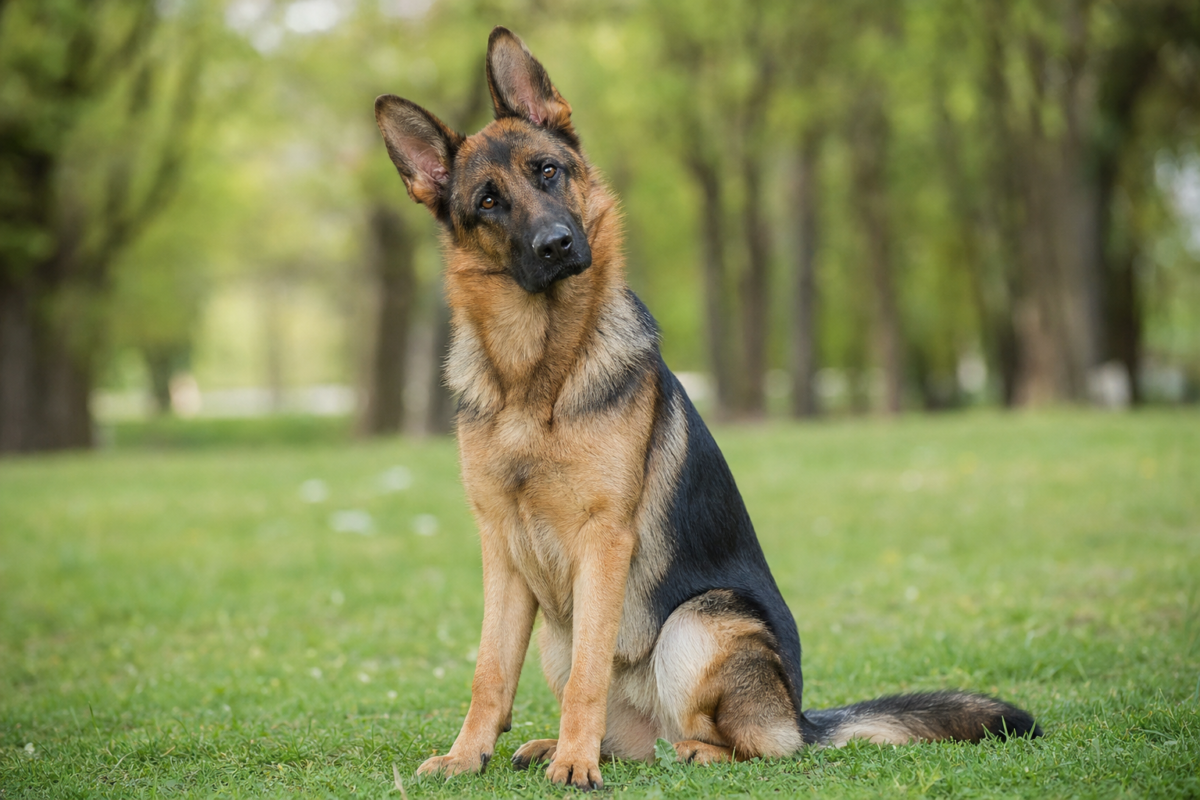
Yes. Size does not predict intelligence, and large breeds are strongly represented among the quickest learners in the dog world. In the best known ranking of working and obedience intelligence, five of the top ten breeds are large dogs. What varies far more than raw ability is style. Some big breeds were built to take instruction from a handler, and others were built to make decisions alone in a field at midnight, which looks like stubbornness and is actually independent judgement.
Every big dog household eventually runs the same experiment. You teach something once, your dog nails it, and then two days later the same dog stares straight through you as if the word has never been spoken. So which is it? Genius or goofball? The honest answer is that most large breeds are considerably smarter than they let on, and that the confusion comes from measuring their intelligence with the wrong ruler. This guide covers what dog intelligence actually means, where large breeds land, why independence gets mistaken for slowness, and how to bring out the best of a big thinking dog.
Are large breed dogs intelligent?
Yes, and by every measure researchers use. Body size has no meaningful relationship with cleverness in dogs. When obedience judges were surveyed for the best known ranking of working and obedience intelligence, the top ten included the German Shepherd, the Golden Retriever, the Doberman, the Labrador and the Rottweiler, all large breeds, alongside smaller dogs. Many other large breeds sit lower on that particular list not because they learn slowly but because the list rewards one narrow skill, which is how quickly a dog follows a new command from a person.
That distinction matters enormously for big dogs. A livestock guardian bred to spend nights alone with a flock was selected for the opposite of instant obedience. It was selected to assess a situation and act without asking anyone. Ranked on command speed it looks unimpressive. Ranked on judgement it is remarkable.
The three kinds of dog intelligence
Researchers usually split canine intelligence into three parts, and separating them explains almost every argument Dog Parents have about which breed is smartest.
- Instinctive intelligence. What the breed was built to do without being taught. A retriever that marks where a bird fell, or a guardian that positions itself between the family and a stranger, is showing this.
- Adaptive intelligence. What the dog works out for itself. Opening a latched gate, learning which family member gives in first, remembering a route walked once. This varies hugely between individuals within a breed.
- Working and obedience intelligence. How quickly a dog learns commands from a person and how reliably it repeats them. This is the one that gets ranked, and it is really a measure of biddability as much as brainpower.
A dog can be exceptional at one and ordinary at another. The Great Pyrenees that ignores a recall on open ground has strong instinctive and adaptive intelligence and low interest in the third category. That is not a flaw. It is the job description that created the breed.
How large breeds show their intelligence
The clearest way to read a big dog is to ask what its ancestors were paid to do. The original job is still running quietly in the background of every modern pet.
| Breed group | Original job | How the intelligence shows |
|---|---|---|
| Herding breeds | Moving and controlling stock beside a handler | Very fast command learning, reads human body language closely |
| Retrievers | Marking and fetching game across water and cover | Strong memory for places, high willingness to work with people |
| Property guardians | Guarding home, stock and family | Situational judgement, tells normal from unusual quickly |
| Livestock guardians | Living alone with a flock for months | Independent decisions with no handler present |
| Draft and water breeds | Hauling loads and water rescue | Calm problem solving under real pressure |
| Sighthounds | Chasing game spotted at distance | Rapid situational reading, little patience for repetition |
| Scent hounds | Following a trail for hours | Extraordinary focus and persistence on one task |
The American Kennel Club’s Chief Veterinary Officer, Dr. Jerry Klein, DVM, has written extensively on the slower growth and development timeline of large and giant breeds. Read more from the AKC’s guidance on caring for large-breed dogs.
None of these is smarter than the others. They are answers to different questions. Judging a livestock guardian by retriever standards is like judging a novelist on their sprint time.
Does body size or brain size make a difference?
Bigger dogs do have bigger brains in absolute terms, and there is some evidence that size tracks with certain thinking skills. A study of thousands of dogs across many breeds found that larger dogs performed better than smaller ones on tasks measuring short term memory and self control, which are the abilities that let a dog hold information briefly and resist an impulse. On other measures, including social skills such as following a human point, size made no difference at all.
What that actually means at home
It means your big dog probably has good raw equipment for waiting, remembering and thinking a beat before acting, and that the equipment needs developing. Self control is a trained skill in any breed. Large dogs also mature slowly, mentally as well as physically, so a two year old giant breed may still be operating with an adolescent brain in an adult body. Patience during that stretch pays back for the next decade. Our guide to setting a large breed puppy up properly covers the practical side of those early months.
Independence
A pause before responding is often a big dog deciding whether the request makes sense, not failing to understand it.
Slow Maturity
Many large and giant breeds are mentally adolescent until two or three years old. Judgement arrives late, then stays.
Boredom With Drills
Repeating an exercise a clever dog learned ten minutes ago reads as disobedience. It is usually just tedium.
Visible Errors
A mistake by a 120 pound dog is impossible to ignore, so big dogs get labelled difficult for behaviour nobody notices in a terrier.
Training a clever big dog
Large breeds tend to reward a particular teaching style. They learn quickly, they dislike being nagged, and they are strong enough that you need cooperation rather than force.
- Keep sessions short. Five focused minutes twice a day beats a half hour of repetition for almost every big breed.
- Reward the first correct response and stop asking. Repeating a cue a clever dog has already answered teaches it that the cue is optional.
- Give the behaviour a purpose. Big working breeds engage far better when a task leads somewhere, such as a door opening or a meal appearing.
- Train self control directly. Waiting at doors, settling on a mat and leaving food alone are the skills that make size manageable.
- Be consistent across the whole household, because a clever dog will find the one person whose rules are softest.
- Start early. Habits set in the first year are far easier than habits corrected in the third.
How to spot the way your dog learns
Watch what your dog does when it wants something it cannot reach. Some dogs immediately look at a person, which is a partnership brain and usually means classic training will fly. Others try to solve it alone, which is an independent brain and means you will do better setting up the environment so the right choice is also the easiest one. Neither is superior. Teaching against the grain is simply harder work for both of you.
Mental exercise matters as much as physical
Big dogs need their minds worked, and that need does not shrink because a walk was long. Thinking work has a real practical advantage during the growing years too, because it tires a young dog without loading a frame that is still developing. If you are raising a puppy, our guide to safe exercise while the growth plates are still open pairs naturally with this.
- Scent games. Hiding food around a room uses a system big dogs excel at and settles them quickly.
- Puzzle feeders and scatter feeding, which turn a two minute meal into fifteen useful minutes.
- Name games. Teaching the names of toys builds vocabulary and gives a bored dog something to do.
- Short problem tasks, such as finding a hidden family member or working out which hand holds a treat.
- New places. Ten minutes of sniffing an unfamiliar path is more mentally taxing than an hour on the usual route.
Signs your big dog is smarter than you think
Intelligence rarely announces itself with tricks. It shows up in the quiet stuff. A dog that watches you pick up your keys and heads for the door already understands sequence. A dog that behaves differently with a toddler than with an adult is reading social context. A dog that tries one route to a dropped biscuit, fails and immediately tries another is problem solving in real time.
Other everyday signs include remembering where a favourite toy was left days earlier, learning the names of people and objects without formal teaching, anticipating a routine before it starts, and testing whether a rule applies today. That last one is genuinely irritating and is a strong sign of a thinking dog.
A stage by stage plan for building a thinking dog
You are not teaching intelligence, which is already there. You are building the habits that let it show up usefully.
8 weeks to 6 months. Foundation. Handle everything, visit everywhere, and keep sessions playful and brief. Introduce names for objects and people. Reward calm choices as much as clever ones.
6 to 18 months. Adolescence, and the stage where a big dog starts testing which rules are real. Stay consistent, keep asking once, and add scent and puzzle work to absorb the growing energy without pounding young joints.
18 months to 3 years. Judgement arrives. Give real responsibilities such as settling in cafes, waiting off lead in safe places and holding a stay while life happens nearby. This is where the slow maturing breeds suddenly look brilliant.
3 years and beyond. Keep learning. Older dogs stay sharper with regular novelty, and gentle mental work remains valuable well into the senior years when physical exercise naturally eases off.
Common mistakes to avoid
- Confusing biddable with brilliant. An eager to please breed is easier to train, which is not the same as being cleverer than an independent one.
- Repeating cues. Saying a command four times teaches a smart dog that the first three do not count.
- Only exercising the body. A physically tired big dog with an unused mind still finds trouble.
- Treating breed rankings as fate. The variation between individuals inside a breed is larger than the gap between most breeds.
- Reading size as intent. Big dogs get accused of dominance for behaviour that is really confusion or excitement, a pattern we cover in our piece on whether large breed dogs are more aggressive than small dogs.
- Giving up during adolescence. The most frustrating months usually sit right before the most rewarding ones.
Intelligence, temperament and living with a big dog
A clever dog is not automatically an easy dog. Intelligence raises the ceiling and it also raises the demands. A bright, under occupied large breed will invent a job, and its version of a job is rarely the one you would have chosen. The households that thrive with big dogs are usually the ones that treat mental work as a daily requirement rather than a wet weather substitute for a walk.
The reward is a companion who genuinely participates in family life. Big dogs that are given something to think about tend to be calmer, more confident and far easier to live with, because a settled mind produces a settled body. Understanding what your breed was built to think about is the shortcut, and it is available to anyone willing to watch their own dog closely for a week.
Frequently asked questions
Which large dog breed is the smartest?
On the best known ranking of working and obedience intelligence, the German Shepherd, Golden Retriever, Doberman, Labrador Retriever and Rottweiler all appear in the top ten. That list measures how quickly a breed learns commands from a person, so independent breeds score lower without being less intelligent.
Are big dogs harder to train than small dogs?
Not inherently. Large breeds often learn faster, but their mistakes are more consequential and many mature slowly, so training feels harder. Short consistent sessions and early work on self control make the difference.
Do bigger dogs have bigger brains?
Yes in absolute terms, and research across thousands of dogs found larger dogs performed better on tasks involving short term memory and self control. Size made no difference to social skills such as following a human point.
Why does my large breed dog ignore a command it knows?
Usually because the cue has been repeated until it became optional, because the reward for compliance is weaker than the distraction, or because an independent breed has judged the request unnecessary. Ask once, make it worth doing, and train in gradually harder settings.
How much mental exercise does a large breed dog need?
Most large breeds do well with two short thinking sessions a day, roughly ten to fifteen minutes each, through scent games, puzzle feeders or training. Mental work also tires a growing dog without loading developing joints.
The bottom line
Large breed dogs are intelligent, often strikingly so, and the ways they are clever follow the jobs they were built for rather than their body size. Some want a partner and instructions. Others want a problem and no interference. Work out which kind of thinker is lying on your floor, ask once, give the mind daily work, and stay patient through a long adolescence. Do that and the size stops being the interesting thing about your dog.
Want the simple roadmap in one place? Grab our free Big Dog Mobility Guide for the body condition check, home setup and movement framework, all written for large and giant breeds.
This article is for general educational purposes only and is not veterinary advice. It is not intended to diagnose, treat, cure or prevent any disease. Always consult your veterinarian about your dog’s individual health, nutrition and supplement needs. These statements have not been evaluated by the Food and Drug Administration.
Support Big Breed Joints from Day One
Large and giant breeds carry more load through every growth stage. MoveGuard Growth supports developing joints in young big dogs (8 to 30 months); MoveGuard Adult keeps grown big dogs moving comfortably.
Leave a Reply