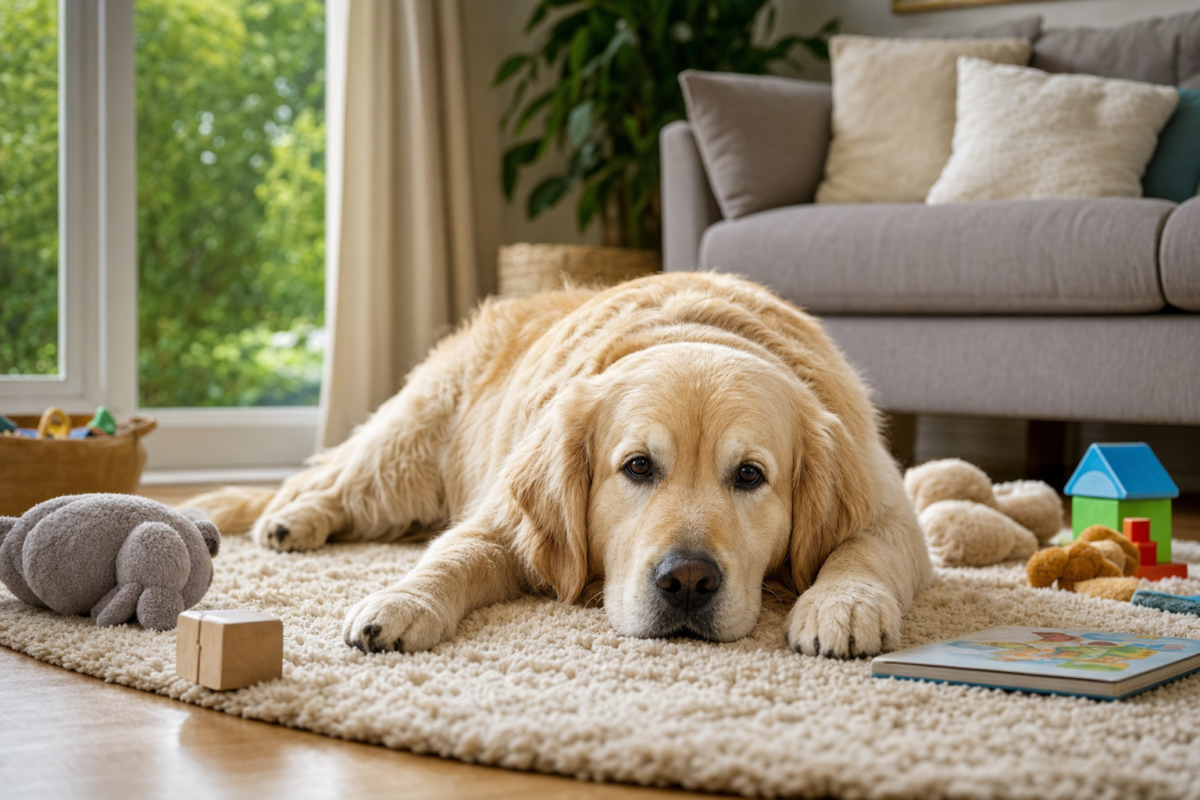
Yes, as a group they are. Several of the largest breeds have long reputations as some of the steadiest family dogs there are, and a calm, well socialised big dog is often easier around children than a small dog who has never been taught otherwise. What size changes is the margin for error. A tail at toddler head height and a happy shoulder barge from a hundred pound dog are accidents waiting to happen, so supervision, teaching the child, and choosing the individual dog matter more than the breed name does.
It is the question that decides the whole thing for a lot of families. You love the idea of a big dog, the children are excited, and somewhere at the back of your mind sits a picture of a dog that outweighs your youngest. That instinct is worth listening to, but not for the reason most people assume. Big dogs and children go together beautifully more often than not, and the risks worth planning for are almost never the ones people imagine. Here is what actually matters.
Are big dogs good with children?
Yes, in general, and the reputation is well earned. Many of the largest breeds were developed to work closely alongside people, and the temperament that came with that work is patient, tolerant and slow to take offence. Ask a room of Dog Parents which breeds they would trust around a five year old and the answers skew large surprisingly often.
The qualification is that a breed reputation is a starting point, never a guarantee. Individual variation within any breed is far wider than the average gap between breeds, so the dog in front of you tells you more than the label does. What size genuinely changes is not how likely a dog is to be good with children, but what happens on the day something goes wrong. A small dog who bumps a toddler is a moment. A giant dog who bumps a toddler is a trip to the doctor. That is a reason to manage the household well, not to avoid big dogs.
Why size and temperament are different questions
Almost every worry about big dogs and children collapses two separate things into one. Likelihood is how probable it is that a dog behaves badly. Consequence is how much it matters if one does. Size barely touches the first and dominates the second.
The research on canine behaviour has been fairly consistent on the first point for years, and it does not put the giant breeds at the top of the list. We covered that argument in full in whether large breeds are more aggressive than small dogs. For families the takeaway is simple. You are not choosing between a safe dog and a risky one. You are choosing a dog whose bad days need more thought than they would in a smaller animal.
There is a second point that gets missed. Most incidents between dogs and children are not aggression at all. They are accidents. A dog spinning around a kitchen at speed, a wagging tail at eye level, a paw on a small chest during play. None of that is a behaviour problem, and all of it is easier to prevent than to explain afterwards.
The large breeds most often described as good with children
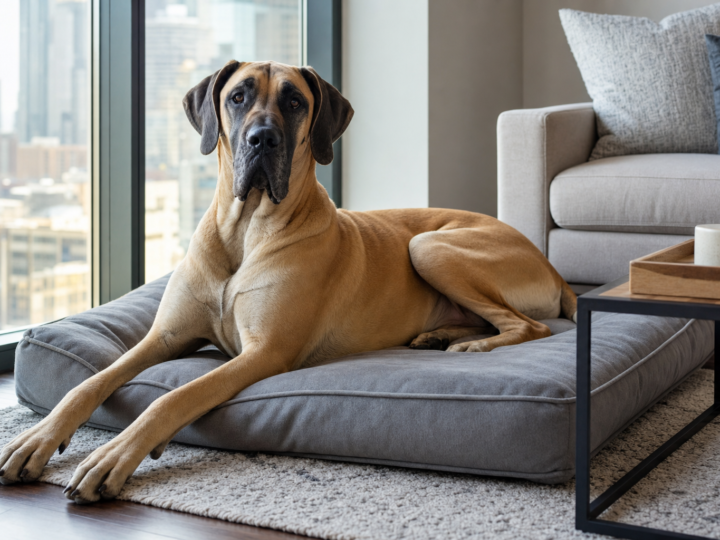
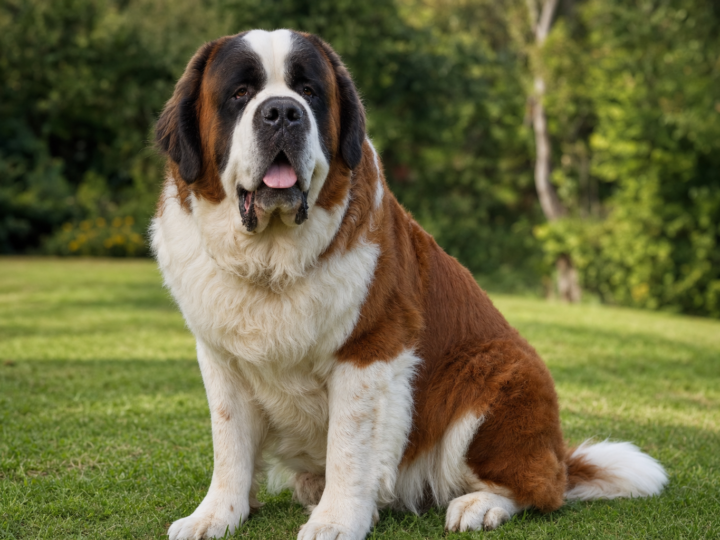
If temperament rather than size is what you are actually shopping for, several of the biggest breeds carry the gentlest reputations in dogs. Newfoundlands are famous for tolerance and were bred to work in close partnership with people. Great Danes are affectionate, sociable and generally convinced they are lap dogs. Labradors and Golden Retrievers have earned their place as family defaults for good reason. Bernese Mountain Dogs, Greater Swiss Mountain Dogs, Saint Bernards and Leonbergers all turn up repeatedly on lists of breeds that are patient with children and reluctant to make a fuss about anything.
Treat that as a shortlist to research, not a promise. Every one of those breeds contains individuals who are nervous, pushy or poorly socialised, and a gentle reputation has never raised a puppy by itself. Be honest about energy too. A breed can be wonderful with children and still be far too much dog for a household with a newborn and no time. Match the energy and the handling to your actual life, not the version you hope to have next year.
What actually makes a dog good with children
The short list is the same one that predicts everything else about behaviour, and breed sits well down it.
- The individual dog. Ask a breeder about the temperament of the parents and how the litter is raised around noise and handling. If you are rehoming an adult, ask directly about their history with children rather than accepting a general “good with everyone”.
- Early experience. Calm, positive exposure to children in the first months shapes an adult more than anything that follows. A puppy who has met children as an ordinary part of life rarely finds them startling later.
- Training and handling. Reward based training builds a dog who offers behaviour instead of guessing. It also gives you the recall and lead manners that make a big dog easy company in a busy house.
- Health and comfort. Discomfort lowers tolerance in any animal. A previously patient dog who becomes snappy deserves a veterinary conversation before a behavioural one.
- Management. Most trouble traces back to a situation the dog was put in rather than a decision the dog made. Good management is invisible and does most of the work.
Accidental Knocks
The most common real risk is physical, not behavioural. A happy big dog at speed and a small child occupy the same space badly.
Unsupervised Time
Young children and dogs should not share a room without an adult present. This single rule prevents most incidents.
Resource Guarding
Food bowls, chews and beds are the usual flashpoints. Children should never approach a dog who is eating or resting.
Missed Quiet Signals
Dogs ask for space politely first. Teach everyone to read a turned head or a lip lick as the request it is.
What to focus on as your children grow
The job changes as the child does, and planning by stage makes the whole thing much lighter work.
| Child stage | Main risk | What to focus on |
|---|---|---|
| Baby and crawling | Being knocked or stepped on | Physical separation by default. Gates, a settled dog bed away from floor level play, and no shared floor time without an adult right there. |
| Toddler, 1 to 3 years | Grabbing fur, ears and tails | Constant supervision. Teach gentle hands early and give the dog an easy exit from every room. |
| Young child, 4 to 7 years | Hugging and face to face contact | Teach the rules properly now. Stroke the chest and shoulder, no hugging, and leave a dog alone when eating or sleeping. |
| Older child, 8 to 12 years | Rough play and overexcitement | Involve them in training. A child who can ask for a sit and reward it becomes part of the team rather than a variable. |
| Teenager | Walking a strong dog alone | Match handler to dog honestly. Lead manners and recall have to be solid before a teenager takes a big dog out alone. |
The American Kennel Club’s Chief Veterinary Officer, Dr. Jerry Klein, DVM, has written extensively on the slower growth and development timeline of large and giant breeds. Read more from the AKC’s guidance on caring for large-breed dogs.
Teaching children how to be around a big dog
Half of a successful household is training the dog. The other half is training everyone else, and children pick this up quickly when it is framed as respect.
- Stroke the chest, shoulder and side rather than reaching over the head.
- No hugging, no lying on the dog and no climbing. Most dogs tolerate it and very few enjoy it.
- Leave a dog completely alone while eating, chewing or sleeping. Make this rule absolute so nobody has to judge it.
- Let the dog come to them. A dog who chooses to approach is comfortable.
- Be calm near the dog. Running and squealing invite chasing, which is a game a hundred pound dog cannot play safely indoors.
- Teach one simple job, such as asking for a sit before a treat. Children love having a role and dogs learn that small humans are worth listening to.
Setting the home up so both can relax
The layout of a house does more for safety than most training does, because it removes the situation instead of managing it.
- Give the dog a quiet retreat, a crate or bed in a low traffic corner, and make it genuinely off limits to children.
- Use baby gates to create dog free and child free zones rather than policing a whole floor.
- Feed the dog behind a closed door or gate. This removes the single most common flashpoint entirely.
- Put rugs and runners on slippery floors. A big dog scrabbling on laminate near a toddler is a hazard to both.
- Keep a lead by the door for busy arrivals, when excitement and small children collide.
- Meet the physical needs first. A big dog with enough daily exercise and something to chew is a far easier housemate than one with energy to burn.
Signs worth taking seriously in any dog
Dogs almost always ask for space quietly before they ask loudly. The early signals are easy to miss precisely because they are subtle.
- Turning the head away, lip licking or repeated yawning when a child comes close
- Getting up and moving away, which should always be allowed to work
- Stiffening, freezing or a hard stare, especially near food, a chew or a bed
- Growling, which is information and should never be punished out of a dog
- A clear change in tolerance in a dog who used to be easy
Any of these deserves a conversation with your veterinarian first, since discomfort is a common driver, and then with a qualified behaviourist who uses reward based methods. Acting early is far easier than acting late, and that is doubly true in a house with children.
Bringing a big dog and children together, stage by stage
None of this needs a complicated programme. It needs the right emphasis at the right time.
Puppy, 8 weeks to 4 months. The window that matters most. Calm, positive exposure to children of different ages, in short doses, always with the option to retreat. The early socialisation you do now shapes the adult far more than anything later. Practise handling so nail trims and vet visits stay possible at full size.
Adolescent, 4 to 18 months. The body outruns the brain. Your dog gets big and clumsy while still thinking like a puppy, which is exactly when accidental knocks happen. Keep training short and frequent, build a reliable settle, and supervise play more closely rather than less.
Adult. Usually the easiest phase. Keep the household rules consistent and remember that a dog raised around one child still needs a gentle introduction to a new baby or a visiting group of children.
Senior. Tolerance often drops as comfort does. An older dog who suddenly wants space from the children is usually telling you something physical, so protect their rest and speak with your veterinarian about how they are moving.
Common mistakes to avoid
- Choosing on reputation alone. A gentle breed with more energy than your household can meet is still the wrong dog. Match the whole package.
- Leaving them alone together. Not for a minute, not to answer the door. Almost every serious incident involving a child has this detail in it.
- Punishing a growl. Removing the warning does not remove the feeling. It removes your notice period.
- Letting children use the dog as furniture. Lying on a tolerant dog works right up until the day it does not.
- Treating patience as unlimited. A dog who puts up with a great deal is not enjoying it, and tolerance quietly runs out.
- Assuming friendly means safe. A joyful hundred pound dog who greets by jumping is a hazard to a child however sweet the intent.
The honest version
Big dogs are, on the whole, wonderful with children. The families who make it look effortless are not lucky, they are organised. They picked an individual dog rather than a reputation, they did the early work, they taught the children as carefully as they taught the dog, and they built a house where the two never have to negotiate over a food bowl.
Do that and you get the thing people who grew up with a big dog never stop talking about. A patient, unbothered animal content to spend most of the day being enormous and asleep near the people it loves, and who becomes a genuine part of a childhood rather than a risk to be managed.
Frequently asked questions
Are big dogs good with children?
Generally yes. Several of the largest breeds have strong reputations as patient, tolerant family dogs, and temperament is not predicted by size. What size changes is consequence, so supervision, early socialisation and teaching children how to behave around a dog matter more than they would with a smaller breed.
What is the best big dog breed for a family with young children?
Newfoundlands, Great Danes, Labradors, Golden Retrievers, Bernese Mountain Dogs and Saint Bernards all appear repeatedly on lists of breeds that are patient with children. Treat that as a shortlist to research rather than a guarantee, and weigh energy and grooming needs against your actual household.
Can a big dog be left alone with a child?
Young children should never be left unsupervised with any dog, whatever its size or history. Use baby gates and separate spaces so supervision does not depend on constant vigilance. Older children can spend time with a well known family dog, though feeding and resting times are still best kept separate.
Are big dogs too rough for toddlers?
The main risk with toddlers is physical rather than behavioural. Tails at head height, an excited dog turning at speed and affectionate leaning can all knock a small child over. Manage the space, keep indoor play calm and give the dog somewhere to go, and the problem largely disappears.
How do I introduce a big dog to a new baby?
Start before the baby arrives by building the routines you will need, including a solid settle and a comfortable retreat. Introduce scent first, keep the first meetings brief and calm with the dog on a lead, and never place the baby on the floor within reach. Ask your veterinarian or a behaviourist for a plan tailored to your dog.
The bottom line
Big dogs are good with children far more often than the nervous version of this question suggests, and the families it works for are the ones who planned. Choose the individual dog rather than the reputation, do the early socialisation properly, teach your children how to read and respect a dog, and set the house up so nobody has to make a judgement call over a food bowl. Get that right and size stops being the interesting part.
Want the simple roadmap in one place? Grab our free Big Dog Mobility Guide for the body condition check, home setup and movement framework, all written for large and giant breeds.
This article is for general educational purposes only and is not veterinary or behavioural advice. It is not intended to diagnose, treat, cure or prevent any disease. Always consult your veterinarian or a qualified behaviourist about your dog’s individual health and behaviour. These statements have not been evaluated by the Food and Drug Administration.
Support Big Breed Joints from Day One
Large and giant breeds carry more load through every growth stage. MoveGuard Growth supports developing joints in young big dogs (8 to 30 months); MoveGuard Adult keeps grown big dogs moving comfortably.
Leave a Reply