
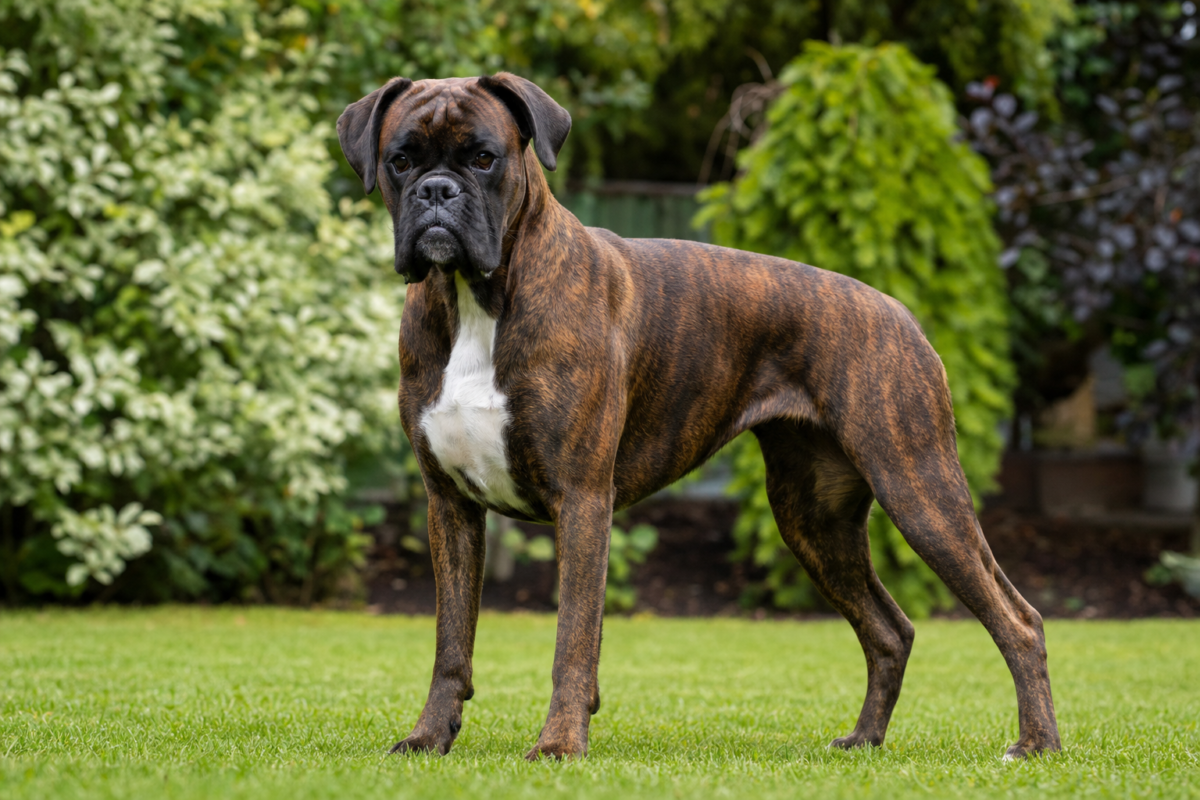
A big dog who is comfortable on their feet stands square with weight spread evenly across all four legs, moves off smoothly in the first few steps, lies down in one controlled motion and sits straight rather than slumping onto one hip. Watch for the opposite: a foot held slightly off the ground, weight shifted forward onto the front end, a wide or wandering stance, careful placement on hard floors, or a dog who circles several times before settling. Check the paws weekly and the standing posture daily, and you will see change while it is still small.
Everything a big dog does starts at the ground. A hundred pound frame is balanced on four surfaces smaller than your palm, and the way your dog loads those surfaces tells you more about day to day comfort than almost anything else you can observe at home. The best part is that reading it takes no equipment and about ten seconds. You only need to know what you are looking at.
How can I tell if my big dog is comfortable on their feet?
You can tell a big dog is comfortable on their feet by watching four things: the standing posture, the first few steps after rest, how they lower themselves to the floor, and how they sit. A comfortable dog stands square with weight shared evenly, walks off smoothly, lies down in one controlled motion rather than dropping, and sits with both back legs tucked neatly underneath. Persistent changes in any of those four are your signal to look closer.
Comfort is not the same as enthusiasm. Big dogs will happily run on a body that is asking for a lighter day, which is why watching how they move matters more than watching how much they want to. The signs below are the ones that show up before a dog stops wanting to do anything at all.
Start with how your dog stands
Stand your dog on a flat, non slip surface and simply look for ten seconds from the side and then from behind. You are looking for symmetry.
A comfortable big dog carries weight roughly evenly across all four feet, with the back legs directly under the hips and the topline level rather than sloping. The head sits in a natural position rather than being carried low, and the dog stays still without constant small adjustments.
Signals worth noting are a foot resting lightly with the toe barely touching, weight visibly pushed forward onto the front legs, back feet placed wider apart than the hips, or a dog who cannot settle into a still stance and keeps shuffling. None of those is a diagnosis. All of them are worth writing down and watching across a few days.
The ten second gait check
Watch your dog walk away from you and then back toward you on a flat surface, twice. Do it after rest, when anything stiff will show most clearly, and again after a walk when the body is warm.
| What to watch | Comfortable | Worth a closer look |
|---|---|---|
| First three steps after rest | Smooth and even from the start | Stiff, short strides that loosen after a minute |
| Head carriage while walking | Steady and level | Bobbing up and down in time with a front leg |
| Back leg reach | Both legs swing through equally | One leg takes a shorter step than the other |
| Rear view | Hips move evenly, feet track straight | Hips swaying, feet crossing or placed wide |
| Turning | Turns tightly in both directions | Swings wide, or favours turning one way |
| Pace on a familiar walk | Holds a steady pace throughout | Starts well then drops back toward the end |
Cornell University’s College of Veterinary Medicine covers how growth rate, nutrition, and exercise interact with joint development in large breed dogs. Read more from Cornell’s canine hip dysplasia overview.
A single odd step means nothing. A pattern you can see twice in one week means something, and it is worth mentioning to your veterinarian even if your dog seems bright and happy in every other way.
Toe Touching
A foot resting with only the toe on the ground is a dog quietly taking weight off that leg while standing still.
Front End Loading
Weight shifted forward onto the front legs often shows up long before anything looks like a limp.
Sloppy Sit
Slumping onto one hip rather than tucking both back legs underneath is one of the earliest posture changes to appear.
Dropping To Lie
Falling the last few inches instead of lowering under control suggests the back end is doing less of the work.
Paws, pads and nails
Before assuming a change comes from a joint, check the feet themselves. Big dogs pick up cracked pads, split nails, grass seeds between the toes and small cuts constantly, and any of those will change how a dog stands within hours.
Nails deserve particular attention. When a nail grows long enough to contact the ground while standing, it pushes the toe backward and shifts the whole standing posture up the leg. On a dog carrying ninety or a hundred pounds, that small change matters. If you can hear the nails clicking on hard floors, they are ready for a trim.
The weekly paw check
- Pads. Look for cracks, dryness, cuts, or a pad that has worn smooth and shiny.
- Between the toes. Part the fur and check for grass seeds, matted hair, redness or moisture.
- Nails and dewclaws. Trim or file every two to four weeks. Dewclaws grow unchecked because they never touch the ground.
- Fur. Trim the hair growing between the pads, since a furry foot slides on hard floors like a sock on polished wood.
- Temperature and swelling. Compare one foot against the other. A warmer or puffier foot is worth a call.
Floors, footing and the confidence problem
Half of what looks like a mobility problem indoors is actually a traction problem. Hard flooring gives a big dog nothing to push against, and a dog who has slipped once will start planning routes around the room to avoid it happening again. That careful, deliberate walk across the kitchen is not stiffness. It is caution, and it is easy to fix.
- Lay runners or rugs along the routes your dog uses most, especially between the bed, the door and the food bowl.
- Put a mat at the bottom and top of any stairs so the first and last steps have grip.
- Keep the fur between the pads short.
- Add a ramp or steps for the car, which removes the impact of jumping down entirely.
- Give food and water bowls a non slip mat so your dog is not bracing while eating.
Fix the footing first, then watch again for a week. If the careful walking disappears, it was traction. If it stays, you have learned something useful.
How they sit, lie down and get up
Transitions between positions ask more of the body than walking does, so they change first. Watch these three several times a day, since they happen naturally without you setting anything up.
Sitting. A comfortable big dog sits square with both back legs folded underneath. Slumping to one side, sliding a leg out, or hovering rather than committing to the sit are all worth noting.
Lying down. Look for a controlled lowering rather than a drop through the last few inches, and note whether your dog always goes down onto the same side.
Getting up. Time it roughly. A comfortable dog is on its feet in a second or two. Needing several attempts, walking the front feet forward to lever the back end up, or a long pause before committing are the signs most big dog parents notice first. Our big dog mobility check quiz turns these observations into a score you can compare over time.
Daily habits that support comfortable movement
Reading your dog is only half of it. The other half is the routine that keeps the answer good, and for feet and joints that comes down to lean weight, regular gentle movement, good footing and consistency.
Keep exercise little and often rather than long and occasional, choose grass and soft trails over concrete, and let your dog set the pace. Swimming and other low impact exercise suit heavy frames particularly well. Many big dog parents also add a daily joint support chew as an easy habit anchored to breakfast.
MoveGuard Adult is made for adult medium and large breed dogs. It combines clinically studied eggshell membrane and New Zealand green lipped mussel with glucosamine, chondroitin, MSM and hyaluronic acid to support healthy joints, cartilage and connective tissue. It comes as 60 soft chews in chicken liver flavour, is made in the USA in an NSF facility, and carries a 60 day guarantee. Dose by weight following the label, and speak to your veterinarian if your dog already takes other supplements.
Support Every Step
Give your big dog daily joint support built for adult large breeds. Explore MoveGuard Adult.
Weight lands on the feet first
Every extra pound your dog carries travels down through four small surfaces on every step. Weight is the one variable you control completely, and it is the fastest way to change how comfortable a big dog is on its feet.
Check body condition every couple of weeks rather than relying on the scale alone. Run your hands along the ribs, which should be easy to feel under a thin layer. Look down from above for a clear narrowing behind the ribs. From the side, the belly should rise toward the back legs. Feel across the thighs and shoulders too, because losing muscle while holding weight steady is a change worth reporting to your veterinarian.
Measure meals rather than pouring them, count treats within the daily total rather than on top of it, and review portions at every veterinary visit, since the right amount at seven is rarely the right amount at ten.
When to call your veterinarian
Home observation is for spotting change, not for explaining it. Call your veterinarian if you see any of the following.
- A limp that appears suddenly, or any limp lasting more than a day or two.
- A foot your dog will not put weight on at all.
- Heat, swelling or obvious pain in a joint or a paw.
- Stiffness that is getting worse week by week rather than staying level.
- Visible muscle loss over the back legs or shoulders.
- A sudden change of any kind, or a young dog showing effort in ordinary movement.
Bring a short phone video of your dog rising from rest and walking away from the camera, plus rough dates for when you first noticed each change. Twenty minutes in a consulting room shows your veterinarian far less than you see in a week, and a clip of the real thing is genuinely useful.
Common mistakes when reading a big dog
- Watching only when warmed up. The first minute after a long sleep is the most informative moment of the day.
- Assuming a limp means a joint. Check pads, nails and between the toes before anything else.
- Calling it old age. Age explains a slower pace. It does not explain a change that appeared last week.
- Ignoring the floors. Traction problems look exactly like mobility problems and cost far less to solve.
- Resting a dog completely. Doing nothing loses muscle quickly. Do the same amount, gently, in smaller pieces.
The signs your large dog is slowing down tend to arrive in a predictable order, and knowing that order makes each one easier to catch.
Frequently asked questions
How can I tell if my dog is limping or just tired?
A tired dog moves slowly but evenly, while a limping dog shortens the stride on one leg or bobs the head in time with a front foot. Tiredness disappears after rest. A limp usually looks the same or worse the next morning.
Should my big dog nails touch the ground when standing?
No. On a flat surface the nails should sit just clear of the ground when your dog is standing normally. Nails long enough to contact the floor push the toes backward and change how the whole leg loads, so trim or file every two to four weeks.
Why does my big dog struggle to get up from hard floors?
It is often traction rather than joints. Hard flooring gives a heavy dog nothing to push against, and a single slip makes many dogs cautious for weeks. Add runners on the main routes and trim the fur between the pads, then watch again for a week.
Is it normal for a big dog to shift weight while standing?
Occasional shifting is normal, especially when a dog is waiting or excited. Constant small adjustments, standing with one toe barely touching, or a dog who will not settle into a still stance are all worth mentioning to your veterinarian.
How often should I check my big dog feet?
Look at the paws properly once a week and glance at the standing posture daily, which takes about ten seconds. The value is in knowing what normal looks like on your own dog, so that different becomes obvious immediately.
The bottom line
Comfort on the feet is the clearest window you have into how a big dog is doing. Watch the stand, the first three steps, the sit and the lie down. Check the paws weekly and the nails every few weeks. Sort out the floors, hold the weight lean, keep movement regular and gentle, and support the joints daily. Do that and you will notice change while it is still small, which is exactly when there is most you can do about it.
Want the simple roadmap in one place? Grab our free Big Dog Mobility Guide for the daily comfort checklist, feeding framework and low impact movement limits, all written for large and giant breeds.
This article is for general educational purposes only and is not veterinary advice. It is not intended to diagnose, treat, cure or prevent any disease. Always consult your veterinarian about your dog’s individual health, nutrition and supplement needs. These statements have not been evaluated by the Food and Drug Administration.
Support Big Breed Joints from Day One
Large and giant breeds carry more load through every growth stage. MoveGuard Growth supports developing joints in young big dogs (8 to 30 months); MoveGuard Adult keeps grown big dogs moving comfortably.
Leave a Reply