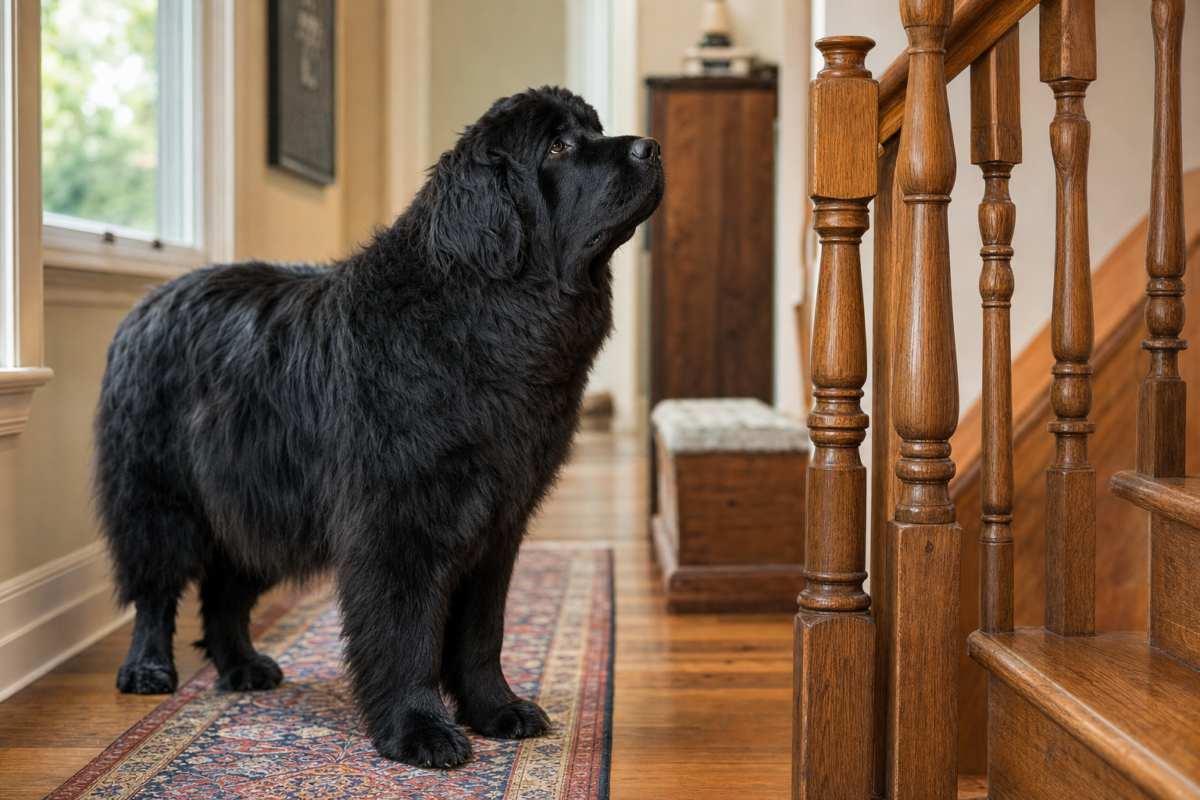
The everyday signs that a big dog wants more mobility support are small and easy to miss. Watch for a slower rise from the floor, a pause before stairs or the car, sitting down partway through a walk, stiffness in the first few minutes after a nap, a shift from trotting to a steady plod, reluctance to jump onto the sofa, and a dog who settles further from the family than usual. None of these is a diagnosis. Together they tell you your big dog is asking for lighter loading, softer surfaces and steadier daily joint support.
Big dogs are stoic. They carry far more weight through every stride than a small dog does, and they rarely announce that something feels harder than it used to. What you get instead is a set of quiet everyday edits: a pause at the bottom of the stairs, a longer stretch after a nap, a hesitation before the leap into the car. Reading those edits is one of the kindest skills a big dog parent can build.
What everyday signs show a big dog needs mobility support?
The clearest everyday signs are a slower or more effortful rise from lying down, a visible pause before stairs, a jump into the car that becomes a scramble, stiffness for the first few minutes after rest that loosens once your dog warms up, shorter and slower walks by choice, and a growing preference for soft surfaces over hard floors. Many big dogs also start sitting during activities they used to stand through, or choose a bed one room away instead of the hard kitchen tiles beside you.
These signs rarely arrive together and are almost never dramatic, which is exactly why they are worth writing down. A single slow morning means very little. The same slow morning three weeks running is real information you can act on with feeding, surfaces, activity and daily habits.
Why big dogs hide the early signs so well
Dogs are wired to keep up with the group, and a large breed dog will work hard to keep up with you long after movement stops feeling easy. Instead of limping, most big dogs make quiet adjustments. They take the stairs one at a time. They stop offering the greeting leap. They shift weight forward so the back legs do less work. From a distance it simply looks like a calm, mature dog settling into adulthood.
There is a second reason these signs slip past us. We live with our dogs daily, so change that arrives at the pace of a season is nearly invisible. Old video on your phone is the fastest reality check you have.
Everyday moments that tell you the most
The most useful information sits inside the ordinary moments of your day. Use this as a checklist rather than a scorecard.
| Everyday moment | What comfortable looks like | What is worth noting |
|---|---|---|
| Getting up from the floor | One smooth motion, front and back together | A pause, a push off with the front end, a wobble |
| The first two minutes after a nap | Moves normally straight away | Stiff at first, then loosens as the body warms |
| Stairs | Steady rhythm up and down | Hesitating at the bottom, hopping both back legs together |
| Getting into the car | One confident hop | A run up, a scramble, or waiting to be lifted |
| Halfway through a walk | Same pace out and back | Slowing, sitting, or turning toward home early |
Cornell University’s College of Veterinary Medicine covers how growth rate, nutrition, and exercise interact with joint development in large breed dogs. Read more from Cornell’s canine hip dysplasia overview.
The everyday signs, one at a time
Here are the signs big dog parents report most often, with what each one usually means in plain language.
- The slow rise. Your dog gathers the front end first, then brings the back end along a beat later. This is the most commonly reported early sign and the easiest to spot in the morning.
- Morning stiffness that fades. The first few minutes look creaky, then your dog warms up. Because it resolves, it is easy to explain away.
- The stair pause. A beat at the bottom, or a change from a flowing rhythm to one careful step at a time.
- The car hesitation. An automatic jump becomes a run up, a scramble with the back legs, or a look back at you for a lift.
- Sitting mid activity. Sitting during a groom, a wait at the kerb, or partway along a walk your dog used to stand through.
- Bunny hopping. Both back legs moving together on stairs or up a slope instead of alternating.
- Surface preference. Choosing rugs and grass, and avoiding tile, laminate and polished wood.
- Settling further away. A dog who always lay at your feet now picks the padded bed next door.
- Next day payback. A big weekend hike followed by a noticeably slower Monday.
One item is a normal week. Several items holding steady for a month is a pattern, and patterns are what you act on.
Extra Weight
Every additional pound travels through the joints on every stride. Lean body condition is the highest leverage thing you control.
Slippery Floors
Hard smooth flooring makes a big dog brace on every rise. Runners and rugs change how your dog moves at home.
Weekend Warrior Pattern
Five quiet days and one enormous Saturday asks a lot of a big frame. Even, regular activity is far kinder.
Waiting For A Limp
The quiet signs come first. Building supportive habits early beats reacting once movement has clearly changed.
Feeding for comfortable movement
Nothing on this page matters more than keeping your big dog lean. A large breed dog carries serious weight through the hips, knees, elbows and shoulders, and a few extra pounds change every step of the day. A few habits do most of the work:
- Measure meals rather than filling the bowl by eye, and reset the amount when activity changes with the seasons.
- Count treats and chews in the daily total, since they quietly add up.
- Feed to a lean body condition rather than to a number on a bag, because the right portion for your dog is the one that keeps the waist visible.
- Ask your veterinarian to confirm a healthy target weight, then check in against it every few months.
How to check body condition in ten seconds
The scale tells you weight. Body condition tells you what that weight is doing. You can check it at home in seconds.
- Ribs. Run your hands along the sides. You should feel the ribs easily under a thin layer. If you have to press, ease back on food.
- Waist. Look down from above. You want a clear waist that tucks in behind the ribs.
- Tuck. From the side, the belly should rise toward the back legs rather than hanging level.
Do this every few weeks. It takes less time than filling the bowl, and it catches slow weight gain long before a scale visit would.
Movement that supports comfortable joints
When a big dog starts making quiet edits, the instinct is to stop exercise altogether. That usually backfires, because muscle is part of what holds a joint steady. The goal is not less movement but better movement: regular, moderate and predictable rather than rare and enormous.
- Favour daily walks of consistent length over one long weekend expedition.
- Choose grass, dirt trails and sand over pavement where you can.
- Warm up with five slow minutes before anything brisk, and cool down the same way.
- Explore low impact exercise such as swimming, gentle hill walking and sniffing games that build condition without pounding.
- Keep repeated jumping and hard turns occasional rather than routine.
Watch how your dog looks the day after, not just during. Bright and loose the next morning means the dose was right. Slow the next morning means it was a little too much.
Daily habits that support joint comfort at any age
Once you have read the everyday signs, the response is simple: keep your big dog lean, put traction where the floors are slippery, ramp the car instead of asking for the leap, keep activity steady, and give the joints daily nutritional support rather than waiting for a reason.
Alongside lean feeding and sensible movement, many big dog parents add a daily joint support chew. MoveGuard Adult is built for medium and large breed adult dogs from 25 to 75 pounds. It brings together glucosamine, chondroitin, MSM, New Zealand Green Lipped Mussel, eggshell membrane collagen, hyaluronic acid and vitamins C and E to support cartilage, connective tissue and comfortable movement. Dosing follows weight, so a dog from 25 to 50 pounds takes one chew a day and a dog from 50 to 75 pounds or more takes two, with the label advising senior dogs aged seven and over to use the higher amount for their weight and to allow six to eight weeks. It ships as 60 chicken liver flavoured chews, is made in the USA in an NSF registered facility, and carries a 60 day guarantee.
Support Comfortable Movement
Give your grown big dog daily joint support made for medium and large breeds. Explore MoveGuard Adult.
When to call your veterinarian
Some observations belong in a clinic, and quickly. Book a visit if you see limping that lasts more than a day or two, a leg your dog will not put weight on, a sudden change in how your dog moves, yelping when a joint is handled, swelling or heat around a joint, or a dog who becomes withdrawn or unwilling to be touched.
It is also worth booking simply because you have a written list. Bring your notes and a short phone video of your dog rising from the floor and walking away from the camera. Changes often vanish under the lights of an exam room, and thirty seconds of video is the most useful thing you can hand over.
A simple weekly mobility check
You do not need a system. You need a habit that takes two minutes.
Once a week, watch the rise. Call your dog from a full lie down on a surface with grip and watch how the back end comes up. Note smooth, slightly slow, or effortful.
Once a month, take the video. Ten strides walking directly away from you, same spot and same angle. Over a year this becomes the best record you have of how your dog moves, and it beats memory every time.
Every few months, check body condition. Ribs, waist, tuck. Adjust portions gently with your veterinarian’s guidance rather than in big swings.
Common mistakes to avoid
Most of the ground lost with big dog mobility comes from a handful of very human habits.
- Calling it age. Slowing down gets read as a birthday rather than as information. It is worth investigating whatever the number says.
- Letting weight creep. Two extra pounds a year is invisible for a while and then it is not. Lean is the whole game for a heavy framed dog.
- Stopping exercise entirely. Rest has a place, but sustained inactivity costs muscle, and muscle is what supports the joint.
- Ignoring the floors. Runners cost very little and change daily life.
- Waiting for a reason to start. The best time to build supportive daily habits is while movement still looks easy.
How your home shapes the way your big dog moves
We tend to think about mobility as something that happens outdoors, on walks. For most big dogs the harder work happens inside the house, on surfaces we chose for looks rather than grip. A large breed dog rises from the floor a dozen or more times a day, and every rise on polished wood or tile asks for a bracing, splayed effort that grass never demands.
The fixes are unglamorous and they work. Lay runners along the routes your dog actually uses, especially from the favourite bed to the door. Put a rug where your dog eats. Add a ramp for the car, keep nails short so the toes grip properly, and give your dog a supportive bed long enough to stretch out fully, which for a giant breed means bigger than the shop label suggests. If your dog is already pausing at the bottom of the staircase, a gate makes stairs a choice rather than a habit. None of this is about wrapping your dog in cotton wool. It is about spending the joint load out on a walk instead of on a slippery hallway.
Frequently asked questions
Is slowing down just a normal part of a big dog getting older?
Some slowing is normal with age, but age alone is not an explanation. Large breeds carry more load through every joint, so changes in how a dog rises, climbs stairs or finishes a walk are worth noting and discussing with your veterinarian rather than filed away as a birthday.
At what age should I start watching for mobility signs in a large breed dog?
Start watching in early adulthood, around two to three years of age, and keep watching from there. Many large and giant breeds show their first quiet edits well before the age most people think of as senior, so an early baseline makes later changes much easier to spot.
Can a joint supplement help a big dog that is already slowing down?
A daily joint chew is a nutritional support, not a treatment. Ingredients such as glucosamine, chondroitin, MSM, green lipped mussel and hyaluronic acid are used to support cartilage, connective tissue and comfortable movement. If your dog has changed how they move, speak with your veterinarian about what is going on before adding anything.
How long does it take to see a difference from daily joint support?
Nutritional joint support works gradually rather than overnight. The MoveGuard Adult label advises allowing six to eight weeks of consistent daily use, which is why starting before movement clearly changes tends to make more sense than starting after.
Do stairs and slippery floors really matter that much for a big dog?
They matter more than most people expect. A large breed dog rises from the floor many times a day, and doing that on a smooth surface asks for a braced, splayed effort. Runners on the main routes and a ramp for the car remove a surprising amount of daily load.
The bottom line
Your big dog will tell you what is changing, quietly, in the ordinary moments of an ordinary week. The slower rise, the pause at the stairs, the scramble into the car, the bed one room away. None of those is a diagnosis and none needs to be alarming. They are your dog asking for a lighter load, better footing and steadier support. Keep your big dog lean, keep movement regular, fix the floors, use a ramp, build a daily joint support habit before you feel you need one, and bring your notes and your video to your veterinarian. That is how a big dog keeps moving comfortably through the years you have together.
Want the simple roadmap in one place? Grab our free Big Dog Mobility Guide for the everyday signs checklist, the home setup fixes and the low impact activity plan, all written for large and giant breeds.
This article is for general educational purposes only and is not veterinary advice. It is not intended to diagnose, treat, cure or prevent any disease. Always consult your veterinarian about your dog’s individual health, nutrition and supplement needs. These statements have not been evaluated by the Food and Drug Administration.
Support Big Breed Joints from Day One
Large and giant breeds carry more load through every growth stage. MoveGuard Growth supports developing joints in young big dogs (8 to 30 months); MoveGuard Adult keeps grown big dogs moving comfortably.

Leave a Reply