
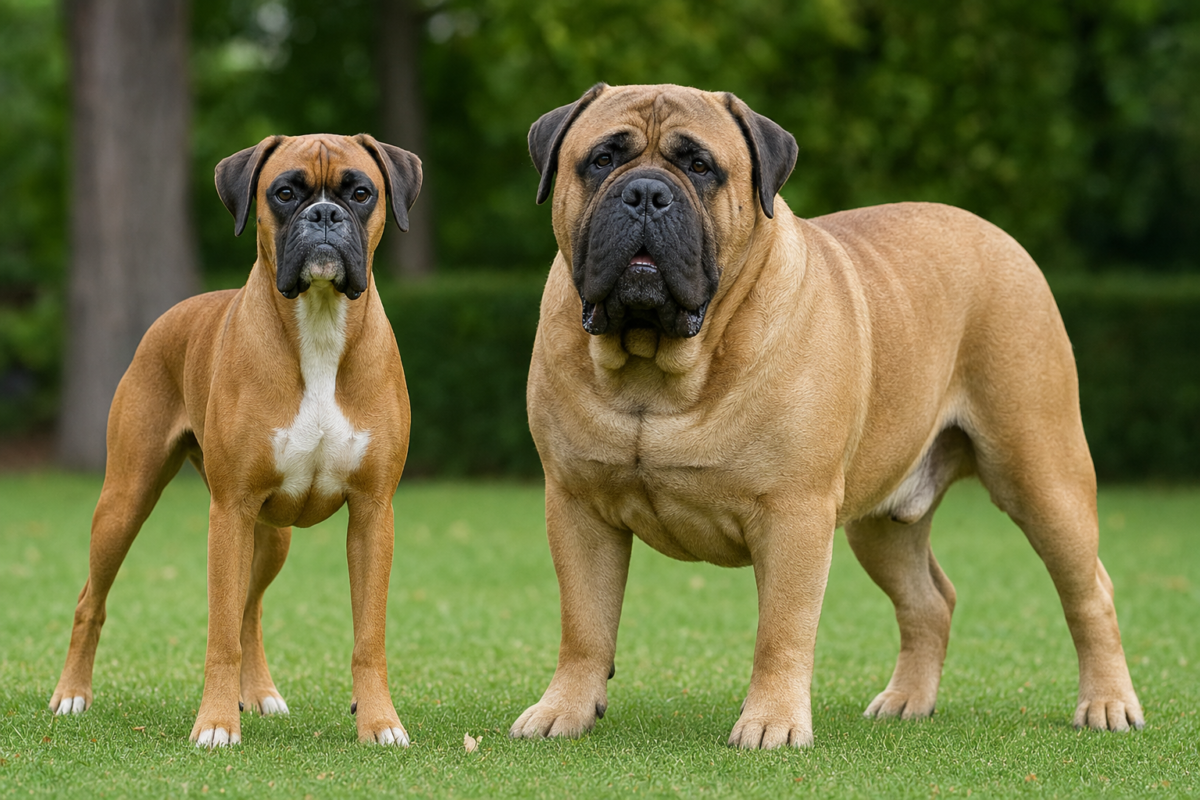
A Boxer is a mid sized, athletic working dog standing 21 to 25 inches and weighing 50 to 80 pounds, with high energy and a famously playful, clownish temperament that lasts well into adulthood. A Bullmastiff is a true giant at 24 to 27 inches and 100 to 130 pounds, bred as a silent guardian, and is calm, quiet and considerably less demanding of exercise. Both share a short coat, a black mask and a broad head, but a Bullmastiff is roughly 50 pounds heavier and a great deal slower moving.
These two breeds get confused more often than you might expect. They share ancestry, they share the short fawn or brindle coat and the dark mask, and from a distance a big Boxer and a lighter Bullmastiff can read as the same dog. Up close they are living very different lives. One is an athlete who never fully grows up, the other is a watchful giant who would rather lean on you than run with you. This guide sets them side by side on size, growth, temperament, exercise, care and cost so you can tell which one actually fits the home you have.
What is the difference between a Boxer and a Bullmastiff?
The core difference is size and tempo. A Bullmastiff outweighs a Boxer by roughly 50 pounds and carries that weight in a heavy, square, deliberate frame built for standing ground. A Boxer is lighter, longer in the leg and built to move, with an energy level that stays high for years. In temperament the Bullmastiff is calm, quiet and reserved with strangers, while the Boxer is exuberant, demonstrative and endlessly playful.
They also age on different clocks. A Boxer commonly lives 10 to 12 years, a Bullmastiff usually 7 to 9. That difference shapes everything from how you plan the growth years to how soon you start thinking about a senior routine, and it is the single most important thing many prospective parents overlook when comparing the two.
Boxer and Bullmastiff side by side
Here is the comparison in one place. Use it as an honest orientation rather than a scorecard, since individuals within both breeds vary a great deal.
| Feature | Boxer | Bullmastiff |
|---|---|---|
| Male height | 23 to 25 inches | 25 to 27 inches |
| Female height | 21.5 to 23.5 inches | 24 to 26 inches |
| Male weight | 65 to 80 lb | 110 to 130 lb |
| Female weight | 50 to 65 lb | 100 to 120 lb |
| Build | Square, lean, athletic | Square, heavy, powerfully boned |
| Coat | Short and smooth, fawn or brindle | Short and dense, fawn, red or brindle |
| Energy level | High and sustained | Moderate to low |
| Daily exercise | 60 to 90 minutes, varied | 30 to 45 minutes, steady |
| Temperament | Playful, boisterous, affectionate | Calm, watchful, quietly devoted |
| Drool | Modest | Considerable |
| Growth window | 18 to 22 months | 22 to 26 months |
| Typical lifespan | 10 to 12 years | 7 to 9 years |
Where they came from, and why it still matters
The Bullmastiff was created in England in the nineteenth century as a gamekeeper’s night dog, bred from roughly 60 percent Mastiff and 40 percent Bulldog to be fast enough to catch a poacher, heavy enough to hold one down, and quiet enough to do it without barking a warning first. Everything about the modern dog follows from that brief. The silence, the watchfulness, the willingness to hold position rather than chase, the sheer mass.
The Boxer came out of Germany from bull baiting and hunting stock, refined into a versatile working dog used for guarding, messenger work and police duties. It needed stamina, agility and a biddable, people focused mind. That history produced a dog who wants to be involved in everything, works happily alongside a handler, and treats the whole household as a team.
Read those two briefs again and you have most of the difference between them. One was bred to wait. The other was bred to work all day. Neither is better, but they suit genuinely different households.
Growth and the puppy years
Both breeds are large enough that the growth window deserves real attention, but they run on different schedules. A Boxer reaches most of its adult height by around 14 to 16 months and finishes filling out through the chest by 18 to 22 months, with mental maturity arriving much later, often closer to three years. A Bullmastiff takes longer at every stage, reaching adult height around 18 months and continuing to broaden and thicken until 22 to 26 months.
That longer runway matters because a Bullmastiff is putting on far more mass over a far longer period. A 12 week old Bullmastiff puppy can already outweigh an adult spaniel, and it is gaining several pounds a week. Through that window, steady growth beats fast growth every time, which means a complete food formulated for large breed puppies and portions matched to body condition rather than to appetite.
The Boxer’s challenge is different and is mostly about impact. This is a naturally springy, bouncy breed that will happily leap, twist and sprint on hard ground all afternoon if allowed, and doing that on open growth plates asks a lot of a young frame. With a Boxer you are managing enthusiasm. With a Bullmastiff you are managing mass.
Heat Sensitivity
Both are short faced and neither cools efficiently. Walk early, walk shaded, and skip hot afternoons entirely.
Mass On Young Joints
A Bullmastiff gains weight fast over a long growth window. Feed for a steady curve, never a quick one.
Bounce And Impact
A young Boxer will jump and twist all day. Keep repeated hard landings moderate while growth plates are open.
Under Stimulation
A bored Boxer becomes destructive. A bored Bullmastiff becomes stubborn. Both need a job of some kind.
Temperament and living with each
A Boxer is a comedian. This is a breed that keeps the play drive of a puppy well past its third birthday, greets the family with a whole body wiggle, and genuinely struggles to be left alone for long stretches. Boxers are patient and typically excellent with children, though a young one has no idea how much dog it is and will knock a toddler over through pure enthusiasm. They are sensitive to tone, respond poorly to harshness and brilliantly to play based training.
A Bullmastiff is a presence rather than a performer. Devoted to its family, undemonstrative, naturally reserved with strangers and content to spend most of the day lying somewhere it can see the door. That calmness is the breed’s greatest appeal in a home, and it comes attached to real stubbornness. A Bullmastiff that decides not to move is a hundred and twenty pounds of decision, which is why early training and consistent handling are not optional here.
Both breeds are strongly people oriented and neither does well as an outdoor dog or one left alone for long working days. Both want to be indoors with their family. The difference is what they do once they are there: the Boxer wants to play, the Bullmastiff wants to lean.
Exercise needs compared
This is where the two diverge most sharply in daily life, and where most mismatches between dog and household happen.
- Boxer. Plan on 60 to 90 minutes of varied activity daily, split across sessions. Walks alone will not do it. This breed needs play, training games and something to think about, and it stays that way until well past middle age.
- Bullmastiff. Plan on 30 to 45 minutes of steady walking, ideally in two calm sessions. Moderate and regular beats long and hard. An adult is usually content with a walk and a patrol of the garden.
- Both. Avoid exercise in heat. Short faced breeds cool themselves inefficiently, and a hot day plus enthusiasm is the combination that causes trouble for both of these dogs.
- Both while growing. Favour soft ground, keep sessions short and frequent, and let a puppy rest fully between bursts rather than pushing through.
Feeding, weight and body condition
A Bullmastiff eats considerably more than a Boxer, but not as much more as the weight difference suggests, because calorie need rises more slowly than body mass. A typical adult Boxer sits near 1,350 to 1,600 calories a day and a typical adult Bullmastiff near 2,200 to 2,500. What matters more than either figure is body condition, and on both breeds the check takes seconds.
- Ribs. Run your hands along the sides. You should feel each rib easily under a thin layer. On a short coated breed this is unusually easy to judge, so there is no excuse for letting it slide.
- Waist. From above, look for a clear narrowing behind the ribs. A Boxer should look athletic and a Bullmastiff should look substantial, but neither should look barrel shaped.
- Tuck. From the side, the belly should rise toward the back legs rather than running level.
Weight control matters more on the Bullmastiff simply because there is more of it. Every extra pound travels through the joints on every stride, and on a breed already carrying 120 pounds the margin for carelessness is smaller. Feed both to a lean condition and check every couple of weeks.
Grooming and household realities
Both wear short coats and neither needs professional grooming, but neither is as low maintenance as the coat suggests. Boxers shed steadily year round despite the short hair, and a weekly rubber curry brush keeps it manageable. Bullmastiffs shed similarly and add drool to the equation, particularly after drinking, so a cloth by the water bowl becomes part of life.
Both breeds have facial folds that need wiping and checking, and both are sensitive to heat inside the home as well as outdoors. Air conditioning in summer is a genuine welfare consideration rather than a luxury for either. On cost, a Bullmastiff is meaningfully more expensive to run: more food, larger beds, bigger doses of everything, and veterinary treatment priced by weight.
Supporting the joints of a heavy framed breed
Both breeds ask a lot of their joints, for different reasons. The Bullmastiff carries serious mass over a compact frame for its entire life. The Boxer lands, turns and springs with an enthusiasm that never really fades. Supporting healthy joint development while either dog is growing, and maintaining that support as an adult, is a simple daily habit with a long payoff.
Alongside lean feeding and sensible exercise, many big dog parents add a daily chew made for large and giant breeds. MoveGuard Growth is built for the roughly 8 to 30 month growth window and combines nine actives including 250mg New Zealand Green Lipped Mussel, 400mg glucosamine, 300mg chondroitin, 250mg MSM and 15mg hyaluronic acid to support developing joints. You dose by expected adult weight, so most Boxers sit at two chews a day and most Bullmastiffs at three. MoveGuard Adult carries the same support forward. Both ship as 90 chicken liver flavour chews, are made in the USA in an NSF facility, and are backed by a 60 day guarantee.
Daily Support For Big Frames
Give your Boxer or Bullmastiff daily joint support built for large and giant breeds. Explore MoveGuard Growth.
Which one is right for your home?
Choose a Boxer if your household is active and noisy, if someone is home most of the day, if you want a dog that joins in with everything, and if you genuinely enjoy training games. Boxers suit families with older children, gardens, and people who want a companion for daily activity for the next decade. They do not suit quiet homes, long working days or anyone hoping for a calm dog by age two.
Choose a Bullmastiff if you want a large, steady presence rather than an activity partner, if you can commit to early and consistent training, if you have the space and budget for a dog of that size, and if you can accept a shorter life together. Bullmastiffs suit calmer households and confident handlers. They do not suit first time parents looking for an easy giant, homes that cannot manage drool and shedding, or anyone who wants a dog to run with.
If you are torn, be honest about your calendar rather than your intentions. The most common regret with a Boxer is underestimating the exercise. The most common regret with a Bullmastiff is underestimating the size, the cost and how quickly the senior years arrive.
Common mistakes with both breeds
- Exercising in heat. Both are short faced and neither cools well. This is the mistake most likely to cause real harm on a summer day.
- Treating a Boxer as a calm adult too early. Mental maturity arrives around three years. Planning for a settled two year old leads to frustration on both sides.
- Letting a Bullmastiff grow fast. A heavy puppy is not a healthier one. Steady growth over a long window is what a frame that size needs.
- Skipping early training on the Bullmastiff. Habits set at 40 pounds are much easier to change than habits set at 120.
- Under stimulating either. A Boxer without an outlet chews the house. A Bullmastiff without structure simply stops listening.
- Waiting for a problem before supporting joints. The growth window is the time to support developing joints, not after signs appear.
Frequently asked questions
Is a Bullmastiff bigger than a Boxer?
Yes, considerably. A male Bullmastiff stands 25 to 27 inches and weighs 110 to 130 pounds, while a male Boxer stands 23 to 25 inches and weighs 65 to 80 pounds. The Bullmastiff is roughly 50 pounds heavier and much more heavily boned.
Which breed is calmer, a Boxer or a Bullmastiff?
The Bullmastiff is significantly calmer. It was bred to wait quietly and hold ground, and an adult is usually content with a moderate walk and a long rest. A Boxer keeps a high, playful energy level well into adulthood and needs 60 to 90 minutes of varied activity daily.
Do Boxers and Bullmastiffs get along with children?
Both are typically affectionate with children in their own family. The practical difference is physics: a bouncing Boxer can knock a small child over through sheer enthusiasm, and a Bullmastiff can do the same simply by turning around. Supervision and early training matter for both.
Which breed lives longer?
The Boxer, by a clear margin. Boxers commonly live 10 to 12 years while Bullmastiffs typically live 7 to 9. Giant breeds age faster across the board, which is why senior planning starts earlier with a Bullmastiff.
Are Boxers and Bullmastiffs related?
They share bull breed ancestry but were developed separately. The Bullmastiff was created in England from roughly 60 percent Mastiff and 40 percent Bulldog as a gamekeeper’s night dog, while the Boxer was developed in Germany from bull baiting and hunting stock into a versatile working dog.
The bottom line
A Boxer and a Bullmastiff look like cousins and live like strangers. The Boxer is a 50 to 80 pound athlete with a decade of play in it and a real daily exercise bill. The Bullmastiff is a 100 to 130 pound guardian who wants a calm home, firm early training and a shorter, quieter life at your side. Match the dog to the household you actually have, feed both for a lean frame, respect the heat, support the joints through the growth window and beyond, and either one will be a devoted companion for every year you get.
Want the simple roadmap in one place? Grab our free Big Dog Growth Guide for the growth window checklist, feeding framework and joint safe exercise limits, all written for large and giant breeds.
This article is for general educational purposes only and is not veterinary advice. It is not intended to diagnose, treat, cure or prevent any disease. Always consult your veterinarian about your dog’s individual health, nutrition and supplement needs. These statements have not been evaluated by the Food and Drug Administration.
Support Big Breed Joints from Day One
Large and giant breeds carry more load through every growth stage. MoveGuard Growth supports developing joints in young big dogs (8 to 30 months); MoveGuard Adult keeps grown big dogs moving comfortably.
Leave a Reply