
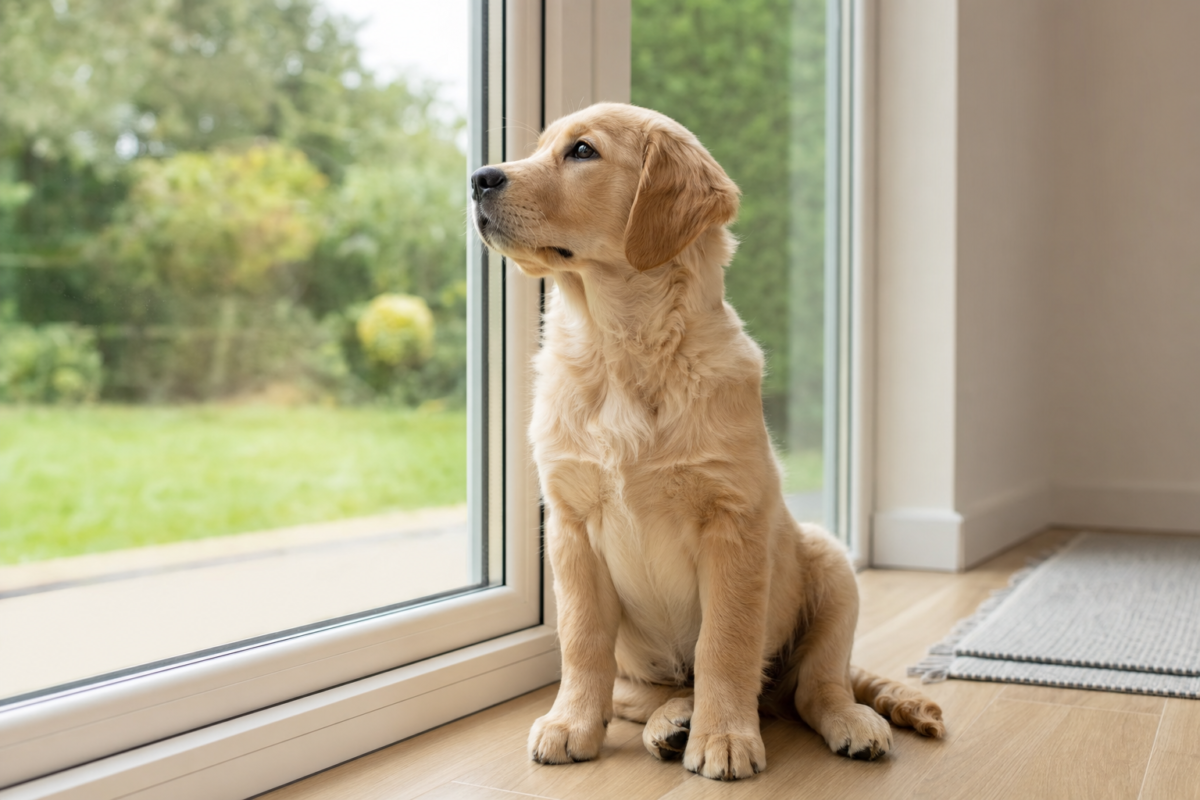
House train a big puppy by taking it outside every hour while awake, plus immediately after every wake up, meal, drink and play session, always to the same spot, and rewarding within three seconds of the puppy finishing. Use a crate or a small confined area whenever you cannot watch, feed on a fixed schedule so the output becomes predictable, and expect a young puppy to hold its bladder for roughly one hour per month of age. Most large breed puppies are reliably clean in the house by four to six months, with the occasional accident until around eight months.
Bringing home a large breed puppy means bringing home an animal that grows faster than any small dog ever will, and house training is usually the very first project you take on together. The encouraging news is that big puppies are not harder to train than small ones. In several ways they are easier, because a bigger bladder holds on a little longer and a calm, methodical breed tends to settle into a routine quickly. What is different is the margin for error. A missed signal from a Great Dane puppy is a much larger event on your floor than a missed signal from a terrier, so getting the system right early is worth real effort.
How do I house train a big puppy?
House train a big puppy with three things working together: a schedule, supervision and immediate reward. Take your puppy out on the hour while it is awake, and always the moment it wakes up, finishes a meal, finishes a drink or stops playing. Go to the same patch of ground every time so the surface and the smell become the cue. Stand still and wait quietly rather than walking about, then praise and reward within about three seconds of your puppy finishing. When you cannot actively watch, your puppy should be in a crate or a small safe area rather than loose in the house.
That is the whole method. Everything else in this guide is detail on making it sustainable through the weeks when a big puppy is growing fast, sleeping hard and drinking a surprising amount of water.
Why house training a big puppy is a little different
Large and giant breed puppies bring a few specific wrinkles to an otherwise ordinary process.
Volume. A big puppy drinks more and produces more, so the same number of successful trips outside removes a much greater quantity from the house. It also means an accident soaks through rather than sitting on the surface, which makes thorough cleaning more important.
Growth speed. A large breed puppy can double in weight in a month. Bladder capacity grows along with everything else, so a schedule that felt right two weeks ago is often too cautious now. Review it fortnightly rather than setting it once.
Physical fragility while growing. This is the one most new Dog Parents miss. Rushing a heavy puppy up and down steps a dozen times a day asks a great deal of a frame that is still forming, and it is worth planning a route that avoids repeated stairs. Our guide on stairs and big breed puppies covers why.
Slip risk indoors. A big puppy hurrying to the door on a smooth floor slides. Runners or rugs along the route to the door make the trip safer and quicker, and floor traction matters for a growing frame in general.
How long can a big puppy hold it, by age?
The rough rule is one hour of bladder control per month of age while awake, with a practical ceiling of around six to eight hours for an adult. Big puppies often manage slightly longer than the rule suggests, but treat the numbers below as the interval at which you offer a trip, not the interval at which your puppy must last.
| Age | Daytime interval | Overnight | Trips per day |
|---|---|---|---|
| 8 to 10 weeks | Every 45 to 60 minutes | 2 to 3 wake ups | 12 to 16 |
| 10 to 12 weeks | Every 60 to 90 minutes | 1 to 2 wake ups | 10 to 14 |
| 3 to 4 months | Every 2 hours | 1 wake up | 8 to 10 |
| 4 to 5 months | Every 3 hours | Often through the night | 6 to 8 |
| 5 to 6 months | Every 4 hours | Through the night | 5 to 6 |
| 6 months plus | Every 4 to 6 hours | Through the night | 4 to 5 |
The American Kennel Club’s Chief Veterinary Officer, Dr. Jerry Klein, DVM, has written extensively on the slower growth and development timeline of large and giant breeds. Read more from the AKC’s guidance on caring for large-breed dogs.
How long does house training take for a large breed?
Most large breed puppies are reliably clean in the house between four and six months of age, given a consistent schedule from day one. Expect the occasional accident up to around eight months, usually tied to something identifiable: a change of routine, a long day of visitors, a growth spurt with a bigger appetite, or a house move.
What progress actually looks like
House training does not improve in a straight line, and knowing that in advance saves a lot of worry. The pattern almost every Dog Parent sees is a strong first fortnight of rapid learning, then a flat spell around twelve to sixteen weeks where accidents reappear for a week or two, then steady reliability from about four months. The flat spell is not a failure of training. It is usually a puppy who has become confident enough to get absorbed in play and stop reading its own signals. Tighten the schedule for a week and it passes.
Too Much Freedom
A puppy loose in a large house will find a quiet corner. Earn space room by room as reliability builds, not all at once.
Punishing Accidents
Scolding teaches a puppy to go somewhere you cannot see rather than to hold on. Clean it up and tighten the schedule instead.
Rewarding Too Late
A treat given at the back door rewards coming inside. Reward outdoors, within about three seconds of your puppy finishing.
Free Access To Water Overnight
Water all day, lifted an hour or two before bed with your veterinarian agreeing it suits your puppy, makes nights far easier.
The daily routine that does the work
House training is mostly logistics. A big puppy on a predictable input schedule produces a predictable output schedule, and that is the entire advantage you are buying.
- Take your puppy out immediately on waking, every time, before anything else happens.
- Go out again after every meal, usually within 10 to 20 minutes, and after every long drink.
- Go out after every play session and every training session, because activity moves things along.
- Use a fixed feeding schedule of three measured meals a day while young rather than leaving food down.
- Use the same door, the same route and the same patch of ground every single time.
- Use one quiet cue word as your puppy starts, then praise and reward the moment it finishes.
- Stay outside a further two or three minutes after success, because big puppies often go twice.
How to read the signals in ten seconds
Almost every accident is preceded by a signal you can learn to catch. Big puppies broadcast fairly clearly once you know what to look for.
- Sudden disengagement. A puppy that stops playing mid game and wanders off is the most reliable tell there is.
- Circling and sniffing the floor. Nose down, tight circles, often in a corner or behind furniture.
- Heading for the door, or heading for a rug. Both are the same instinct. Move first and ask questions later.
- Whining or restlessness in the crate. Treat any waking complaint at night as a bathroom request until proven otherwise.
When in doubt, go outside. A trip that turns out to be unnecessary costs three minutes. A missed one costs a great deal more.
Crates, confinement and why they help
A correctly sized crate is the single most useful house training tool available, because it works with a puppy’s natural preference not to soil where it sleeps. The size rule is important for a big breed: the crate should allow your puppy to stand, turn and lie flat, and no more. A crate large enough for an adult Great Dane gives an eight week old puppy a bedroom and a bathroom, which teaches exactly the wrong lesson. Buy the adult sized crate and use a divider, moving it out as your puppy grows. Our guides to crate training a large breed puppy and to crate sizing walk through both parts in detail.
When a crate is not the right fit for your household, a small confined area with a washable floor achieves most of the same thing. The principle is the same either way: your puppy is either under active supervision or in a space small enough that it would rather hold on. Unsupervised freedom in a big house is what creates hidden habits.
Nights, and getting them back
Nights come good faster than most people expect. A puppy of eight to ten weeks usually needs two or three trips out; by four months most large breed puppies sleep through.
- Lift the water bowl an hour or two before bed once your veterinarian confirms that suits your puppy, and offer a final trip outside as the very last thing.
- Keep the crate where you can hear it, ideally in your room at first. A puppy you cannot hear is a puppy whose request you will miss.
- Make night trips boring on purpose. No lights, no talking, no play. Out, praise quietly, straight back to bed.
- Set an alarm for the first week rather than waiting to be woken, so you arrive before the accident rather than after it.
Cleaning up properly matters more for a big dog
An accident from a large puppy carries a great deal of liquid into carpet, underlay and floorboards, and any residual scent is an instruction to come back to the same spot. Blot rather than rub, use an enzymatic cleaner made for pet accidents rather than a general household cleaner, and avoid anything containing ammonia, which smells to a dog like more of the same. Treat a generous area around the visible mark, because the spread underneath is always wider than what you can see.
Daily habits during the growth window
House training is one of several habits you are laying down in the first year, and the physical ones sit alongside it. Twelve to sixteen trips outside a day is real mileage for a growing frame, so keep those trips calm, keep the footing good, and avoid making a game of the stairs. Steady, moderate movement and a lean body condition support comfortable development far better than bursts of hard activity, which is the same principle behind safe exercise for large breed puppies.
Many big dog parents also start a daily joint support routine during this stage, while the frame is still forming. MoveGuard Growth is built for exactly that window. It brings together nine actives, including New Zealand Green Lipped Mussel, glucosamine, chondroitin, MSM and hyaluronic acid, to support healthy joint development across the roughly 8 to 30 month growth window. You dose by expected adult weight, so most large breeds sit at two chews a day and the biggest at three. It ships as 90 chews in a chicken liver flavour, is made in the USA in an NSF registered facility, and is backed by a 60 day guarantee.
Start The Habit Early
Support your growing puppy with daily joint care built for large and giant breeds. Explore MoveGuard Growth.
Signs your house training is on track
Progress shows up as pattern rather than perfection. Look for a puppy who heads for the door on its own at least sometimes, who settles in the crate without complaint, who wakes you at night less often each week, and who produces predictably about twenty minutes after a meal. Fewer accidents week over week, even with the odd bad day, is exactly the shape of success.
Two things are worth raising with your veterinarian rather than training harder. One is a puppy who suddenly regresses after weeks of reliability, especially with frequent small amounts or obvious straining. The other is a puppy who seems unable to hold on at all for its age. Both are worth a quick check before you assume a training problem.
A simple house training game plan, stage by stage
Week one, 8 to 10 weeks. Hourly trips while awake, two or three overnight, and total supervision or confinement in between. Do not attempt to teach anything else this week. Establish the spot, the cue and the reward and let everything else wait.
Weeks two to four, 10 to 12 weeks. Stretch daytime intervals to 90 minutes as successes accumulate. Start leaving the crate door open during the day so it becomes a resting place rather than only a bedroom. Expect one poor day in every five.
3 to 4 months. Two hour intervals, usually one night trip, and the flat spell many parents hit. If accidents reappear, tighten back to 90 minutes for a week rather than adding pressure. Begin opening up one extra room at a time.
4 to 6 months. Three to four hour intervals and nights through. Your puppy should be asking to go out with some consistency. Keep the schedule visible for the whole household, because inconsistency between people is now the main source of accidents.
6 to 8 months. Essentially reliable, with the occasional lapse around disruption. Hold the routine loosely rather than abandoning it, and give a trip out after any long stretch of excitement or visitors.
Common house training mistakes to avoid
These are the six that account for most of the difficulty, and every one of them is easy to fix.
- Free feeding. Food available all day makes output unpredictable, which removes your main advantage. Measured meals at fixed times.
- Rewarding indoors. Reward at the spot, not at the door, and within a few seconds. The gap is what teaches the lesson.
- A crate that is too big. Very common with big breeds, because parents buy for the adult size. Use a divider.
- Going out with your puppy and then playing. Toileting trips and play sessions should look different, or your puppy learns to hold on for the fun part.
- Inconsistent cue words. Agree one phrase across the whole household and use only that.
- Assuming a quiet puppy is an empty puppy. Many calm giant breed puppies simply do not ask. Those puppies need the clock, not the signal.
Temperament, and why big puppies often learn this fast
There is a genuine advantage hiding in large breed temperament. Many of the big working and guardian breeds are deliberate, people focused and strongly motivated by routine, and house training is fundamentally a routine. A Newfoundland or a Great Pyrenees puppy will often slot into a predictable day faster than a small, busy terrier, simply because the pattern suits how it already thinks.
The flip side is sensitivity. Many of these breeds take correction to heart far more than their size suggests, and a puppy that has been scolded for an accident frequently responds by becoming secretive rather than more careful. Calm, matter of fact handling gets you there faster with a big dog than firmness does. Keep the tone of the whole project cheerful and mechanical, notice the wins out loud, treat the accidents as information about your schedule rather than about your puppy, and you will be through the hard part in a few short weeks with a puppy who still thinks the back door is the best place in the house.
Frequently asked questions
How long does it take to house train a large breed puppy?
Most large breed puppies are reliably clean indoors between four and six months of age with a consistent schedule from the first day, and the occasional accident is normal until around eight months. Progress usually comes in a strong first fortnight, a flat spell around three months, then steady reliability.
How often should I take my big puppy outside?
While awake, offer a trip roughly every hour at eight to ten weeks, stretching to every two hours by three or four months. Always go out immediately after waking, after every meal, after a long drink and after play, which for a young puppy means twelve to sixteen trips a day.
Should I use a crate to house train a big puppy?
A correctly sized crate is the most useful tool available, because puppies prefer not to soil where they sleep. Buy the adult sized crate for your breed and fit a divider so the space allows standing, turning and lying flat and no more. A small confined area with a washable floor works too.
Why is my puppy having accidents again after weeks of success?
A regression around twelve to sixteen weeks is common and usually means a confident puppy is getting absorbed in play and missing its own signals. Tighten the schedule back for a week. If it comes with frequent small amounts or straining, speak with your veterinarian before adjusting training.
Should I take water away from a big puppy at night?
Water should be freely available during the day. Many Dog Parents lift the bowl an hour or two before bedtime and offer a final trip outside as the last thing, which makes nights considerably easier. Confirm with your veterinarian that this suits your individual puppy first.
The bottom line
House training a big puppy is a scheduling job, not a battle of wills. Take your puppy out on the hour while awake and after every wake up, meal, drink and play session. Use the same spot, reward within three seconds, and confine rather than supervise whenever you cannot actively watch. Feed measured meals at fixed times so the output becomes predictable, expect a wobble around three months, and clean accidents thoroughly with an enzymatic cleaner. Do that and most large breed puppies are trustworthy in the house by four to six months, with a routine that quietly supports a growing frame at the same time.
Want the Simple Roadmap in One Place?
Grab our free Big Dog Growth Blueprint for the growth window checklist, feeding framework and joint safe exercise limits, all written for large and giant breeds.
This article is for general educational purposes only and is not veterinary advice. It is not intended to diagnose, treat, cure or prevent any disease. Always consult your veterinarian about your dog’s individual health, nutrition and supplement needs. These statements have not been evaluated by the Food and Drug Administration.
Support Big Breed Joints from Day One
Large and giant breeds carry more load through every growth stage. MoveGuard Growth supports developing joints in young big dogs (8 to 30 months); MoveGuard Adult keeps grown big dogs moving comfortably.
Leave a Reply