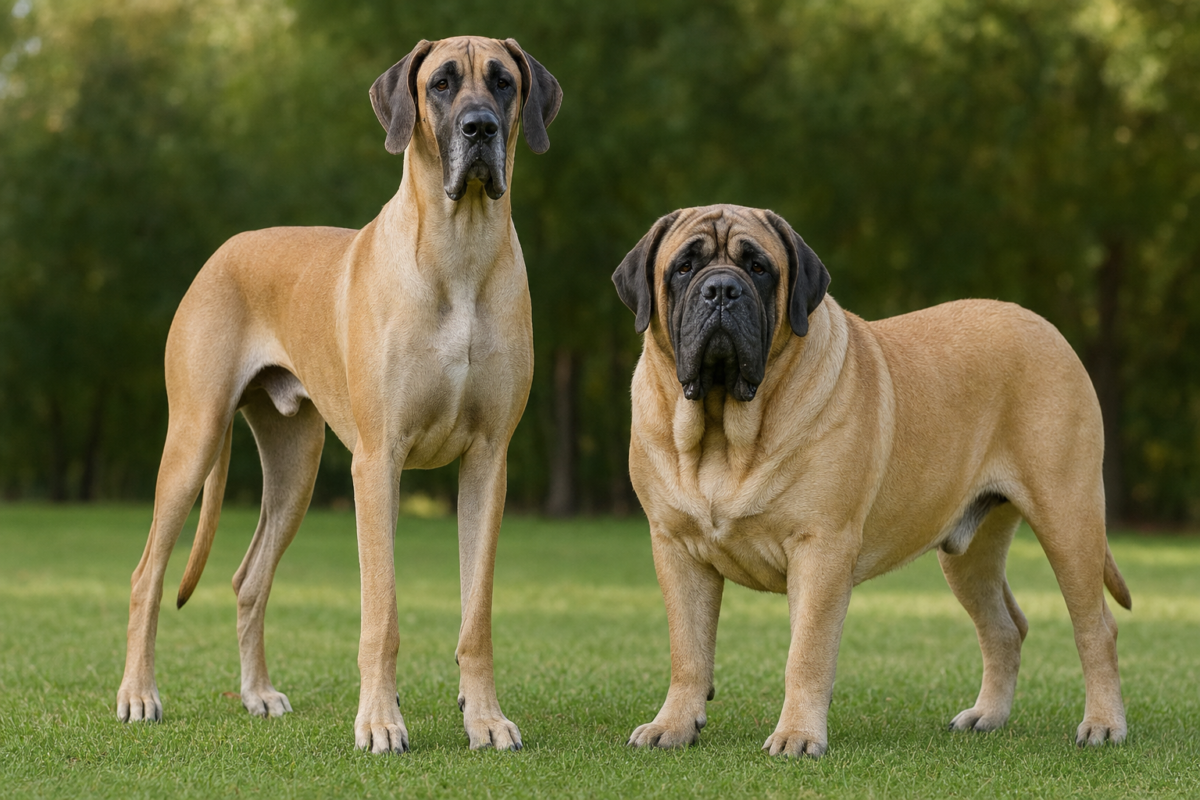
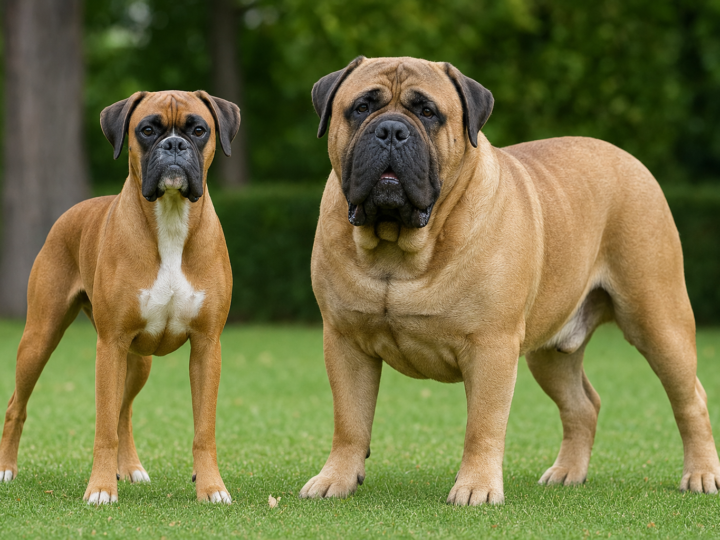
The Great Dane is the taller, leaner giant, with males standing 30 to 32 inches at the shoulder and weighing 140 to 175 pounds. The English Mastiff is the heavier, broader giant, with males standing 30 inches and up and weighing 160 to 230 pounds. Danes are elegant and springy, Mastiffs massive and slow moving, and both keep growing until roughly two and a half to three years of age.
If you are choosing between a Great Dane and an English Mastiff, the difference between them is bigger than the numbers suggest. One is a tall, graceful athlete who fills a doorway with height. The other is a deep, powerful giant who fills it with sheer breadth. This guide covers the size difference, the growth timelines, and the temperament that decides which giant fits your life.
What is the difference between a Great Dane and an English Mastiff?
The main difference between a Great Dane and an English Mastiff is build. A Great Dane is taller and leaner, standing 30 to 32 inches for males and 28 to 30 inches for females, with a typical adult weight of 140 to 175 pounds for males and 110 to 140 pounds for females. An English Mastiff is shorter through the leg but far heavier and broader, with males standing 30 inches and up at 160 to 230 pounds and females standing about 27 and a half inches and up at 120 to 170 pounds.
Temperament follows the frame. Danes tend to be playful and springy well into adolescence, while Mastiffs are famously steady, quiet and content to lie in one spot for hours. Both mature slowly, so the growth years matter enormously.
Great Dane and English Mastiff at a glance
Here is the side by side picture most Dog Parents want before committing.
| Feature | Great Dane | English Mastiff |
|---|---|---|
| Male height | 30 to 32 inches | 30 inches and up |
| Female height | 28 to 30 inches | 27 and a half inches and up |
| Male weight | 140 to 175 lb | 160 to 230 lb |
| Female weight | 110 to 140 lb | 120 to 170 lb |
| Build | Tall, lean, athletic | Broad, deep, massive |
| Energy level | Moderate with playful bursts | Low and steady |
| Drool | Moderate | Generous |
| Full maturity | About 2 to 3 years | About 2 and a half to 3 years |
The American Kennel Club’s Chief Veterinary Officer, Dr. Jerry Klein, DVM, has written extensively on the slower growth and development timeline of large and giant breeds. Read more from the AKC’s guidance on caring for large-breed dogs.
What makes a Great Dane grow the way it does
The Great Dane grows upward first. Bred for real speed, the Dane carries height on comparatively fine legs, and that frame arrives fast. A Dane puppy can gain three to five pounds a week through the middle of the first year, one of the steepest growth curves in the dog world, which is why Dane parents hear so much about steady feeding. A young Dane often looks all legs and elbows at eight or nine months, with a narrow chest that has not caught up yet. That gangly stage is normal and resolves as the chest deepens through the second year.
What makes an English Mastiff grow the way it does
The English Mastiff grows outward as much as upward. This is a breed built for mass, with a broad skull, a deep chest and heavy bone throughout, so a Mastiff puppy piles on weight rather than height. It is not unusual for one to pass 100 pounds around six months while still behaving like a clumsy baby. Because so much weight arrives so soon, the Mastiff growth years ask more of developing joints than almost any other breed. Many also stay puppyish in the head past two years, inside an adult sized body.
Great Dane growth chart, month by month
Treat this as a guide, not a report card.
| Age | Male weight | Female weight |
|---|---|---|
| 2 months | 25 to 35 lb | 20 to 30 lb |
| 3 months | 40 to 50 lb | 35 to 45 lb |
| 4 months | 55 to 70 lb | 50 to 60 lb |
| 6 months | 85 to 105 lb | 70 to 90 lb |
| 9 months | 105 to 130 lb | 90 to 110 lb |
| 12 months | 120 to 145 lb | 100 to 125 lb |
| 18 months | 135 to 165 lb | 105 to 135 lb |
| 2 years plus | 140 to 175 lb | 110 to 140 lb |
English Mastiff growth chart, month by month
Mastiff numbers run heavier at every stage, with a wide spread between individuals.
| Age | Male weight | Female weight |
|---|---|---|
| 2 months | 30 to 40 lb | 25 to 35 lb |
| 3 months | 50 to 60 lb | 40 to 50 lb |
| 4 months | 65 to 85 lb | 55 to 70 lb |
| 6 months | 100 to 120 lb | 80 to 100 lb |
| 9 months | 130 to 155 lb | 100 to 125 lb |
| 12 months | 150 to 175 lb | 110 to 140 lb |
| 18 months | 160 to 200 lb | 120 to 155 lb |
| 2 years plus | 160 to 230 lb | 120 to 170 lb |
When do Great Danes and English Mastiffs stop growing?
A Great Dane reaches most of its adult height by around 18 to 24 months, then keeps adding chest depth and muscle until roughly two and a half to three years of age. An English Mastiff follows a similar height timeline but packs on substance for longer, often until three years. In both breeds height finishes well before the body looks finished, so a lanky twenty month old Dane and a rangy two year old Mastiff are both right where they should be.
Why the growth window matters more for giant breeds
Growth plates, the soft areas at the ends of the long bones, stay open through much of the first year and close later in giant breeds than in smaller dogs. While they are open, every extra pound and every hard landing asks more of a frame that is still forming. Dogs with an expected adult weight of 130 pounds and above keep developing for roughly 24 to 30 months, which is why lean feeding, sensible exercise and daily joint support carry so much weight for these two breeds.
Growing Too Fast
Both breeds pile on weight faster than their joints prefer. A steady curve beats a rapid one.
Excess Weight
Every extra pound on a giant frame multiplies through the joints. Lean is kind at this size.
Slippery Floors
Tile and polished wood cause splayed legs and awkward landings. Runners and rugs are essential.
Stairs And Jumping
Repeated stairs and leaping from cars load open growth plates. Ramps help while young.
How much should a Great Dane or English Mastiff eat while growing?
Giant breed puppies do best on steady, moderate growth. A few habits make a real difference for both breeds:
- Choose a complete food formulated for large or giant breed puppies, which balances calories, calcium and phosphorus for steadier growth.
- Split the daily amount into three meals while young, then two as an adult.
- Feed to a lean body condition. You should feel the ribs easily under a light layer.
- Resist feeding for size. A bigger puppy is not a healthier puppy, and adult size is written in the genes anyway.
- Ask your veterinarian to confirm the daily amount at each checkup.
How to check body condition in ten seconds
The scale tells you weight, but body condition tells you health, and on a giant breed it is the number that matters.
- Ribs. Run your hands along the sides. You should feel the ribs under a thin layer. If you have to press, ease back on food.
- Waist. From above, you want a clear waist that tucks in behind the ribs.
- Tuck. From the side, the belly should rise toward the back legs rather than hang level.
Growth safe exercise for a giant breed puppy
Both breeds need movement, but during the fast growth months the goal is regular, moderate activity rather than repeated hard impact. The Dane will ask for more of it. The Mastiff will happily ask for less.
- Favour free play, sniffing walks and gentle exploring on soft ground such as grass.
- Keep long runs, forced jogging and repeated jumping moderate while the growth plates are open.
- Lift or ramp your puppy in and out of the car rather than letting them leap down.
- Add early training and scent games, which satisfy a young giant without pounding on joints.
- Let your puppy rest fully between bursts. Growing bodies do their work while sleeping.
Protecting giant joints during the growth years
Both breeds carry more weight through their joints than nearly any other dog, and they carry it while the frame is still forming. Supporting healthy joint development through those years is one of the simplest habits you can build.
Alongside lean feeding and sensible exercise, many giant breed parents add a daily joint support chew made for large and giant breeds. MoveGuard Growth is built for exactly this stage. It combines nine actives, including New Zealand Green Lipped Mussel, glucosamine, chondroitin, MSM and hyaluronic acid, to support the developing joints of young large and giant breed dogs across the roughly 8 to 30 month growth window. You dose by expected adult weight, so both Danes and Mastiffs sit at three chews a day. It is made in the USA, arrives as a 90 chew jar at about $39.99 on subscription, and is backed by a 60 day guarantee. Many parents then move across to MoveGuard Adult and keep the routine going.
Support A Giant Frame
Give your growing Dane or Mastiff daily joint support built for large and giant breeds. Explore MoveGuard Growth.
Signs your giant breed puppy is growing on track
You do not need a weekly weigh in. Look for a bright, alert puppy with a waist you can see from above, ribs you can feel with light pressure, smooth even movement, and a healthy appetite. If you notice limping, stiffness after rest, splaying legs on smooth floors, or a sudden growth surge, a quick conversation with your veterinarian lets you adjust food or activity early.
A simple growth game plan, stage by stage
Raising a sound Dane or Mastiff takes the right emphasis at the right time, not a complicated program.
8 weeks to 4 months. Foundation stage. A complete large or giant breed puppy food, three calm meals a day, early socialisation, and short bursts of free play on soft ground. Put down rugs and runners now, before your puppy is heavy enough to hurt themselves slipping.
4 to 8 months. Growth is quickest here and your puppy may look leggy and comical. Keep feeding lean, keep exercise moderate, and build steady habits around stairs and car entry. This is the natural point to begin a daily joint support routine.
8 to 18 months. Height nears its peak while muscle starts to arrive. Match portions to a lean body condition, because a teenage appetite outpaces need. Danes want more outlet than Mastiffs here, so give it in short, playful bursts.
18 months to 3 years. The lanky adolescent becomes a genuine giant. Growth slows while chest and muscle continue to develop, especially in Mastiffs.
Common growth mistakes to avoid
Most growth troubles in giant breeds come from a few avoidable habits.
- Overfeeding for size. Extra weight loads developing joints at the wrong moment. Feed lean and let size arrive on its own schedule.
- Skipping large or giant breed puppy food. These formulas control calcium and calories for steady growth. Confirm the food with your veterinarian.
- Too much hard exercise, too young. Long runs and repeated jumping ask a great deal of open growth plates on a 120 pound puppy.
- Leaving floors bare. Rugs and mats around food bowls protect a heavy puppy from awkward splays and falls.
- Waiting for a problem before supporting joints. The growth window is the ideal time to support developing joints, not the months after.
Temperament, and which giant might suit your home
Both breeds are gentle and both are enormous. The real difference is the daily rhythm they bring into your house.
The Great Dane is playful, sociable and expressive. Danes lean on people, follow you room to room, and keep a goofy streak well into their third year. They want company, they get bored alone, and they will happily attempt your lap at 150 pounds. A daily walk, some free play and a warm household satisfies a Dane completely.
The English Mastiff is calm, watchful and profoundly steady. Mastiffs are quiet dogs who prefer to lie near the door and observe, naturally protective without much noise about it. They need less exercise and more space, and they drool with real commitment. Their slow mental maturity means training should be patient, consistent and started early, while your puppy grows into a body that will soon outweigh you.
Both breeds live shorter lives than most dogs, typically around seven to ten years, one more reason the growth years deserve real care.
Frequently asked questions
Which is bigger, a Great Dane or an English Mastiff?
The English Mastiff is bigger by weight and the Great Dane is bigger by height. A male Mastiff typically weighs 160 to 230 pounds while a male Great Dane weighs 140 to 175 pounds. Danes stand 30 to 32 inches at the shoulder and are the taller, leaner breed of the two.
Is a Great Dane or an English Mastiff better for a family?
Both are gentle and devoted family dogs. A Great Dane suits an active, sociable household that wants a playful companion, while an English Mastiff suits a calmer home that prefers a quiet, steady presence. Either way, early socialisation and training matter enormously with a dog this large.
When is a Great Dane or English Mastiff full grown?
Both breeds reach most of their adult height by around 18 to 24 months, then continue filling out in chest and muscle. Great Danes usually finish at roughly two and a half to three years, and English Mastiffs often take the full three years or a little longer.
Do Great Danes and English Mastiffs have joint problems?
As giant breeds carrying substantial weight through a frame that develops slowly, both put real demand on their joints. Steady growth, a lean body condition, sensible exercise and daily joint support through the growth window are all sensible ways to support long term comfort. Speak with your veterinarian about your individual dog.
How much does it cost to feed a Great Dane or English Mastiff?
Both breeds eat a great deal, and an English Mastiff generally eats more than a Great Dane because of the extra body mass. Budget for a large or giant breed puppy formula through the first eighteen months, plus supplements and larger doses of any routine care, since almost everything is priced by body weight.
The bottom line
Choose the Great Dane if you want height, playfulness and a sociable shadow. Choose the English Mastiff if you want mass, quiet and a calm guardian content to lie at your feet. Both grow for two and a half to three years, both need lean feeding and gentle exercise through that window, and both reward the care you put into the early years with a comfortable, confident adulthood.
Want the Simple Roadmap in One Place?
Grab our free Big Dog Growth Blueprint for the growth window checklist, feeding framework and joint safe exercise limits, all written for large and giant breeds.
This article is for general educational purposes only and is not veterinary advice. It is not intended to diagnose, treat, cure or prevent any disease. Always consult your veterinarian about your dog’s individual health, nutrition and supplement needs. These statements have not been evaluated by the Food and Drug Administration.
Support Big Breed Joints from Day One
Large and giant breeds carry more load through every growth stage. MoveGuard Growth supports developing joints in young big dogs (8 to 30 months); MoveGuard Adult keeps grown big dogs moving comfortably.
Leave a Reply