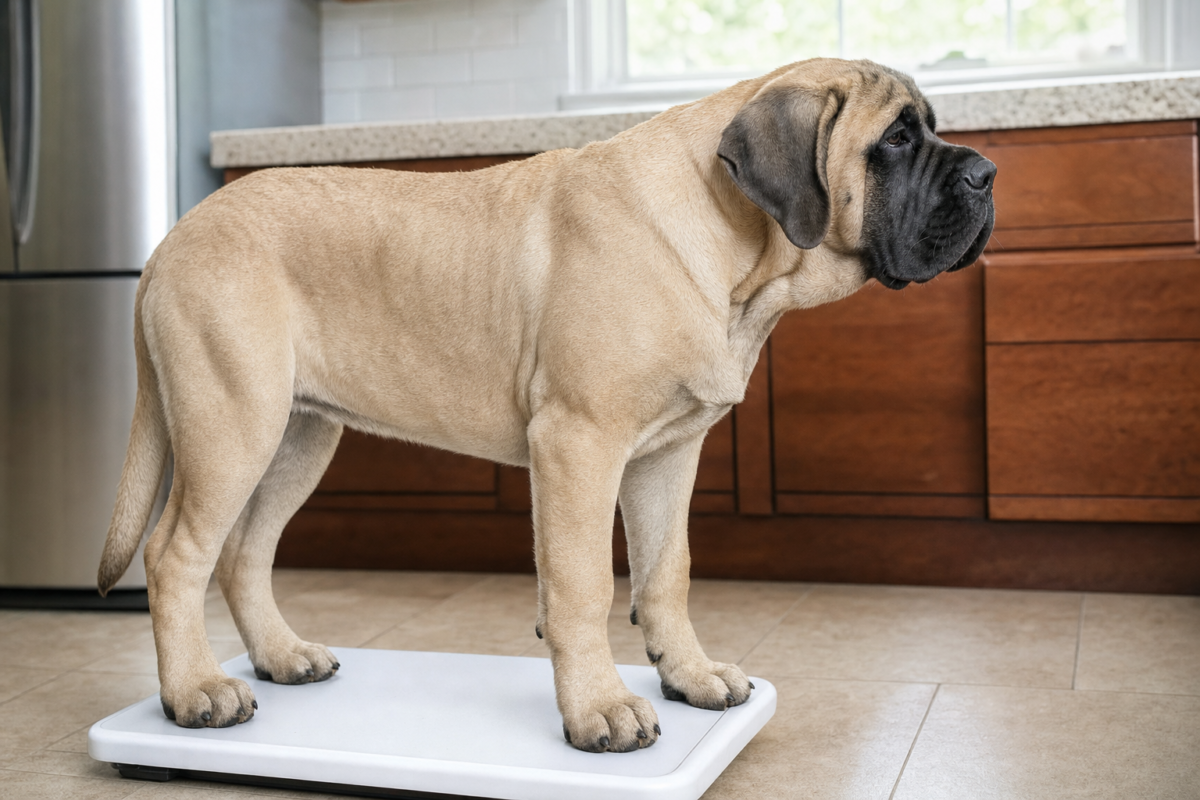
A large breed puppy is growing on track when the gains arrive steadily rather than in jumps, the ribs are easy to feel under a thin layer, there is a clear waist from above, movement is smooth and free, and the food is a complete large breed puppy formula fed in measured portions. Exact weight matters far less than the shape of the curve. The quiz below turns those checks into a score in about a minute.
Almost every big dog parent asks the same question somewhere around the four month mark. Is this normal? The paws look enormous, the legs look too long, the weight went up five pounds in a fortnight and there is no obvious way to tell whether that is brilliant or worrying. This quiz gives you a structured way to answer it. Seven quick questions, one score, and a clear sense of whether to carry on as you are or change something this week.
Is my large breed puppy growing on track?
Your large breed puppy is growing on track if the weight climbs on a steady, even curve, the body stays lean enough that the ribs are easy to feel and the waist is visible from above, and movement stays smooth with no stiffness or limping. The food should be a complete formula built for large breed puppies, measured rather than free poured, and the exercise should be moderate and mostly on soft ground. Being above or below a published chart matters much less than any of that, because the pace and the shape of your puppy are the things that actually tell you how growth is going.
Is Your Big Dog On Track Growth Quiz
Answer seven questions about your puppy as things stand this week. The score tells you whether to keep going or adjust.
This quiz is general guidance for healthy puppies, not a diagnosis. Any limping, stiffness or sudden change in weight is worth a conversation with your veterinarian.
How to read your score
The quiz scores seven habits and signs out of a possible fourteen. Each answer is worth two, one or zero, so the total is a quick read on how many of the levers you control are pointing the right way.
- 12 to 14. On track. The curve, the shape and the routine all look right. Keep doing what you are doing and check again in a month.
- 8 to 11. Broadly on track with one or two habits worth tightening. Look at which questions cost you points and fix the cheapest one first, which is usually measuring portions.
- Below 8. Worth a proper review. Nothing here is a crisis, but several levers are working against you at once and that is the pattern most likely to push growth faster than a big frame appreciates.
Whatever the number, any answer describing limping or lasting stiffness outranks the score. That one goes to your veterinarian regardless of the total.
Large breed puppy growth chart, month by month
Once you have your score, the chart gives you context. Find the column closest to your puppy’s expected adult weight and read down. Sitting a little above or below is normal.
| Age | Large breed | Giant breed |
|---|---|---|
| 2 months | 15 to 22 lb | 25 to 35 lb |
| 3 months | 25 to 33 lb | 40 to 55 lb |
| 4 months | 33 to 43 lb | 55 to 75 lb |
| 6 months | 45 to 60 lb | 80 to 105 lb |
| 9 months | 58 to 72 lb | 100 to 125 lb |
| 12 months | 63 to 80 lb | 110 to 140 lb |
| 18 months | 68 to 88 lb | 120 to 155 lb |
| 2 years plus | 65 to 90 lb | 125 to 165 lb |
The American Kennel Club’s Chief Veterinary Officer, Dr. Jerry Klein, DVM, has written extensively on the slower growth and development timeline of large and giant breeds. Read more from the AKC’s guidance on caring for large-breed dogs.
A puppy tracking two or three pounds above the range while lean, bright and moving well is almost always fine. A puppy inside the range but round, soft and slow to rise is the one worth a second look. Shape beats the number.
When do large breed puppies stop growing?
Large breeds reach most of their adult height between 12 and 18 months, then keep adding muscle and chest for another year. Giant breeds run later on both counts and often keep developing well past their second birthday. As a rough guide by expected adult weight: 50 to 65 pounds finishes around 16 to 18 months, 65 to 80 pounds around 18 to 22 months, 80 to 100 pounds around 20 to 24 months, 100 to 130 pounds around 22 to 26 months, and above 130 pounds growth can continue to 30 months and beyond.
Why the growth window changes what on track means
Across that window your puppy is building the cartilage, bone and connective tissue meant to last a lifetime. The growth plates at the ends of the long bones stay open through much of the first year and close later in giant breeds than in anyone else. That is why on track for a big dog means steady rather than impressive. A frame still under construction does better with an even load than with a fast climb.
Fast Weight Gain
Sudden jumps ask more of developing joints than an even curve does. Pace beats size.
Soft Body Condition
A round puppy carries load the frame has not built for yet. Lean is the target throughout.
Guesswork Portions
Free feeding and eyeballed scoops drift upward quietly. Measuring fixes most scores by itself.
Hard Impact
Long runs, slick floors and repeated jumping are a lot to ask while the growth plates are open.
Fixing a low score in the bowl
Most lost points come from feeding, and feeding is also the easiest thing to correct. A few habits do nearly all of the work:
- Switch to a complete food formulated for large breed puppies, which balances calories, calcium and phosphorus for steadier growth.
- Measure every meal with a proper cup or a kitchen scale rather than pouring by eye.
- Split the daily amount into three meals while young, then two as your dog matures.
- Feed to a lean body condition rather than to the number on the bag, which is a starting point only.
- Count treats inside the daily total instead of adding them on top of it.
- Confirm the amount with your veterinarian at each checkup, since the right portion changes fast in the first year.
How to check body condition in ten seconds
Two of the quiz questions come straight from this check, so it is worth doing properly.
- Ribs. Run your hands along the sides. You should feel them easily under a thin layer, without pressing.
- Waist. Look down from above. There should be a clear waist behind the ribs.
- Tuck. From the side, the belly should rise toward the back legs rather than hanging level.
Repeat every two weeks and write it down. A trend you can see beats a memory you cannot, and it turns this quiz into a running score rather than a single snapshot.
Fixing a low score in the exercise column
The other common place to lose points is activity. Big puppies need movement, but during the fast growth months the goal is regular and moderate rather than long and hard.
- Favour free play, sniffing walks and exploring on grass or soft trails over pavement.
- Keep long runs, jogging alongside a bike and repeated jumping moderate while the growth plates are open.
- Put runners on slippery floors, because scrabbling on a hard surface happens dozens of times a day.
- Alternate bursts of activity with real rest. Big puppies sleep a great deal and that sleep is part of the growing.
- Use training and scent games as a second outlet that tires a puppy without loading a joint.
Supporting the joints while the frame is built
Steady feeding, lean condition and sensible exercise all point the same way, and a daily joint support routine sits naturally alongside them. The growth window is when the joints are being built, which makes it the sensible time to start.
Many big dog parents add a daily joint support chew made for large and giant breeds. MoveGuard Growth is built for this stage. It combines nine actives, including New Zealand Green Lipped Mussel, glucosamine, chondroitin, MSM, krill oil and hyaluronic acid, to support healthy joint development in young large breed dogs across the roughly 8 to 30 month growth window. You dose by expected adult weight, so a puppy heading for 50 to 80 pounds takes two chews a day and one heading for 80 pounds or more takes three. It ships as 90 chicken liver flavour chews, is made in the USA in an NSF facility, and is backed by a 60 day guarantee.
Support The Growth Window
Daily joint support built for large and giant breed puppies. Explore MoveGuard Growth.
Signs your puppy is growing on track
Beyond the score, the everyday picture tells you plenty. A puppy on a good curve is bright and curious, has a waist you can see from above and ribs you can feel with light pressure, moves fluidly with no hitch after a nap, eats well without being frantic, and sleeps deeply between bursts of energy. Growth that arrives evenly, with muscle appearing underneath it, is exactly what you want.
Speak with your veterinarian if you see limping, stiffness that lasts, a sudden reluctance to use stairs, a jump in weight that does not settle, or a puppy sprinting far ahead of the chart. Early adjustments are simple. Late ones are not.
Retake the quiz on a schedule
One score is a snapshot. A series of scores is a growth record, and that is where the real value sits. Run the quiz once a month through the first year and again every couple of months until growth finishes, ideally on the same day you weigh your puppy and check body condition.
Watch the direction rather than the number. A score that slips from thirteen to nine over two months usually means portions have crept up while the walks got longer, which is an easy fix caught early and a much harder one caught late. A score that climbs tells you a change you made is working, which is worth knowing too.
Common growth mistakes to avoid
- Feeding for size. A chunky puppy is not a healthier puppy. Extra weight loads developing joints every hour of the day.
- Chasing the chart. Ranges are guidance. A lean, well moving puppy slightly outside one is in better shape than a round puppy inside it.
- Adding calcium. A complete puppy food is already balanced, and extra calcium should never be added without veterinary direction.
- Too much hard exercise, too young. Long runs, agility and repeated jumping ask a great deal of open growth plates.
- Weighing without looking. The scale alone misses the body condition picture, which is where the useful signal lives.
- Waiting for a problem before supporting joints. The growth window is the time to support developing joints, not the period after signs appear.
Frequently asked questions
How do I know if my large breed puppy is growing too fast?
Look for weight arriving in jumps rather than a steady climb, ribs that are hard to feel, a waist that has disappeared from the view above, and a puppy who looks round rather than lean. Any of those is a reason to review portions with your veterinarian.
Is it bad if my puppy is above the growth chart?
Not by itself. Charts are broad guides and a big framed puppy from big parents can sit above one while being perfectly lean. What matters is the pace of the gains and the body condition underneath, which is exactly what the quiz scores.
How often should I weigh a large breed puppy?
Every two weeks through the first year is plenty for most puppies, paired with a hands on body condition check at the same time. Write both down so you can see the trend rather than reacting to a single reading.
What should a large breed puppy eat?
A complete food formulated for large breed puppies, which balances calories, calcium and phosphorus to support slower and steadier growth. Measure the portions, feed to a lean body condition, and confirm the daily amount with your veterinarian.
When should I start joint support for a big puppy?
Early in the growth window rather than after signs appear. Big dogs build joint tissue across roughly 8 to 30 months, so a routine started in the first year runs alongside the period when the joints are forming. Discuss any supplement with your veterinarian.
The bottom line
On track for a big breed puppy is not a number on a chart. It is a steady curve, a lean body you can read with your hands, easy movement, measured meals of the right food and sensible activity while the frame is still forming. Score it, fix the cheapest lever first, support the joints through the growth window, and keep your veterinarian in the loop. Run it again next month and you will always know where you stand.
Want the Simple Roadmap in One Place?
Grab our free Big Dog Growth Blueprint for the growth window checklist, feeding framework and joint safe exercise limits, all written for large and giant breeds.
This article is for general educational purposes only and is not veterinary advice. It is not intended to diagnose, treat, cure or prevent any disease. Always consult your veterinarian about your dog’s individual health, nutrition and supplement needs. These statements have not been evaluated by the Food and Drug Administration.
Support Big Breed Joints from Day One
Large and giant breeds carry more load through every growth stage. MoveGuard Growth supports developing joints in young big dogs (8 to 30 months); MoveGuard Adult keeps grown big dogs moving comfortably.
Leave a Reply