
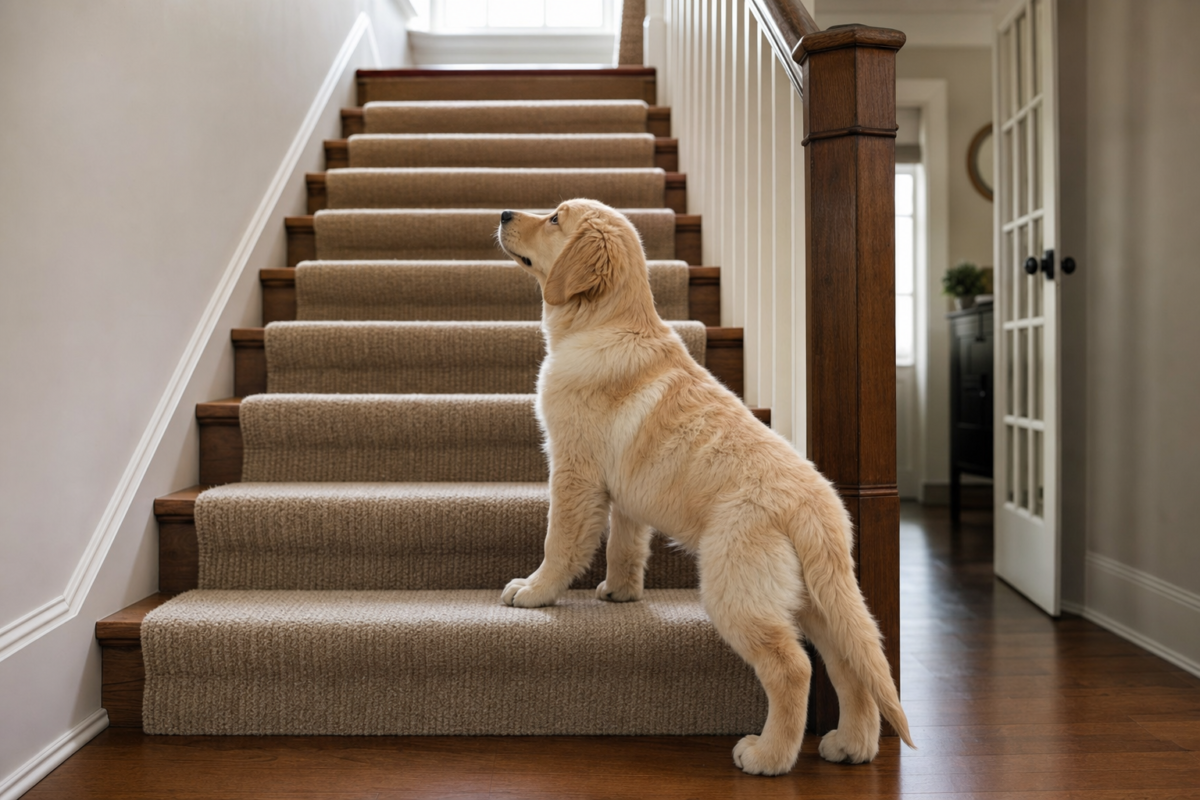
Stairs are not forbidden for large breed puppies, but repeated, unsupervised stair use in the first few months is worth limiting. A young big dog is carrying a fast growing frame on joints that are still forming, and stairs combine impact, twisting and awkward footing in one place. Most Dog Parents do best by carrying very young puppies, teaching slow and controlled stair use from around four months, and keeping the staircase off the free play list until the growth plates close. A few flights a day on a surface with grip is a very different thing from a puppy racing up and down all afternoon.
Almost every large breed puppy meets a staircase in the first week home, usually at speed and usually while you are carrying something. It is one of the most common worries Dog Parents raise, and the answer is more reassuring than the internet suggests. Stairs are a normal part of a dog’s life. The goal is not to ban them, but to control how often, how fast and on what surface your puppy uses them while the frame is still under construction.
Are stairs bad for large breed puppies?
Stairs are not automatically bad for a large breed puppy, but frequent, fast and uncontrolled stair use during the first several months asks a lot of a body that is still growing. Some research has linked regular stair climbing in very young puppies with a higher chance of hip problems later, while other everyday activity on soft ground has been linked with better outcomes. The picture is not settled, so the sensible approach is moderation rather than fear. Carry puppies who are small enough to lift, keep early stair trips slow and supervised, and save unlimited access for a dog whose growth is finished.
What matters most is repetition and speed. A calm walk down carpeted steps twice a day sits at one end of the scale. A twelve week old giant breed puppy bolting down a flight of polished wood ten times an afternoon sits at the other, and only one of those is worth worrying about.
What is happening inside a growing puppy
Big dogs grow for a long time. A large breed usually keeps developing for 18 to 24 months, and a giant breed can take 24 to 30 months to finish. Through most of that stretch the growth plates at the ends of the long bones are still soft areas of cartilage rather than solid bone. They are where new length is added, and they stay open far longer in a big dog than in a small one.
While those plates are open, the frame handles steady, moderate movement well. What it handles less well is repeated hard impact, sharp twisting and heavy loading, which is exactly the combination a staircase produces. Going down is the harder direction, because the front legs absorb the landing while the body is angled forward. Add a slippery surface and a puppy who has not yet learned where its back feet are, and you have the ingredients for an awkward slip.
None of this means a staircase is dangerous. It means it deserves a little management for a year or so, in the same way you would not take a growing puppy on a ten mile run.
Stairs by age, a simple guide
Use this as a friendly framework rather than a rulebook, and adjust to your own dog, your own staircase and your veterinarian’s advice.
| Age | Approach to stairs | Why |
|---|---|---|
| 8 to 12 weeks | Carry your puppy while you still can | Coordination is minimal and the puppy is light enough to lift safely |
| 3 to 4 months | Introduce a few slow, guided steps on a surface with grip | Builds confidence and technique before size makes carrying impractical |
| 4 to 6 months | Short, supervised trips only. Gate the stairs the rest of the time | Growth is quick and coordination lags behind the legs |
| 6 to 12 months | Normal daily use at a walk. No racing, no games on the steps | The frame is stronger but plates are still open |
| 12 to 18 months | Free use for most large breeds, still no charging | Growth is finishing and habits are set |
| 18 months and beyond | Normal use for large breeds. Giant breeds may need a few more months | Growth plates in the biggest breeds close last |
The American Kennel Club’s Chief Veterinary Officer, Dr. Jerry Klein, DVM, has written extensively on the slower growth and development timeline of large and giant breeds. Read more from the AKC’s guidance on caring for large-breed dogs.
Slippery Treads
Polished wood, tile and laminate give a big puppy nothing to grip. Traction fixes more than restriction does.
Speed
Charging down at full pelt is the real risk, not the stairs themselves. Teach a walking pace early.
Repetition
Ten trips an afternoon adds up quickly. A gate turns an all day activity into a few planned ones.
Extra Weight
A heavy puppy loads every landing harder. A lean body condition lightens the whole staircase.
How to teach a big puppy to use stairs safely
Technique is a skill, and a puppy who learns it calmly at four months rarely becomes a dog who throws itself down the flight at four years.
- Start at the bottom. Practise the last two or three steps first so your puppy never faces a full flight while learning.
- Add traction. A carpet runner, stair treads with grip or a textured rug transforms a slippery staircase.
- Use a lead indoors. A light lead lets you set the pace and stops a rush before it starts.
- Reward slow. Treat the calm, four paw walk rather than the arrival at the top.
- Go down before up. Descending is harder, so practise it first while you are close enough to support.
- Gate both ends. A stair gate removes the decision entirely on days when the house is busy.
- Keep games off the steps. Never throw a toy up or down a staircase for a growing dog.
Weight matters more than steps
If you only change one thing, change the body condition rather than the staircase. Every extra pound on a growing dog travels through the same developing joints on every landing. A complete food formulated for large breed puppies, fed in measured portions, does more for those joints than any amount of stair management.
- Weigh meals rather than scooping them, and split the daily total into three meals while young.
- Count treats and chews inside the daily total rather than on top of it.
- Aim for steady, moderate growth instead of the biggest puppy on the street.
- Confirm portions with your veterinarian at each visit, since the right amount changes quickly.
How to check body condition in ten seconds
The scale tells you weight. Body condition tells you whether that weight suits your dog right now.
- Ribs. Run your hands along the sides. You should feel the ribs easily under a thin layer.
- Waist. Look down from above and you want a clear waist tucking in behind the ribs.
- Tuck. From the side, the belly should rise toward the back legs rather than hanging level.
Growth safe movement beyond the stairs
Stairs are one small part of a bigger picture. The same logic applies to everything a young big dog does with its body.
- Favour free play and exploring on grass over structured, repetitive exercise.
- Lift your puppy into the car, or use a ramp, rather than allowing a jump down onto hard ground.
- Keep long runs and hard sprints for later. Our guide on when a big puppy can start running covers the timing.
- Let your puppy rest fully between bursts of activity, because tired dogs move sloppily.
- Save repeated jumping, agility work and hard turns for a fully grown frame.
Supporting the joints that take the landing
Managing stairs, keeping meals measured and choosing soft ground all point at the same goal, which is asking less of joints that are still forming. Daily joint support is a natural companion habit through the growth years.
Alongside lean feeding and sensible movement, many big dog parents add a daily joint chew made for large and giant breeds. MoveGuard Growth is built for exactly this stage. It combines nine actives, including New Zealand Green Lipped Mussel, glucosamine, chondroitin, MSM and hyaluronic acid, to support healthy joint development across the roughly 8 to 30 month growth window. You dose by expected adult weight, so most large breeds sit at two chews a day and the biggest at three. It ships as 90 chews, is made in the USA in an NSF facility, and carries a 60 day guarantee.
Support Every Landing
Give your growing puppy daily joint support built for large and giant breeds. Explore MoveGuard Growth.
Signs the stairs are asking too much
Watch how your puppy moves rather than counting the flights. A confident dog goes up and down with an even rhythm, uses all four legs and shows no hesitation at the top.
Worth a conversation with your veterinarian: hopping or skipping a back leg, stiffness after rest, sitting down partway up, a sudden reluctance to use stairs the dog used happily last week, or any limp that lasts more than a day. None of these are reasons to panic, and all of them are easier to sort out early.
A stage by stage stair plan
Here is the whole approach in four simple stages.
8 weeks to 3 months. Carry your puppy up and down while lifting is still easy and safe for your own back. Fit a stair gate now rather than later, because a gate installed before the habit forms saves months of negotiation.
3 to 6 months. Introduce the staircase deliberately. Add traction, practise the bottom steps on a light lead, and keep every trip slow and supervised. Two or three planned journeys a day is plenty.
6 to 12 months. Normal daily use at a walking pace, with the gate still handy for busy days. This is the stage where speed creeps in, so keep rewarding the calm version.
12 months and beyond. Most large breeds can use stairs freely from around this point, while giant breeds benefit from a few more months of moderation. Keep the traction, keep the habits, and the staircase stops being something you think about.
Common stair mistakes to avoid
- Banning stairs completely, then allowing them at once. A dog who has never practised is the one who slips. Teach the skill gradually instead.
- Leaving the surface slippery. Traction is the cheapest and most effective fix available.
- Letting stairs become a game. Chasing children or toys up and down turns a routine into repeated impact.
- Carrying a puppy who is too heavy. Once lifting is a strain, it is safer for both of you to teach the stairs properly.
- Ignoring the weight. A heavy puppy on gentle stairs is under more load than a lean puppy on steep ones.
- Waiting for a problem before supporting joints. The growth window is the time for daily joint habits, not after signs appear.
The big puppy on the landing
There is a household reality to all this. Stairs are usually the busiest part of a home, and a large breed puppy wants to be exactly where the people are. Blocking the staircase can turn into an all day battle unless you give your puppy somewhere better to be.
The trick is to make the ground floor genuinely appealing. A settled bed near the family, a chew that lasts, and a routine your puppy can predict all reduce the pull of the stairs far more effectively than a gate alone. Big breeds are companionable and often anxious about being separated from their people, so the goal is company without the climbing. Get that right during the growth window and you end up with a calm adult who walks stairs sensibly out of habit rather than one who charges them out of excitement.
Frequently asked questions
At what age can a large breed puppy use stairs freely?
Most large breeds can use stairs freely from around 12 to 18 months, once growth is largely finished. Giant breeds often benefit from a few extra months of moderation because their growth plates close last. Your veterinarian can advise on your individual dog.
Is going down stairs harder than going up?
Yes. Descending loads the front legs as the body angles forward, which is more demanding than the pushing motion of climbing. That is why it is worth teaching the downward direction slowly and on a surface with grip.
Should I carry my large breed puppy up and down stairs?
Carrying is sensible for the first couple of months while your puppy is light and coordination is still developing. Once lifting becomes a strain for you, stop and teach controlled stair use instead, because a dropped puppy is a far bigger risk.
Do stairs cause hip problems in big dogs?
No single activity causes joint problems on its own. Genetics, growth rate and body condition all play a large part. Some research has associated frequent stair use in very young puppies with a higher chance of hip trouble, which is why moderation during the growth window is the practical approach.
What is the best surface for stairs with a big dog?
Anything with grip. Carpet runners, rubber backed stair treads or textured adhesive strips all give a big puppy something to push against, and traction prevents far more slips than restricting access ever will.
The bottom line
Stairs are a normal part of life with a big dog, and your puppy will use them for years. What deserves care is the first year or so, while the growth plates are open and coordination is still catching up with those legs. Carry the youngest puppies, add traction, teach a slow and controlled technique from around four months, gate the staircase when the house is busy, and keep your puppy lean. Do those things and the staircase becomes an ordinary part of the day rather than something to worry about.
Want the Simple Roadmap in One Place?
Grab our free Big Dog Growth Blueprint for the growth window checklist, feeding framework and joint safe exercise limits, all written for large and giant breeds.
This article is for general educational purposes only and is not veterinary advice. It is not intended to diagnose, treat, cure or prevent any disease. Always consult your veterinarian about your dog’s individual health, nutrition and supplement needs. These statements have not been evaluated by the Food and Drug Administration.
Support Big Breed Joints from Day One
Large and giant breeds carry more load through every growth stage. MoveGuard Growth supports developing joints in young big dogs (8 to 30 months); MoveGuard Adult keeps grown big dogs moving comfortably.
Leave a Reply