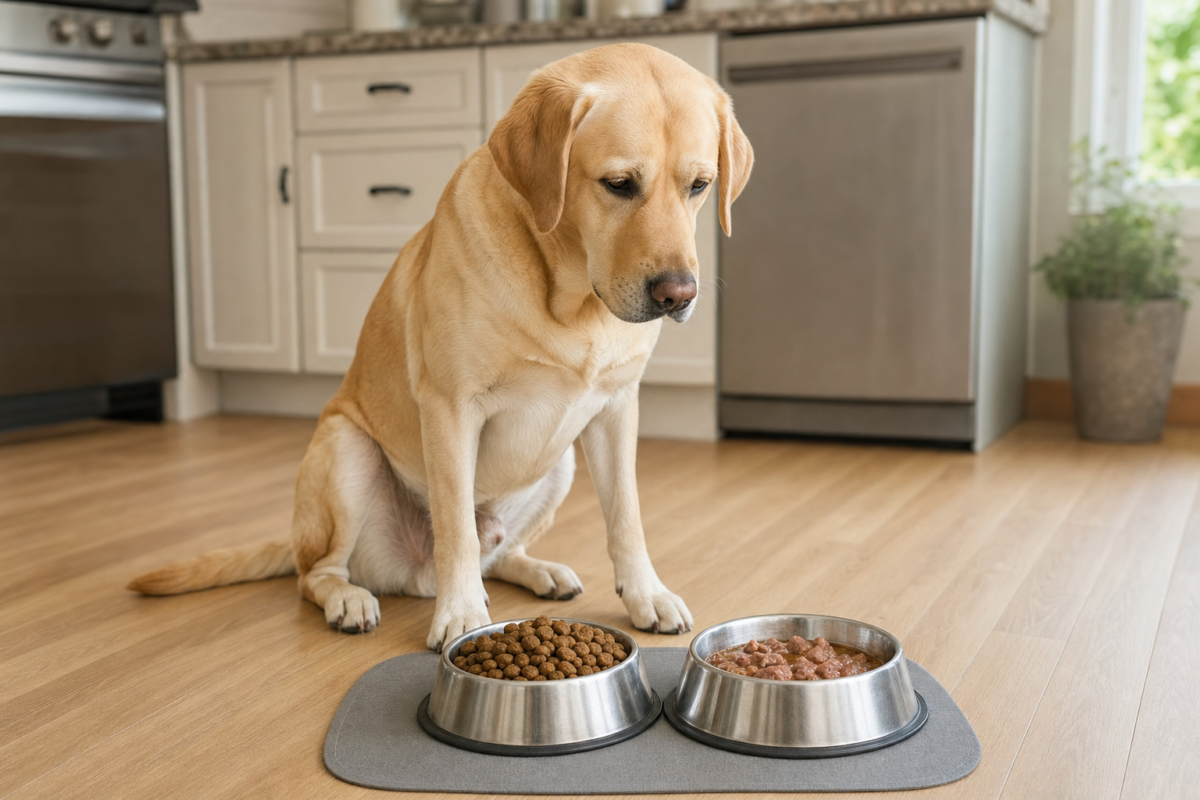
Neither wet nor dry food is automatically better for a large breed dog. What matters far more is that the food is complete and balanced for your dog’s life stage and size, and that you feed the right amount of it. For most big dogs, dry food is the practical everyday base because a large frame needs a lot of calories and kibble delivers them affordably and consistently. Wet food is an excellent topper or partial meal, especially for fussy eaters, seniors and dogs who need more water. Many Dog Parents land happily on a mix of both.
Standing in the pet food aisle with a big dog at the end of the lead can feel like a test you did not study for. The good news is that this decision is far less loaded than it looks. Big dogs thrive on a wide range of feeding setups, and the choice between wet and dry comes down mostly to budget, convenience and what your individual dog actually enjoys eating.
Is wet or dry food better for large breed dogs?
For most large breed dogs, dry food is the better everyday base and wet food is the better addition. A big dog eats a lot, so the cost and convenience of kibble matter in a way they simply do not for a small dog, and dry food is easy to measure precisely, which is the single most important habit in feeding a large breed. Wet food brings more moisture, stronger aroma and softer texture, which helps picky eaters, dogs with dental sensitivity and older dogs whose appetite has faded. Neither format is nutritionally superior on its own, because a complete and balanced dry food and a complete and balanced wet food meet the same nutritional standards.
So the real question is not wet or dry. It is whether the food suits your dog’s life stage and expected adult size, whether you can afford to feed it every day, and whether your dog will happily eat it.
What makes feeding a big dog different
A large or giant breed dog is not simply a bigger version of a small dog at the food bowl. Three things genuinely change with size.
First, the volume. An adult dog in the 80 to 100 pound range typically needs somewhere around 1,700 to 2,400 calories a day. That turns small differences in cost per calorie into large differences in the monthly bill, and small measuring errors into real weight gain over a season.
Second, the growth years. Big dogs spend far longer growing, and during that stretch the balance of calcium, phosphorus and total calories matters a great deal. That is why a complete food formulated for large breed puppies is the standard recommendation rather than a general purpose puppy food.
Third, the load. Every extra pound on a big dog travels through joints that already carry a lot, so keeping a large breed lean is one of the kindest things a Dog Parent can do.
Wet food and dry food, side by side
Here is the honest comparison, written for a dog who weighs a lot.
| Factor | Dry food | Wet food |
|---|---|---|
| Moisture content | Around 10 percent | Around 75 percent |
| Calorie density | High. Roughly 350 to 450 calories per cup | Low by volume. Roughly 450 to 500 calories per large can |
| Daily cost for an 80 pound dog | Usually a couple of dollars | Often several times more |
| Volume in the bowl | Modest and easy to serve | Large. Several cans a day for a big dog |
| Measuring accuracy | Excellent on a kitchen scale | Good, though part cans get messy |
| Aroma and palatability | Moderate | Strong. Tempting to fussy eaters |
| Texture | Crunchy, with some contact against teeth | Soft and easier for sore mouths |
| Storage | Simple. Keep sealed and dry | Opened cans need refrigeration |
| Travel and slow feeders | Works in puzzle bowls and food toys | Less convenient away from home |
The World Small Animal Veterinary Association’s Global Nutrition Committee publishes evidence-based guidance for evaluating dog food and feeding practices. Read more from the WSAVA Global Nutrition Guidelines.
When dry food is the better everyday choice
Dry food earns its place as the base of most big dog diets for practical reasons more than nutritional ones. It is calorie dense, so a dog needing 2,000 calories a day gets there in a reasonable amount of food rather than a bucket of it, and weighing kibble is the most reliable way to keep a large breed at a healthy weight. Feed the same measured amount every day and you can read the results on your dog rather than guessing. If the waist softens, trim the portion slightly. If the ribs sharpen, add a little.
When wet food earns its place
Wet food is not a luxury item without a purpose. There are situations where it is clearly the better tool.
- The fussy eater. A spoon of wet food stirred through kibble often restarts a stalled appetite.
- The senior who has lost interest. Appetite and sense of smell both soften with age, and the aroma of wet food frequently brings an older dog back to the bowl.
- Dental sensitivity. A dog with a sore mouth may find soft food far more comfortable. Your veterinarian can advise on what suits your dog.
- Dogs who drink very little. Extra moisture in food gently supports daily water intake.
- Hiding a supplement. A spoonful of wet food makes almost anything acceptable to a suspicious dog.
The catch is arithmetic. Feeding an 80 pound dog entirely on canned food usually means four or more large cans a day, so most Dog Parents of large breeds use wet food as part of the meal rather than all of it.
Free Feeding
Leaving the bowl down all day makes portions invisible. Big dogs gain quietly, and extra weight loads their joints.
Double Feeding
Adding wet food on top of a full kibble portion adds calories twice. Swap, do not stack.
Constant Switching
Jumping between foods weekly upsets digestion and hides what is working.
Toppers As Meals
Treats and table food can quietly become a quarter of the day’s calories.
How to feed a large breed dog well, whichever bowl you choose
The format matters less than the routine around it. These habits carry more weight than the wet versus dry decision ever will.
- Choose a complete and balanced food for the right life stage. Our guide on puppy food and adult food for large breeds lays out the timing.
- Measure by weight, not by eye. A kitchen scale removes the drift that a scoop introduces over months.
- Split the daily total into two meals. Growing puppies usually do better on three.
- Feed to body condition rather than to the bag. Feeding charts are a starting point. Your dog’s shape is the real instruction.
- Count everything. Training treats, chews and toppers all belong in the daily total.
- Transition slowly. Blend a new food into the old across about seven days.
How to check body condition in ten seconds
The scale tells you weight. Body condition tells you whether that weight is right for your dog. You can check it at home in seconds, and it works the same whether you feed wet, dry or both.
- Ribs. Run your hands along the sides. You should feel the ribs easily under a thin layer. If you have to press to find them, ease back on portions.
- Waist. Look down from above. You want a clear waist that tucks in behind the ribs.
- Tuck. From the side, the belly should rise toward the back legs rather than hanging level.
Check every couple of weeks and adjust gently, because small early corrections beat big late ones. Our guide to body condition in a growing big dog walks through it in more detail.
Mealtimes, movement and rest
How you feed a big dog matters alongside what you feed.
- Give a settled rest period around meals rather than feeding immediately before or after hard activity, which many veterinarians recommend for deep chested breeds.
- Slow a fast eater down with a puzzle bowl or a snuffle mat.
- Keep fresh water available at all times, especially if most of the diet is dry.
- Feed in a quiet spot so your dog is not guarding the bowl or bolting food.
- Speak with your veterinarian about any concerns over how your dog eats.
Food is the foundation, joints carry the frame
Everything above is really about one goal. A big dog who stays lean and grows at a steady pace is asking less of the joints that have to carry a heavy frame for a decade or more, and daily joint support is a natural companion habit for large and giant breeds.
Alongside measured meals and sensible exercise, many big dog parents add a daily joint chew made specifically for large and giant breeds. MoveGuard Growth is built for the growing years, combining nine actives including New Zealand Green Lipped Mussel, glucosamine, chondroitin, MSM and hyaluronic acid to support healthy joint development across the roughly 8 to 30 month growth window. You dose by expected adult weight, so most large breeds sit at two chews a day and the biggest dogs at three. For a dog already fully grown, MoveGuard Adult carries the same idea into adulthood to support comfortable movement. Both ship as 90 chews, are made in the USA in an NSF facility, and carry a 60 day guarantee.
Support The Frame You Are Feeding
Pair measured meals with daily joint support built for large and giant breeds. Explore MoveGuard Growth.
Signs your feeding plan is working
You do not need a spreadsheet to know things are on track. Look for ribs you can feel under a thin layer, a visible waist from above, steady energy through the day, a coat with some shine to it, and consistent, well formed stools. A dog who finishes meals with interest but without frantic hunger is usually being fed about right.
Signals worth a conversation with your veterinarian include a sudden change in appetite, weight that climbs or drops without a change in routine, or loose stools that persist beyond a food transition.
A simple feeding game plan, stage by stage
The wet versus dry balance naturally shifts as your dog moves through life.
8 weeks to 6 months. Base the diet on a complete large breed puppy food, split into three meals a day, and weigh portions from day one so the habit is already in place.
6 to 18 months. Appetite becomes unpredictable during adolescence, which is where a spoonful of wet food stirred through kibble earns its keep. Move to two meals a day and keep checking body condition. Our large breed puppy feeding chart by weight gives you a starting point to adjust from.
18 months to 7 years. Transition to an adult formula and settle into a routine. A measured dry base with an optional topper is the sustainable answer for most households.
7 years and beyond. Appetite, teeth and digestion all shift with age, so wet food often moves from optional to genuinely useful. Warming a portion slightly can make it more appealing, and the whole plan deserves a review at every senior check.
Common feeding mistakes to avoid
Most feeding problems in big dogs come from a handful of habits rather than from the food itself.
- Feeding by scoop and hope. A rounded scoop and a level one can differ by a third.
- Adding wet food without subtracting kibble. Swap calories, never simply add them.
- Chasing the fussy eater with variety. Offering something new every time a dog hesitates teaches the dog to hold out.
- Ignoring treats in the total. Training chews for a big dog can add hundreds of calories a day.
- Feeding an adult formula too early. Large breed puppies need controlled minerals and calories for longer than small breeds do.
- Waiting for a problem before supporting joints. Habits that support comfortable movement belong in the routine from the start.
The big dog at the bowl
There is a personality dimension here that rarely gets discussed. Big dogs tend to be enthusiastic, fast and persistent eaters, and they are tall enough to reach the counter, patient enough to wait you out and charming enough to talk you into extras. That combination is exactly how a lean dog becomes a heavy one over a quiet six months.
Building calm structure around food is worth as much as picking the right formula. Feed at set times rather than on demand, ask for a sit before the bowl goes down, and keep the counter clear and the bin secure. Be honest about how many extras are really going in, since the household total is almost always higher than any one person thinks.
Frequently asked questions
Can I mix wet and dry food for a large breed dog?
Yes, and many Dog Parents do. Mixing is perfectly safe as long as you count both parts in the daily calorie total. The simplest approach is to reduce the kibble portion by roughly the number of calories the wet food adds, so the total stays the same.
Is wet food better for a big dog with a sensitive stomach?
Not automatically. Digestive comfort depends far more on the specific formula, the ingredients and how gradually you introduce it than on whether the food is wet or dry. If your dog has ongoing digestive trouble, your veterinarian is the right person to guide the choice.
Does dry food clean the teeth of a big dog?
Kibble has some mechanical contact with the tooth surface, but it is not a substitute for dental care. Regular brushing and the dental plan your veterinarian recommends do the real work for a large breed mouth.
How much wet food replaces a cup of kibble?
Compare calories rather than volume. A cup of large breed kibble usually sits around 350 to 450 calories, while a large can of wet food often lands near 450 to 500 calories. Both numbers are printed on the packaging, so use those rather than a rule of thumb.
Is wet food too expensive for a giant breed?
Feeding a giant breed entirely on canned food is expensive for most households, because a very large dog may need four or more cans a day. Using wet food as a topper over a measured dry base gives you most of the appetite benefit at a fraction of the cost.
The bottom line
Wet food and dry food are both capable of feeding a large breed dog beautifully, and neither wins on nutrition alone. Dry food is the practical everyday base because it is calorie dense, easy to measure and affordable at the volumes a big frame requires. Wet food is the specialist that solves real problems around appetite, hydration, dental comfort and age. Choose a complete formula for the right life stage, weigh the portions, count the extras, watch your dog’s shape rather than the bag, and support those hard working joints from the start.
Want the Simple Roadmap in One Place?
Grab our free Big Dog Growth Blueprint for the growth window checklist, feeding framework and joint safe exercise limits, all written for large and giant breeds.
This article is for general educational purposes only and is not veterinary advice. It is not intended to diagnose, treat, cure or prevent any disease. Always consult your veterinarian about your dog’s individual health, nutrition and supplement needs. These statements have not been evaluated by the Food and Drug Administration.
Support Big Breed Joints from Day One
Large and giant breeds carry more load through every growth stage. MoveGuard Growth supports developing joints in young big dogs (8 to 30 months); MoveGuard Adult keeps grown big dogs moving comfortably.
Leave a Reply