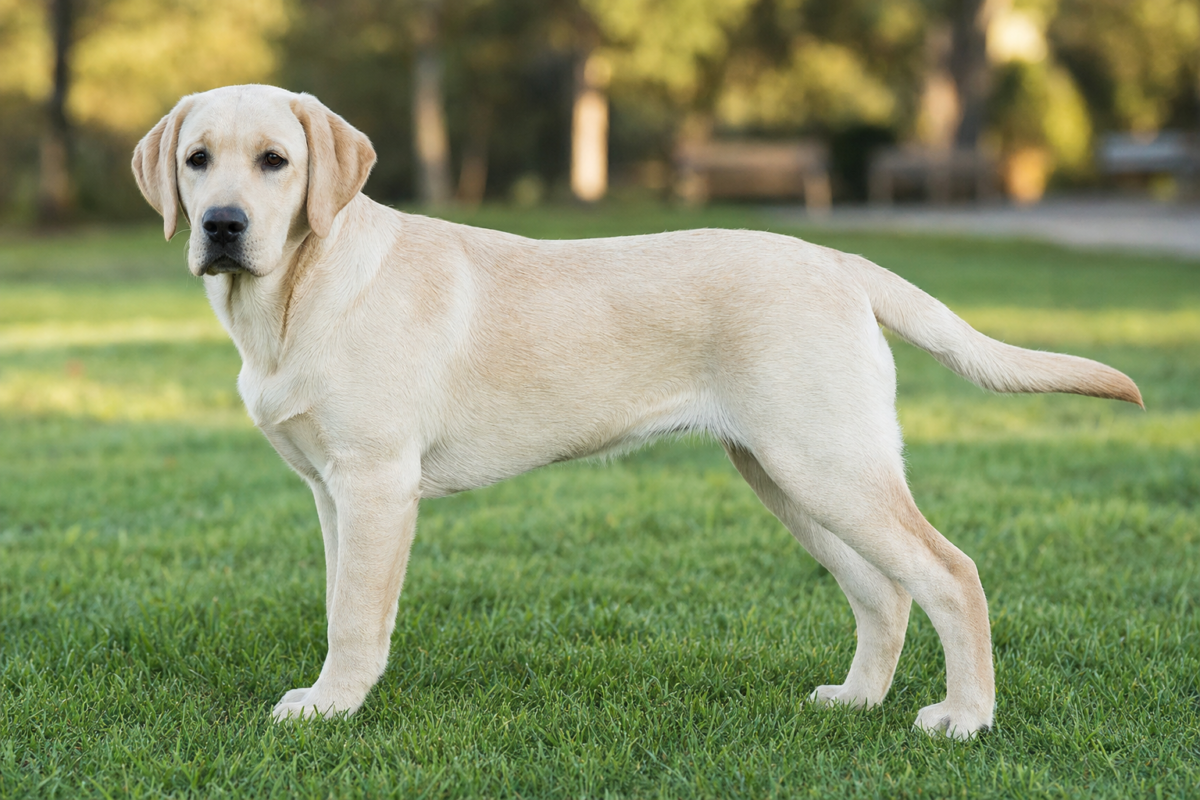
Your hands tell you more than the scale. A Labrador puppy is at a healthy weight when you can feel the ribs easily under a thin covering, see a clear waist behind the ribs from above, and see the belly rise toward the back legs from the side. For reference, most Labradors mature at 65 to 80 pounds for males and 55 to 70 pounds for females, and a growing puppy should look lean and athletic rather than round or bony.
Standing over a Labrador puppy with a bag of food in one hand and a nagging worry in the other is one of the most common moments in big dog parenting. Too thin? Too chunky? Just right? The reassuring news is that you already own the best tool for the job, and it is not a scale. This guide walks you through the hands on check, gives you the weight ranges to test it against, and shows you how to adjust food and activity as your Labrador grows.
How can I tell if my Labrador puppy is at a healthy weight?
You tell by touch and by outline, not by the number on the scale. Run both hands along your puppy sides. At a healthy weight the ribs feel like the back of your hand, easy to find under a thin covering, without pressing. From above you should see a waist that narrows behind the ribs. From the side the belly should tuck upward toward the back legs rather than hanging level with the chest. If the ribs are visible from across the room or the hip bones stand out sharply, your puppy is carrying too little. If you have to press to find ribs and the outline runs straight from chest to hip, your puppy is carrying too much.
Weight ranges are a useful cross check but never the verdict. Two Labrador puppies of the same age can differ by ten pounds and both be perfectly healthy, because bone size, sex, line and timing all vary. What matters is that condition stays lean and growth stays steady.
What makes a Labrador grow the way it does
The Labrador is a sturdy sporting breed built for long days of retrieving in cold water. That job shaped a dog with a broad chest, a dense double coat and a solid frame that carries more substance than a purely athletic build would suggest. It also shaped a famously enthusiastic appetite, because a working retriever burns real fuel.
That appetite is why so many Labrador parents ask this exact question. Research has identified a genetic variant carried by a meaningful share of Labradors that is associated with higher food motivation, which is a polite way of saying many Labradors act permanently hungry no matter how well fed they are. Add a dense coat that softens the outline and hides an extra couple of pounds, and you have a dog whose true condition is hard to judge by eye. That is why the hands on check matters more for this breed than for a lean, short coated one.
Labrador growth chart, month by month
Use this as a reference rather than a target. A puppy tracking a little above or below these numbers while feeling lean under your hands is doing just fine, and our Labrador growth chart by month breaks each stage down further.
| Age | Male weight | Female weight |
|---|---|---|
| 2 months | 15 to 20 lb | 13 to 17 lb |
| 3 months | 25 to 30 lb | 22 to 26 lb |
| 4 months | 32 to 40 lb | 30 to 35 lb |
| 6 months | 45 to 55 lb | 40 to 50 lb |
| 9 months | 58 to 68 lb | 50 to 60 lb |
| 12 months | 62 to 75 lb | 55 to 65 lb |
| 18 months | 65 to 80 lb | 55 to 70 lb |
| 2 years plus | 65 to 80 lb | 55 to 70 lb |
The American Kennel Club’s Chief Veterinary Officer, Dr. Jerry Klein, DVM, has written extensively on the slower growth and development timeline of large and giant breeds. Read more from the AKC’s guidance on caring for large-breed dogs.
A fully grown male Labrador usually stands 22.5 to 24.5 inches at the shoulder and a female 21.5 to 23.5 inches. Height arrives earlier than substance, so a tall, narrow twelve month old is following the normal pattern.
When do Labradors stop growing?
Most Labradors reach close to their adult height by around 12 months and finish filling out through the chest and shoulders between 18 and 24 months. The scale therefore keeps creeping up long after your puppy stops getting taller, which trips up a lot of Dog Parents. Weight gained after the frame is set is muscle if condition stays lean, and simply extra if it slips.
As a rough guide, dogs with an expected adult weight of 65 to 80 pounds keep developing for roughly 18 to 22 months. That window is your best opportunity to set the habits around food, movement and joint support that will carry your Labrador through an active adult life.
Why the growth window matters for weight
During this window your puppy is laying down the cartilage, bone and connective tissue that has to carry the adult dog for a decade or more. Growth plates, the soft zones at the ends of the long bones, stay open through much of the first year. Every extra pound during those months asks a little more of a frame that is still forming, which is why keeping a growing Labrador lean costs nothing and pays out for years.
Carrying Too Much
Extra weight loads developing joints. Lean is the goal at every stage of growth.
Growing Too Fast
A fast growth curve asks more of young joints. Even and unhurried beats big and early.
Treats And Table Food
Uncounted extras are the most common reason a lean puppy quietly becomes a heavy one.
Trusting The Coat
A dense coat softens the outline. Judge with your hands, not your eyes, every couple of weeks.
How much should a Labrador puppy eat?
The honest answer is the amount that holds a lean body condition, which changes month by month during the first year. Guides on the bag are a starting point, not an instruction. A few habits keep it simple:
- Choose a complete food formulated for large breed puppies, which balances calories, calcium and phosphorus for slower, steadier growth.
- Measure every meal with a proper cup or a kitchen scale. Eyeballing portions is how gradual weight gain begins.
- Split the daily amount into three meals while young, then two meals as an adult.
- Count treats inside the daily total, not on top of it. Training treats add up fast with a breed this motivated.
- Adjust by condition, not by the bag. If ribs get harder to feel, trim the portion. If they turn sharp, add a little back.
- Confirm the daily amount with your veterinarian at each checkup, since the correct portion moves quickly in the first year.
How to check body condition in ten seconds
This is the whole method, and you can run it while your puppy stands for a fuss.
- Ribs. Run both hands flat along the sides. The ribs should feel like the back of your hand, findable under a thin covering without pressing. If you have to dig, ease back on food. If they feel like your knuckles, add a little.
- Waist. Look down from above. You want a clear narrowing behind the ribs. A straight line from chest to hip means too much, and a dramatic hourglass means too little.
- Tuck. Look from the side. The belly should rise toward the back legs. A level or sagging line means extra weight is sitting where it is easiest to miss.
Run the check every couple of weeks and note what you find. Trend beats snapshot, because a puppy who has slowly become harder to rib check is telling you something a single reading never would.
Growth safe exercise for a Labrador puppy
Exercise supports healthy weight, but during the fast growth months the aim is regular, moderate movement rather than repeated hard impact. Labradors are willing to the point of foolishness and will overdo it if you let them.
- Favour free play, sniffing walks and gentle swimming, which suits the breed beautifully and is kind to young joints.
- Keep long runs, hard sprints and repeated jumping moderate while the growth plates are still open.
- Use retrieving in short, controlled sets rather than an hour of high speed turns and skids.
- Add training and scent games, which burn real mental energy without pounding on a developing frame.
Supporting the joints under all that growth
Weight and joints are the same conversation. Every pound your Labrador carries travels through the hips, elbows and shoulders with each stride, and the growing years are when that frame is being built rather than simply used. Keeping condition lean is the first half of supporting it. A daily habit that supports healthy joint development is the second.
Alongside measured feeding and sensible activity, many big dog parents add a daily joint support chew made for large and giant breeds. MoveGuard Growth is built for exactly this stage. It combines nine actives, including New Zealand Green Lipped Mussel, glucosamine, chondroitin, MSM and hyaluronic acid, to support the developing joints of young large breed dogs across the roughly 8 to 30 month growth window. You dose by expected adult weight, so most Labradors sit at two chews a day. It is made in the USA, ships 90 chews and carries a 60 day guarantee.
Support A Growing Frame
Give your growing Labrador daily joint support built for large and giant breeds. Explore MoveGuard Growth.
Signs your Labrador is growing on track
Look for a bright, springy puppy with a visible waist, ribs you can feel with light pressure, easy flowing movement, a glossy coat and a healthy appetite. A puppy who looks slightly lean at nine months and moves well is almost always in better shape than one who looks solid and impressive.
Some things are worth a call to your veterinarian rather than a wait and see. Weight that stalls or drops while appetite stays strong, ribs and hip bones that become sharply visible, a sudden jump in weight, limping, stiffness after rest, or reluctance to move all deserve a professional eye.
A simple weight game plan, stage by stage
You do not need a complicated program, just the right emphasis at the right time.
8 weeks to 4 months. Foundation stage. Choose a complete large breed puppy food, measure three calm meals a day, and start the ten second check now so it becomes automatic. Round and soft is normal here, but you should still feel ribs.
4 to 8 months. The leggy months. Many Labradors look narrow and unfinished here, and the urge to feed them out of it is strong. Keep portions measured, treats counted and activity moderate. This is a natural point to begin a daily joint support routine.
8 to 18 months. Height nears its peak while substance starts to arrive. Appetite often outpaces need now, especially after neutering, so recheck condition every two weeks and adjust portions gently.
18 months to 3 years. The adolescent becomes a solid adult. Growth is done, so calorie need usually falls even though the enthusiasm does not. Set the adult portion by condition and keep the check going monthly.
Common weight mistakes to avoid
Most weight trouble in Labradors comes from a handful of very forgivable habits.
- Feeding to the expression. A Labrador will always look hungry. Feed to the ribs instead.
- Uncounted extras. Chews, training treats, crusts and the odd bit of cheese quietly add up to a real share of the daily calories.
- Free feeding. Leaving a bowl down removes every bit of control you have over the total.
- Judging by the scale alone. A number without a condition check cannot tell you whether the weight is muscle or padding.
- Feeding a skinny looking adolescent more. Lean and leggy at nine months is usually correct. Filling out comes later.
- Waiting for a problem before supporting joints. The growth window is the ideal time to support developing joints, not after signs appear.
The Labrador temperament and the weight years
The Labrador is cheerful, biddable, sociable and deeply motivated by food, which is why the breed trains so beautifully and why the waistline needs watching. That same food drive makes them expert at negotiating a second dinner from a soft hearted household.
The practical answer is to make food work for you rather than against you. Take training treats out of the measured daily ration so the total never moves, and use part of a meal for training instead of extra food. Reach for puzzle feeders and scatter feeding, which turn a nine second meal into ten satisfying minutes. Get the whole household agreed on what the dog does and does not get, because one generous relative can undo a month of careful measuring. Manage the appetite thoughtfully and you get the best of the breed, which is a happy, willing, athletic companion who moves comfortably for years.
Frequently asked questions
How can I tell if my Labrador puppy is too skinny?
A Labrador puppy is too thin when the ribs are clearly visible from a distance rather than simply easy to feel, and the hip bones and spine stand out sharply. Lean and leggy during adolescence is normal, but visible bone is worth a veterinary check.
How much should a 6 month old Labrador weigh?
At 6 months a male Labrador often weighs around 45 to 55 pounds and a female around 40 to 50 pounds. There is still substance to build, so a narrow look at this age is normal.
Are Labradors prone to putting on weight?
Labradors are one of the most food motivated breeds, and a genetic variant associated with higher appetite is common in them. That makes measured portions, counted treats and a regular body condition check especially important.
Should the ribs show on a Labrador puppy?
On a puppy in good condition the ribs are easy to feel under a thin covering but not obviously visible from across the room. If you can count them by sight, condition is too lean. If you have to press to find them, it is too heavy.
What should I feed a Labrador puppy?
A complete food formulated for large breed puppies is the safest choice, because it balances calories and minerals for steady growth. Measure every meal, count treats within the daily total, and confirm portions with your veterinarian.
The bottom line
Your Labrador will most likely mature at 55 to 80 pounds, reach adult height by around 12 months and finish filling out between 18 and 24 months. Along the way, the answer to whether the weight is right lives in your hands rather than on a scale. Feel for ribs under a thin covering, look for a waist from above and a tuck from the side, measure meals, count the treats, and support the growth window with good daily habits.
Want the Simple Roadmap in One Place?
Grab our free Big Dog Growth Blueprint for the growth window checklist, feeding framework and joint safe exercise limits, all written for large and giant breeds.
This article is for general educational purposes only and is not veterinary advice. It is not intended to diagnose, treat, cure or prevent any disease. Always consult your veterinarian about your dog’s individual health, nutrition and supplement needs. These statements have not been evaluated by the Food and Drug Administration.
Support Big Breed Joints from Day One
Large and giant breeds carry more load through every growth stage. MoveGuard Growth supports developing joints in young big dogs (8 to 30 months); MoveGuard Adult keeps grown big dogs moving comfortably.
Leave a Reply