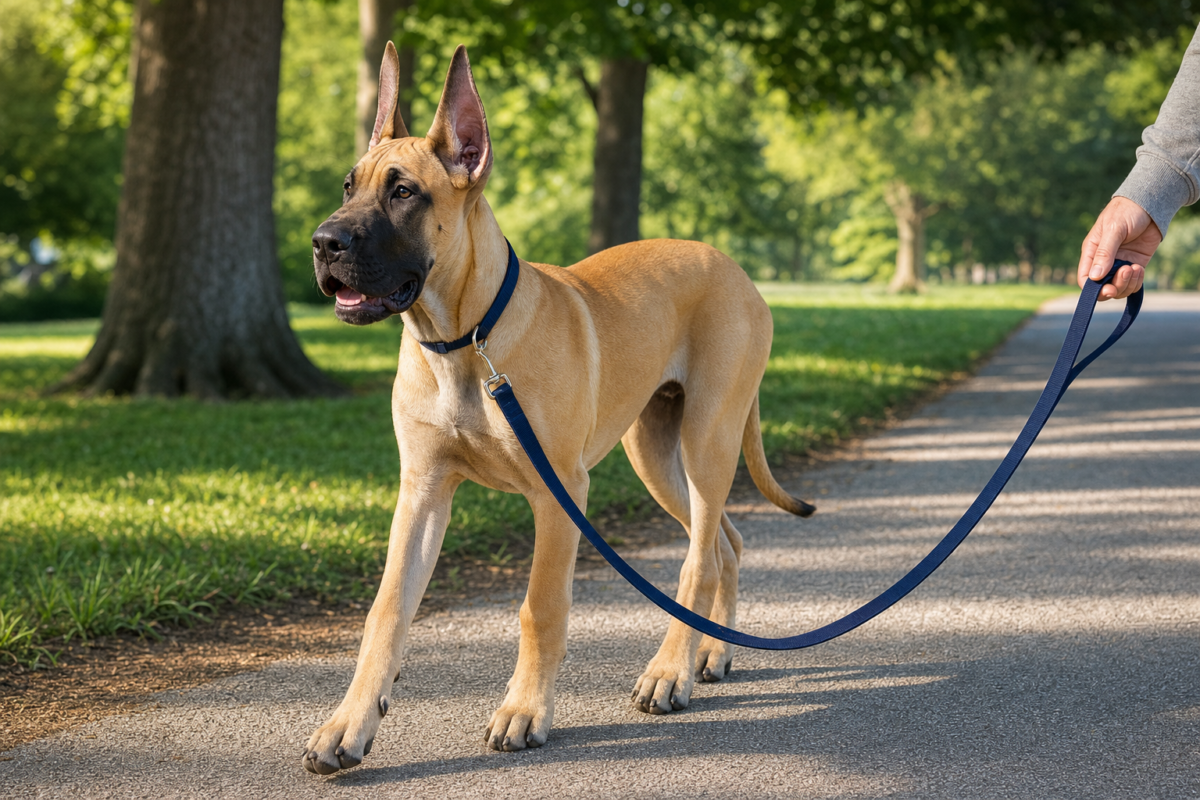
Start by standing still every time the lead goes tight and only moving forward again when the dog brings it loose, because a big dog learns within a few sessions that pulling never gets it where it wants to go. Use a front clip harness for safety during the learning phase, keep sessions short at five to ten minutes, and reward the position you want rather than correcting the position you do not want.
A 30 pound puppy that tugs on the lead is annoying but manageable, while a 90 pound adolescent that launches at full stride toward the park gate is a genuine safety hazard for the dog, the handler and everyone nearby. Teaching loose lead walking early is one of the most practical things a large breed Dog Parent can do, and the good news is that the method itself is straightforward even if the patience required feels anything but. This guide covers the why, the equipment, a step by step method that works with big dogs rather than against them, and the common mistakes that turn a solvable problem into a daily battle.
How do I teach a big dog to walk on a loose lead
You teach a big dog to walk on a loose lead by making pulling unproductive and rewarding the position you want. Every time the lead goes tight you stop moving completely, wait until the dog turns back toward you or steps sideways to bring the lead loose, then mark the moment with a word like “yes” and move forward again. The dog learns two things very quickly: pulling stops all forward progress, and staying near you keeps the walk going. Most large breed dogs begin to show real improvement within five to ten sessions when the handler is consistent, because the reward of moving forward is genuinely what the dog wants and you are putting that reward entirely under the control of the lead staying loose.
Why big dogs pull and why it matters
Dogs pull on the lead because it works. Every step a handler takes while the lead is tight teaches the dog that pulling is the fastest route to whatever it wants to reach, and a big dog has the physical power to drag most people along without much effort, which means the accidental reinforcement of pulling happens faster and more completely than it does with small breeds. A Labrador, a German Shepherd or a Great Dane that has spent months learning that pulling gets results has built a deeply practiced habit, and undoing that habit takes patient repetition rather than a single dramatic correction.
The safety stakes are higher with large breeds. A big dog that lunges on a tight lead can pull a handler off their feet on wet ground, dislocate a shoulder, knock over a child or an elderly person nearby, or bolt into traffic if the lead slips. For the dog, chronic pulling against a flat collar puts sustained pressure on the throat and neck, which is uncomfortable at best and can contribute to tracheal stress in breeds that are already prone to respiratory sensitivity. Getting the lead loose is not just about pleasant walks. It is about keeping everyone safe.
Equipment that helps
The right equipment does not replace training, but it makes the training phase safer and easier for both the handler and the dog.
Front clip harness
A front clip harness redirects the dog toward you when it pulls rather than allowing the dog to throw its full weight forward against your grip. This is the single most useful piece of equipment for teaching loose lead walking to a large breed dog, because it takes the physical contest out of the equation while you teach the behavioural lesson. Look for a harness with broad padded straps that sit well back from the armpits, because a poorly fitting front clip can restrict shoulder movement during the growth months when free natural movement matters most.
Standard lead
Use a flat lead of 1.5 to 2 metres in a comfortable width, ideally with a padded handle. Retractable leads are the enemy of loose lead training because they teach the dog that constant tension is normal and that pulling hard enough earns more line. Put the retractable away until the dog walks reliably on a loose standard lead, and even then use it only in appropriate open spaces.
Treat pouch
Keep small, soft, high value treats accessible on your hip so you can reward quickly without fumbling. For the early sessions the treat rate should be generous, because you are competing with every smell, squirrel and passing dog for your big puppy’s attention, and the faster you mark and reward the loose lead position the faster the habit builds.
The step by step method
This method works with dogs of any size, but it is especially effective with large breeds because it avoids any physical confrontation that a big dog can simply overpower.
Step 1: Start indoors or in a boring space
Begin in a low distraction environment like a hallway, a garden or a quiet car park. The dog needs to learn the basic rules before you ask it to apply them in the park where every blade of grass is more interesting than you are. Clip the lead on, hold it in one hand with your arm relaxed at your side, and have treats ready in the other hand or in a pouch.
Step 2: Move forward and watch the lead
Walk at a normal pace and watch the lead rather than the dog. The moment the lead goes tight, stop completely. Do not pull back, do not say anything, just plant your feet and stand still. With a very large dog or a strong adolescent in the early sessions, you may need to brace slightly, but the goal is to be a post rather than an opponent.
Step 3: Wait for the turn
Stand still and wait. The dog will eventually look back at you, turn toward you, or step sideways to create slack in the lead. The instant the lead goes loose, mark it with a clear “yes” and start walking forward again. This is the critical moment: the dog learns that its own decision to bring the lead loose is what makes the walk resume.
Step 4: Reward position, not just the turn
As the dog walks beside you with a loose lead, deliver a treat down beside your leg every few steps. You are building value in the position itself, not just rewarding the moment of turning back. Over time you can stretch the interval between treats, but in the first few sessions be generous so the dog starts actively choosing to stay near your side rather than surging ahead.
Step 5: Add distractions gradually
Once the dog walks reliably on a loose lead in a boring space, move to slightly more interesting environments one step at a time. A quiet street, then a busier pavement, then the edge of a park, then the park itself. Each new level of distraction will test the habit, and you should expect some regression when you raise the difficulty. That regression is normal and temporary as long as you stay consistent with the rules: pulling stops, loose lead moves.
Handler Injury
A large breed dog that lunges on a tight lead can pull a handler off balance, especially on wet or uneven surfaces. Use a front clip harness during training to reduce the force.
Collar Pressure
Chronic pulling against a flat collar puts sustained pressure on the throat and neck. Switch to a harness during the learning phase and save the collar for dogs that already walk on a loose lead.
Growth Plate Stress
Sudden lunges and abrupt stops load developing joints in growing large breed puppies. Keep early training sessions short and on soft ground when possible.
Frustration Escalation
A handler who jerks the lead or raises their voice when the dog pulls creates anxiety and confusion rather than learning. Stay calm and rely on the method, not the correction.
Common mistakes that slow progress
Most loose lead training failures come from a handful of very human mistakes rather than from a dog that is somehow unteachable, and knowing what to avoid is just as useful as knowing what to do.
- Inconsistency. The biggest mistake by far. If the dog sometimes gets to pull and reach the park gate and other times gets stopped, the dog learns that pulling is worth trying because it works often enough. You need to stop every single time the lead goes tight, every walk, every handler in the household, no exceptions during the learning phase.
- Sessions that are too long. A 45 minute walk is not a training session. Keep dedicated training sessions to five to ten minutes, especially with puppies, because concentration fades fast and a tired dog defaults to pulling out of frustration. Do the training first, then let the dog decompress with a sniff walk or free play.
- Punishing the pull. Jerking the lead, using a prong collar or shouting when the dog pulls introduces pain and stress into an exercise that should be built on clear communication and reward. Large breed puppies in particular are often sensitive and can become anxious walkers if the lead is associated with discomfort rather than partnership.
- Starting in the wrong environment. Taking an untrained puppy to the park and expecting it to walk on a loose lead is like taking a new driver to a motorway for their first lesson. Start boring, build up gradually, and earn the exciting locations through demonstrated skill in the quiet ones first.
- Forgetting to reward. Stopping when the dog pulls is half the method, but many handlers forget the other half: actively rewarding the loose lead position. The dog needs to know what you want, not just what you do not want.
When to start with a large breed puppy
Start loose lead training as soon as your puppy has had its vaccinations and is ready to walk outside, which is typically around 12 to 16 weeks. The earlier you start, the less pulling habit there is to undo, and a young large breed puppy is far easier to manage on the lead than a six month old that has already spent weeks practising the art of dragging its owner down the street.
During the growth window, which for most large and giant breeds lasts 18 to 30 months depending on adult size, keep training sessions short and avoid hard impact surfaces. A few minutes of focused loose lead work on grass or a soft path is far more productive than a long march on pavement, both for the skill itself and for the developing joints and growth plates that are still forming underneath.
Supporting growing joints through the training months
Loose lead training happens during the same growth window when a large breed puppy’s bones, cartilage and connective tissue are still developing, and every walk, every training session and every off lead play session adds up. Alongside sensible exercise and lean feeding, many Dog Parents add a daily joint support chew to cover the nutritional side of the equation. MoveGuard Growth combines nine actives including 250 mg New Zealand Green Lipped Mussel, 400 mg Glucosamine HCl, 300 mg Chondroitin, 250 mg MSM and 15 mg Hyaluronic Acid, dosed by expected adult weight. It ships as 90 chicken liver flavoured chews, is made in the USA in an NSF certified facility, and comes with a 60 day guarantee.
Built For The Growth Window
Support your big puppy’s developing joints from the inside while you teach the walk from the outside. Explore MoveGuard Growth.
Troubleshooting specific scenarios
The dog that lunges at other dogs
If your dog lunges toward other dogs on the lead, the issue is usually excitement rather than aggression, but the effect on a tight lead is the same. Create distance by crossing the road or turning away before the dog reaches the threshold where it lunges, and reward calm attention when other dogs are visible but far enough away that your dog can still think. Over time you close the distance gradually, but only as fast as the dog can handle without lunging.
The dog that pulls toward every lamp post
Sniffing is a legitimate and important part of a dog’s walk, so the goal is not to prevent sniffing but to teach the dog that it reaches the sniff spot by walking on a loose lead rather than by dragging you there. Stop when the lead goes tight, wait for the slack, then walk forward and let the dog sniff as a reward. The sniff itself becomes the reinforcement for loose lead behaviour.
The dog that is perfect at home but pulls on real walks
This is a distraction threshold problem, and it is the most common scenario with large breed puppies that have been trained only in the garden. Bridge the gap by finding environments that are one step above the garden in distraction level, a quiet residential street or an empty field, and practise there until the loose lead behaviour is solid before moving to busier locations.
Frequently asked questions
How long does it take to teach a big dog loose lead walking
Most large breed dogs show noticeable improvement within five to ten consistent sessions, but building a reliable habit in all environments typically takes four to eight weeks of daily short practice. Older dogs with deeply ingrained pulling habits may need longer, and consistency across every walk and every handler is the biggest factor in how fast the dog progresses.
Should I use a head collar or a front clip harness
A front clip harness is generally the better choice for large breeds because it redirects pulling force without putting pressure on the neck or muzzle. Head collars (halters) work well for some dogs but can cause neck strain during sudden lunges if the dog has not been carefully conditioned to wear one, and many large breed dogs resist them strongly in the early stages.
Can I train loose lead walking without treats
Yes, but treats make the process faster and more reliable because they give the dog an immediate, high value reason to stay in position during the learning phase. Once the habit is established you can phase treats out and rely on the walk itself as the reward, but skipping treats at the start usually means slower progress and more frustration for both handler and dog.
Is it too late to teach an adult dog that has always pulled
It is never too late. Adult dogs with years of pulling habit take longer to retrain because the habit is deeply practised, but the same method works. Stop when the lead is tight, move when it is loose, reward position. Expect a longer timeline, be completely consistent, and consider working with a qualified positive reinforcement trainer if progress stalls.
Why does my dog walk perfectly for one family member but pull with everyone else
Because the dog has learned that the rules are different with different handlers. Every person who walks the dog needs to follow the same protocol: stop when the lead is tight, move when it is loose, reward the position. If one handler allows pulling while another does not, the dog simply adjusts its behaviour to match each individual rather than learning a universal rule.
The bottom line
Teaching a big dog to walk on a loose lead is not complicated but it does demand patience and total consistency, because a large breed dog has the physical power to reward itself for pulling whenever a handler lets the rules slide. Use a front clip harness for safety, keep training sessions short and reward heavy, start in boring environments and build up gradually, and make sure every person who holds the lead follows the same rules. The investment pays off in years of safe, enjoyable walks with a dog that weighs more than many adults and walks like a partner rather than a freight train.
Want the simple roadmap in one place? Grab our free Big Dog Growth Guide for the growth window checklist, feeding framework and joint safe exercise limits, all written for large and giant breeds.
This article is for general educational purposes only and is not veterinary advice. It is not intended to diagnose, treat, cure or prevent any disease. Always consult your veterinarian about your individual dog’s health, nutrition and supplement needs. These statements have not been evaluated by the Food and Drug Administration.
Support Big Breed Joints from Day One
Large and giant breeds carry more load through every growth stage. MoveGuard Growth supports developing joints in young big dogs (8 to 30 months); MoveGuard Adult keeps grown big dogs moving comfortably.
Leave a Reply