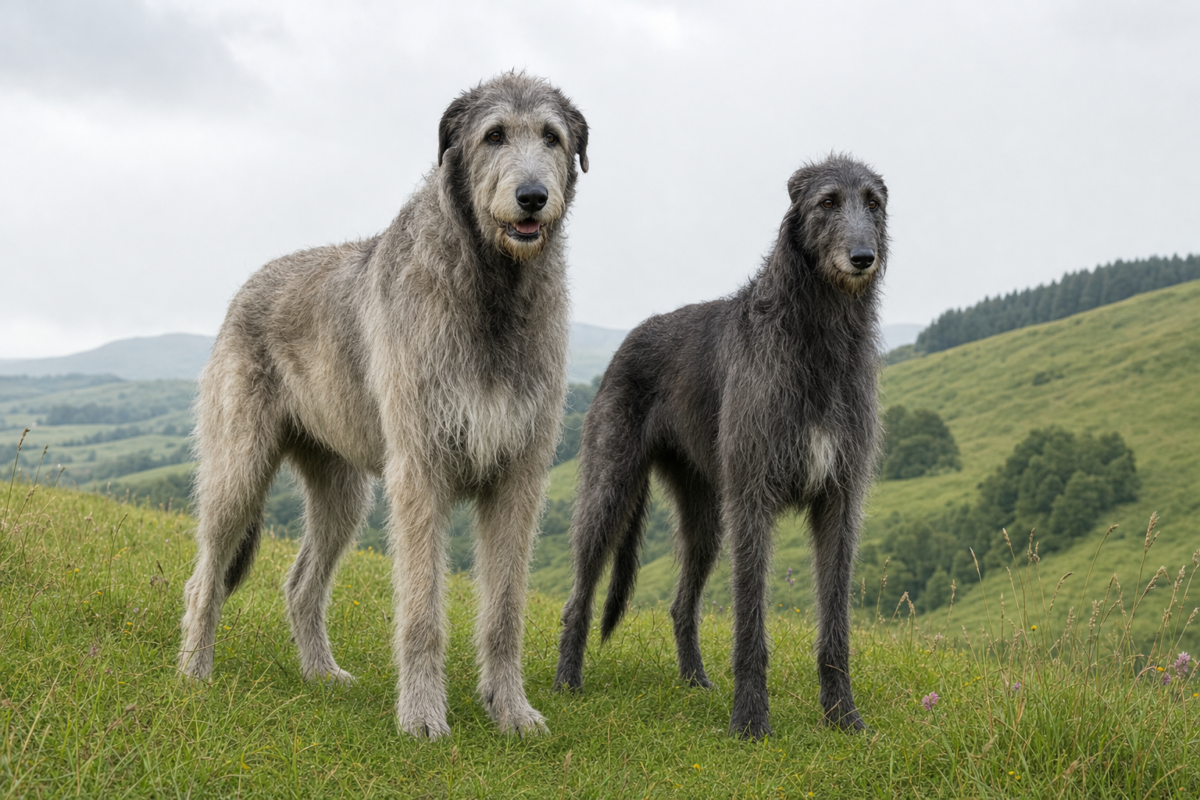
The Irish Wolfhound is the taller and heavier of the two, standing at least 32 inches and weighing 120 pounds or more, while the Scottish Deerhound is slightly smaller at 28 to 32 inches and 75 to 110 pounds. Both are gentle, dignified sighthounds with wiry coats and calm indoor temperaments, but the Wolfhound is more powerfully built and slightly more outgoing while the Deerhound is leaner, more independent and typically lives a couple of years longer.
If you are drawn to the tall, graceful sighthound look and trying to decide between an Irish Wolfhound and a Scottish Deerhound, you are comparing two of the most ancient and noble breeds in the dog world, and the differences between them are real but more subtle than most people expect. Both breeds stand among the tallest dogs alive, both carry rough wiry coats, both are gentle and quiet indoors, and both need thoughtful care during long growth windows that shape the adult frame for years to come. This guide walks you through the practical differences in size, temperament, exercise, health and daily life so you can decide which of these remarkable sighthounds fits your home.
What is the difference between an Irish Wolfhound and a Scottish Deerhound
The Irish Wolfhound is a giant breed that stands at least 32 inches tall and weighs 120 pounds or more, built with a powerful, muscular frame designed originally for hunting wolves and guarding Irish estates. The Scottish Deerhound is a large to giant breed that stands 28 to 32 inches tall and weighs 75 to 110 pounds, with a lighter and more refined build shaped by centuries of coursing deer across the Scottish Highlands. Both are sighthounds that hunt by speed and sight, both are gentle and affectionate at home, and both carry rough wiry coats that give them a similar silhouette from a distance.
The key differences show up in the details. The Wolfhound is broader through the chest and more heavily boned, carries more muscle and moves with a powerful rolling stride, while the Deerhound is narrower, more flexible through the back and moves with a lighter, springier gait built for sustained speed over rough terrain. In temperament the Wolfhound tends to be slightly more sociable and easygoing with strangers while the Deerhound is more reserved and independent, sometimes described as almost catlike in the way it chooses when to engage. The Deerhound also tends to live longer, typically 8 to 11 years compared to the Wolfhound’s 6 to 8 years, which is one of the most important practical differences for Dog Parents weighing the two breeds.
Size and build compared
| Trait | Irish Wolfhound | Scottish Deerhound |
|---|---|---|
| Male height | 32 inches minimum, often 34 to 35 | 30 to 32 inches |
| Female height | 30 inches minimum | 28 inches minimum |
| Male weight | 120 lb minimum, often 140 to 180 | 85 to 110 lb |
| Female weight | 105 lb minimum | 75 to 95 lb |
| Build | Powerful, broad, heavy boned | Lean, flexible, lighter boned |
| Coat | Rough, wiry, especially over eyes and jaw | Rough, wiry, 3 to 4 inches, softer feel |
| Growth window | 24 to 30 months or more | 20 to 24 months |
| Lifespan | 6 to 8 years | 8 to 11 years |
The size difference is significant in practice. An Irish Wolfhound at full maturity can weigh 60 to 80 pounds more than a Scottish Deerhound, which means more food, a bigger vehicle, a larger sleeping area and considerably more physical presence in every room of the house. Both breeds need space to stretch out and neither is suited to apartment living, but the Wolfhound’s sheer mass makes the practical logistics of daily life noticeably larger at every turn.
Temperament and personality
Both breeds are famously gentle, and newcomers to either breed are often surprised by how calm and quiet these tall sighthounds are inside the home compared to their imposing appearance. The similarities are genuine, but the personality differences between the two breeds become clear once you spend time with each of them.
The Irish Wolfhound tends to be warm and openly affectionate with family, welcoming of visitors, and happy to lean into anyone who offers attention. They are sometimes called gentle giants because that description really does fit, and most Wolfhounds carry a patient, easygoing steadiness that makes them surprisingly good with children and other dogs once past the clumsy puppy stage. They want to be near their people and will follow you from room to room with quiet devotion.
The Scottish Deerhound shares that gentle core but wraps it in a more independent and dignified temperament. A Deerhound is affectionate on its own terms, often choosing when to come close for contact rather than seeking it constantly. They tend to be quieter and more reserved with strangers, taking their time to warm up before deciding someone is worth their attention. Many Deerhound owners describe the breed as having a feline quality, loving but self contained, happy to be near you without needing to be on top of you, and perfectly content to observe the household from a favourite spot on the sofa rather than inserting themselves into every activity.
Exercise and activity needs
Both breeds are sighthounds that were built to run, and both need regular opportunities to stretch their legs at full speed in a safely enclosed space. Neither breed is suited to life without access to a large fenced area where they can gallop, because the drive to run is deeply wired into the sighthound temperament and no amount of leash walking fully satisfies it.
The Irish Wolfhound needs moderate daily exercise but is generally the calmer of the two in terms of sustained energy. Adult Wolfhounds are famously relaxed indoors and many Dog Parents are surprised by how much of the day a mature Wolfhound spends sleeping, which is a legacy of the breed’s guarding heritage where bursts of intense activity were followed by long periods of watchful rest.
The Scottish Deerhound tends to have slightly more endurance and a stronger coursing drive that persists further into adulthood. They were bred to pursue deer over miles of rough Highland terrain, and that stamina shows in an adult Deerhound that is ready to run longer and harder than most Wolfhounds of the same age. The Deerhound’s lighter build also means it is faster and more agile at a gallop, which makes safe off leash running space even more important because a Deerhound in full flight covers ground astonishingly quickly.
During the growth window both breeds need careful exercise management. Long runs on hard surfaces, repeated jumping and intense play put stress on developing growth plates, and that caution matters especially with these giant breeds because their growth windows are among the longest in the dog world.
Growing Too Fast
Giant sighthounds that gain weight too quickly put extra strain on long developing bones. Aim for a steady, even growth curve over the full 20 to 30 month window.
Hard Impact Exercise
Long runs on pavement and repeated jumping load open growth plates in breeds with exceptionally long legs. Favour soft ground and free play while young.
Excess Weight
Both breeds should always look lean and athletic. Extra weight is particularly hard on a sighthound frame that was built for speed and flexibility rather than bulk.
Bloat Risk
Deep chested giant breeds carry a higher risk of bloat. Feed two or three smaller meals rather than one large one, and avoid vigorous exercise immediately after eating.
Feeding and nutrition
Both breeds need a complete food formulated for large breed puppies during the growth months, which controls calcium, phosphorus and calorie density to support steady skeletal development without pushing growth too fast. The Irish Wolfhound eats significantly more at maturity simply because of its greater mass, so the difference in food cost between the two breeds is a practical consideration for Dog Parents thinking long term.
Feed to a lean body condition with both breeds rather than targeting a specific weight number, because sighthounds should always carry a visible waist and easily felt ribs. Both breeds do best on two to three meals a day throughout their lives rather than one large meal, partly because splitting meals reduces the risk of bloat in these deep chested breeds and partly because it keeps energy levels more even through the day.
How to check body condition on a tall sighthound
The lean, athletic build that both breeds should carry makes body condition scoring straightforward once you know what to look for.
- Ribs. You should feel the ribs easily under the coat with light pressure. Both breeds carry minimal fat covering even at ideal weight, so ribs that are hard to find suggest the dog is too heavy.
- Waist. Looking from above, both breeds should show a clear tuck behind the ribs. The Deerhound should look narrower and more streamlined while the Wolfhound should look broader but still clearly waisted.
- Hip bones. On a lean sighthound the hip bones may be slightly visible, which is normal for the type. What you do not want is prominent spine or hip bones with no muscle covering, which would indicate the dog is underweight.
Growth and development
Both breeds have exceptionally long growth windows compared to most dogs, which is one of the most important things to understand before bringing either breed home. The Irish Wolfhound, with an adult weight often exceeding 140 pounds, typically grows over a window of 24 to 30 months or more, reaching full height by around 18 to 22 months and then filling out in muscle and substance for another year beyond that. The Scottish Deerhound, lighter and slightly faster maturing, usually reaches adult height by 16 to 20 months and finishes filling out by around 20 to 24 months.
During these long growth windows the bones, cartilage and connective tissue are still forming, and the daily habits around food, exercise and joint support shape the frame the dog will carry for its entire life. Both breeds are prone to the growth related joint concerns that affect most giant breeds, which makes the growth window a particularly important time to get the basics right.
Supporting healthy joints in giant sighthounds
Both the Irish Wolfhound and the Scottish Deerhound carry their considerable height on long legs that transmit every stride, turn and gallop through the joints, and supporting that frame from the growth months onward is one of the most practical things a Dog Parent can do for either breed.
Alongside lean feeding and sensible exercise, many Dog Parents add a daily joint support chew during the growth window and continue it into adulthood. MoveGuard Growth is built for the developmental stage, combining nine actives including 250 mg New Zealand Green Lipped Mussel, 400 mg Glucosamine HCl, 300 mg Chondroitin, 250 mg MSM and 15 mg Hyaluronic Acid to support the developing joints of young large and giant breed dogs. You dose by expected adult weight, so most Deerhounds take two to three chews a day while Wolfhounds typically need three. Once the growth window closes, MoveGuard Adult continues that daily joint support through the active adult years and into the senior stage. Both formulas ship as 90 chicken liver flavoured chews, are made in the USA in an NSF certified facility, and come with a 60 day guarantee.
Built For Giant Breeds
Support your sighthound from the growth window through adulthood. Explore MoveGuard Growth or MoveGuard Adult.
Health considerations
Both breeds share some of the health concerns common to giant dogs, including bloat, heart conditions and bone cancer, but the frequency and severity differ between the two breeds in ways that matter for Dog Parents making a long term commitment.
The Irish Wolfhound has one of the shortest average lifespans of any breed, typically 6 to 8 years, with dilated cardiomyopathy, osteosarcoma and bloat among the most serious concerns. Responsible breeders screen for heart conditions and the breed community invests heavily in cardiac research, but the reality is that Wolfhound Dog Parents need to be prepared for a shorter journey with their dog than most other breeds offer.
The Scottish Deerhound lives somewhat longer at 8 to 11 years, which is better for a giant breed though still shorter than many large breeds. Osteosarcoma and bloat are concerns here as well, and the Deerhound carries a breed specific risk of factor VII deficiency, a blood clotting disorder that responsible breeders test for. Cardiac screening is important in Deerhounds too, though the incidence of dilated cardiomyopathy tends to be somewhat lower than in Wolfhounds.
For both breeds, choosing a breeder who does thorough health testing and keeping the dog at a lean body weight throughout life are two of the most impactful decisions a Dog Parent can make.
Living with each breed day to day
Both breeds are remarkably calm and well mannered indoors for their size, and first time sighthound owners are often struck by how little space a 120 pound dog seems to need when it is curled up on its bed. Both breeds prefer soft sleeping surfaces, both are sensitive to harsh correction, and both thrive on gentle, consistent handling rather than forceful training methods.
The Irish Wolfhound is slightly easier for most families because of its more openly social temperament. A Wolfhound typically gets along well with children, other dogs and visitors without much management, and its relaxed indoor manner makes it a surprisingly adaptable house dog despite its size. The main practical challenge is simply the scale of everything: food bills, veterinary costs, vehicle space, and the sheer physical reality of sharing a home with a dog that can rest its chin on the kitchen counter without standing on its hind legs.
The Scottish Deerhound asks for a bit more understanding of the sighthound temperament. A Deerhound may be slower to warm up to new people, more selective about which other dogs it enjoys, and more likely to choose its own sleeping spot and daily rhythm rather than following the household schedule. That independence is part of the breed’s appeal for many Dog Parents, but it does mean the Deerhound suits a quieter home where its gentle, self possessed nature is appreciated rather than a bustling family environment where constant sociability is expected.
Both breeds have a strong prey drive that must be respected. Neither should be trusted off leash in an unfenced area, because a sighthound that spots a running animal will give chase at speeds no human can match, and recall training, while worth doing, cannot reliably override thousands of years of coursing instinct.
Which breed is right for you
Choose the Irish Wolfhound if you want a giant, openly affectionate companion who greets everyone with warmth, are prepared for the higher food and care costs that come with the larger frame, and can accept the shorter average lifespan with the understanding that every year with a Wolfhound is a deeply bonded one.
Choose the Scottish Deerhound if you prefer a slightly smaller, more independent and longer lived sighthound, appreciate a dignified and reserved temperament that does not demand constant attention, and have the fenced space for a dog with genuine coursing stamina and a strong drive to run.
Neither breed is the right choice for apartment living, for homes without secure fencing, or for Dog Parents who want an eager to please, handler focused dog that trains like a retriever or a shepherd. Both breeds reward patience, gentleness and an appreciation for the sighthound temperament that values grace and dignity alongside deep loyalty.
Frequently asked questions
Which is bigger, an Irish Wolfhound or a Scottish Deerhound
The Irish Wolfhound is larger in both height and weight. Males stand at least 32 inches and weigh 120 pounds or more, while Scottish Deerhound males stand 30 to 32 inches and weigh 85 to 110 pounds. The Wolfhound is also broader and more heavily muscled through the chest and shoulders.
Do Irish Wolfhounds and Scottish Deerhounds get along with children
Both breeds are gentle and tolerant, but the Irish Wolfhound is generally the more naturally sociable of the two with children and visitors. The Deerhound is gentle but more reserved, and some individuals prefer a quieter environment. Supervision is always sensible with any giant breed around small children simply because of the size difference.
How long do Irish Wolfhounds and Scottish Deerhounds live
Irish Wolfhounds typically live 6 to 8 years, which is one of the shortest lifespans of any breed. Scottish Deerhounds live somewhat longer at 8 to 11 years. Keeping either breed lean and well exercised throughout life supports the best possible outcome.
Are Irish Wolfhounds and Scottish Deerhounds easy to train
Both breeds are intelligent but independent, and neither responds well to harsh or repetitive training methods. They learn best through gentle, positive reinforcement with short sessions, and Dog Parents should expect a sighthound that cooperates because it respects you rather than one that obeys eagerly for a treat.
Can Irish Wolfhounds or Scottish Deerhounds live in apartments
Neither breed is well suited to apartment living. Both need access to a large, securely fenced area where they can run at full speed, and their size alone makes tight indoor spaces uncomfortable. A home with a large garden or access to safe enclosed fields is the minimum for either breed.
The bottom line
The Irish Wolfhound and the Scottish Deerhound are two of the most majestic breeds in the world, sharing a gentle sighthound temperament and a tall, wiry coated silhouette that makes them easy to confuse from a distance. The Wolfhound is the larger, more powerful and more openly social of the two, while the Deerhound is lighter, faster, more independent and typically lives a few years longer. Both need space, gentle handling, lean feeding through a long growth window, and daily joint support to keep those tall frames moving comfortably for years. Whichever breed you choose, you are getting a companion of extraordinary grace and quiet devotion.
Want the simple roadmap in one place? Grab our free Big Dog Growth Guide for the growth window checklist, feeding framework and joint safe exercise limits, all written for large and giant breeds.
This article is for general educational purposes only and is not veterinary advice. It is not intended to diagnose, treat, cure or prevent any disease. Always consult your veterinarian about your individual dog’s health, nutrition and supplement needs. These statements have not been evaluated by the Food and Drug Administration.
Support Big Breed Joints from Day One
Large and giant breeds carry more load through every growth stage. MoveGuard Growth supports developing joints in young big dogs (8 to 30 months); MoveGuard Adult keeps grown big dogs moving comfortably.
Leave a Reply