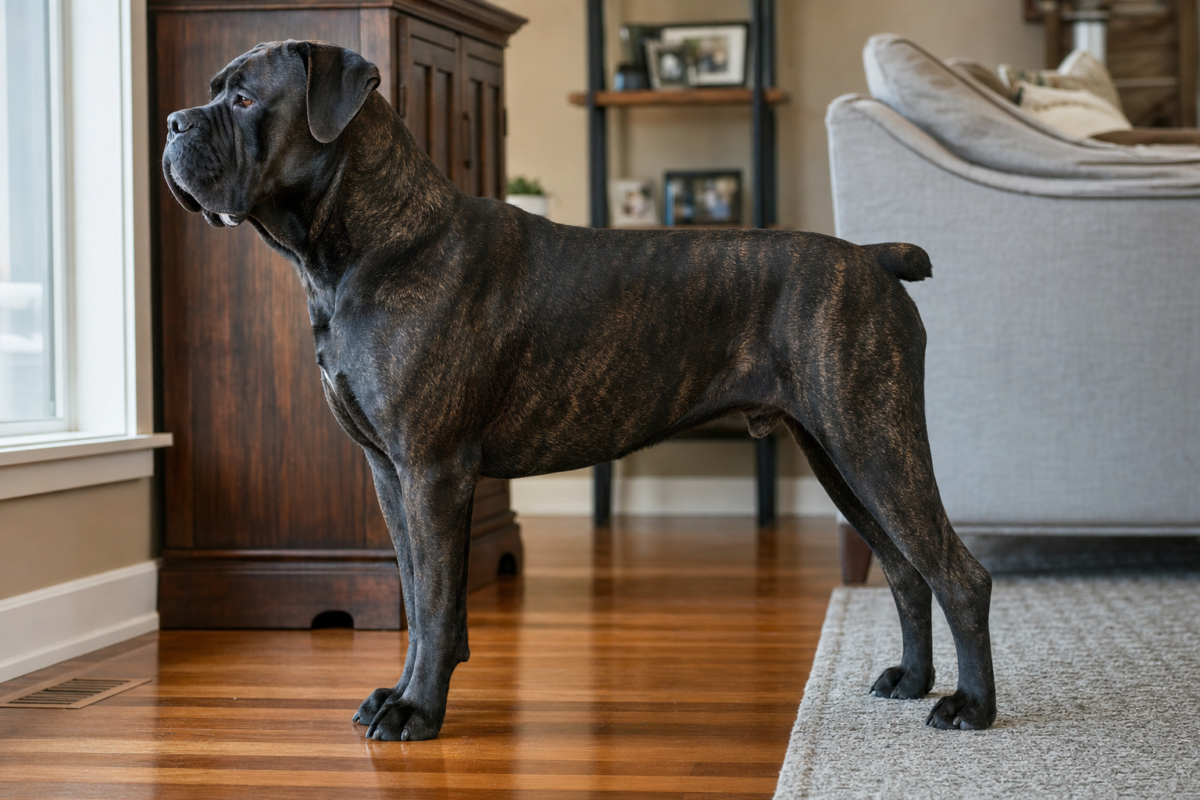
Floor traction matters for large breed dogs because a big dog carries far more weight through the same four paws, and on a smooth floor the feet slide outward instead of gripping. That means every rise, turn and stop asks the shoulders and hips to work harder to hold the body steady, and repeated slipping teaches many big dogs to move cautiously or avoid rooms altogether. Runners, rugs, short nails and trimmed paw fur are the fastest fixes, and they usually change how a dog moves within days.
If your big dog scrabbles on the kitchen tile, takes the hallway at a careful shuffle, or plants himself at the edge of the wood floor and waits for you to come to him, the floor is talking to you. Traction is one of the most overlooked parts of large breed care, partly because it costs so little to fix that it feels too simple to matter. It is not simple to your dog. This guide explains what actually happens under those paws, which surfaces cause the most trouble, and the cheapest changes that make the biggest difference.
Why does floor traction matter for large breed dogs?
Traction matters because grip determines how safely a heavy body can start, stop and turn. A large breed dog puts hundreds of pounds of force through four small contact patches every time it rises or changes direction, and when the surface offers no friction the legs slide apart rather than holding. The muscles around the shoulders and hips then have to stabilise a load they were never meant to catch, and a dog that has done this a few times starts moving defensively.
The effect compounds with age and size. A young athletic dog usually corrects a slip without thinking. An older or heavier dog often cannot, so the same hallway that was a minor nuisance at three becomes a genuine obstacle at eight.
What actually happens when a big dog walks on a slippery floor
Dogs grip in two ways. The paw pads provide friction, like the rubber on a shoe, and the claws dig in for purchase, like a set of studs. On grass, soil or carpet both systems work together and the result is excellent grip. On a hard smooth floor the system breaks down in an interesting way: the claws cannot penetrate the surface, so instead of biting in they hold the pads slightly off the floor, which reduces the contact patch exactly when the dog needs it most.
That is why long nails make a smooth floor dramatically worse, and why you often hear a big dog clicking across the room before you see him slip. Fur growing between the pads has the same effect, acting like a felt sole over the only grippy part of the foot.
The mechanics of size then multiply the problem. Heavier bodies have more momentum to arrest, longer legs create more leverage at the joints, and deep chested breeds sit higher off the ground, so a slide that a small dog absorbs easily turns into a genuine sprawl for a big one. Add the fact that most slips happen during the two highest load moments in a dog’s day, standing up and turning around, and you have a daily tax on the frame that nobody meant to impose.
Flooring types ranked by grip
Use this as a quick audit of your own home. Most houses have at least one surface in the bottom half of this table, and that is where the runners belong.
| Surface | Grip for a big dog | What helps most |
|---|---|---|
| Ceramic or porcelain tile | Very poor, worse when wet | Runners on every path the dog uses |
| Polished or lacquered hardwood | Very poor | Rugs with grip backing, short nails |
| Laminate and vinyl plank | Poor | Runners, paw fur trimmed |
| Sealed or polished concrete | Poor | Rubber matting at key spots |
| Matte or textured luxury vinyl | Fair | Mats at doorways and food bowls |
| Cork and rubber flooring | Very good | Little needed |
| Low pile carpet | Good | Keep it flat and secured |
| Grass and soil outdoors | Excellent | Watch for wet decking and pavers |
Cornell University’s College of Veterinary Medicine covers how growth rate, nutrition, and exercise interact with joint development in large breed dogs. Read more from Cornell’s canine hip dysplasia overview.
Wet is the variable that catches people out. A tile floor that is merely awkward when dry becomes genuinely treacherous with a few drips around the water bowl, and outdoor decking after rain is one of the most slippery surfaces a big dog meets all week.
Where in the house traction matters most
You do not need to carpet the whole house. Traction matters where a big dog changes speed or direction, and that is a surprisingly short list of places.
The high demand zones
- Beside the bed or crate. Rising from a lie down is the single highest load movement of the day, and it happens on the same square metre several times a day.
- The path to the door. This is where dogs accelerate, and a hard start on a smooth floor is where back legs slide outward.
- The turn at the end of a hallway. Corners are where momentum meets no grip.
- The food and water station. Standing braced to eat and drink, often on damp tile.
- The bottom and top of stairs. The transition between carpeted stairs and a hard landing is a common slip point.
- Around the sofa and your chair. Anywhere the dog gets up to greet somebody.
Walk your house and watch where your dog actually travels. Most large breeds use three or four fixed routes, and covering those routes solves the majority of the problem for the price of a couple of runners.
Long Nails
Nails that touch the floor on a smooth surface lift the grippy pads away from it. Short nails restore contact.
Paw Fur
Fur growing over the pads acts like a felt sole. A quick trim between the pads changes grip immediately.
Wet Patches
Water around bowls and doorways turns a manageable floor into a genuinely slippery one.
Sliding Rugs
A rug that moves is worse than no rug. Grip backing or rug tape is not optional with a heavy dog.
How to fix traction, cheapest first
Work down this list in order. Most homes are transformed by the first four, and none of them requires new flooring.
- Trim the nails. On a hard floor, nails should not make contact when the dog stands square. If you can hear clicking, they are long. Trim little and often, or ask your groomer or veterinary practice to keep them short.
- Trim the paw fur. Clip the fur growing between and over the pads flat with the pad surface. On coated breeds this alone can end most kitchen slipping.
- Lay runners on the main routes. Long, low pile runners with rubber backing on the bed to door path, the hallway and the kitchen route. Wash them and put them back.
- Anchor every rug. Rug tape, grip pads or a heavy backing. A big dog pushing off a loose rug creates its own hazard.
- Mat the eating and drinking spot. A rubber backed mat under the bowls handles both grip and splashes.
- Add a ramp or step for the car and sofa. Landing on a hard floor from height is the worst combination of load and low grip.
- Consider toe grips or paw wax. These help some dogs and irritate others. Try them after the basics, not instead of them.
- Look at boots for outdoor decking. Useful for a dog who has to cross wet timber daily, though many dogs need time to accept them.
The paw check that takes ten seconds
Do this once a month, or any time you notice new slipping.
- Nails. Stand your dog square on a hard floor and look at the front feet from the side. The nails should clear the surface. Listen for clicking as he walks away.
- Pad fur. Lift a paw and look at the underside. Fur should sit level with the pads, not bridge across them.
- Pads themselves. They should feel supple rather than glassy and hard. Very dry, smooth pads offer less friction, and cracks or soreness are worth showing your veterinarian.
- Dewclaws. Easy to miss and quick to overgrow, particularly on the back legs of giant breeds.
Movement and exercise on hard surfaces
Traction is not only an indoor question. How and where your dog moves outside changes how much the frame is asked to absorb.
- Favour grass, trails and soft ground over pavement for the bulk of daily walking.
- Keep fast games of fetch off tile, laminate and wet decking entirely. Hard turns on low grip are the highest risk moment a household dog experiences.
- With puppies, keep sliding and scrabbling to a minimum while growth plates are still open, and let young dogs play on grass rather than indoors.
- Let older dogs warm up slowly. A cold, stiff dog crossing a smooth floor first thing in the morning is at its least stable.
- Wipe wet paws at the door. Damp pads on a hard floor remove most of what little grip was there.
Daily habits that support comfortable movement
Fixing the floor sits alongside the other habits that keep a big dog moving well: a lean body condition, steady daily activity rather than weekend bursts, short nails, a supportive bed and regular checkups. Together they take load off the joints on every single step, which is why they matter more than any one purchase.
Many big dog parents also add a daily joint support chew made for larger breeds. MoveGuard Adult is built for adult dogs from 25 to 75 pounds and combines clinically studied eggshell membrane and New Zealand Green Lipped Mussel with glucosamine, chondroitin, MSM and hyaluronic acid to support cartilage, connective tissue and comfortable movement. The daily amount is printed on the label and tiered by weight, at one chew for dogs from 25 to 50 pounds and two for dogs from 50 to 75 pounds and up, and the label advises senior dogs of seven and older to use the higher amount for their weight and to allow six to eight weeks. It ships as 60 soft chews in chicken liver flavour, is made in the USA in an NSF facility, and is backed by a 60 day guarantee.
Steady Footing, Every Day
Pair better traction at home with daily joint support built for larger breeds. Explore MoveGuard Adult.
Signs your dog is struggling with the floor
Dogs rarely make a fuss about traction. They adapt, and the adaptation is the signal.
- He stands at the edge of a hard floor and waits rather than crossing it.
- He takes the room at a low, careful shuffle with the body held stiff.
- The back feet slide outward as he stands up, or he needs two attempts to rise.
- He chooses the long way round through carpeted rooms.
- He lies down only on rugs, never on the hard floor, even in warm weather.
- You hear scrabbling when he gets excited at the door.
- He has stopped greeting people at the door at all, which is often avoidance rather than indifference.
If your dog also limps, seems stiff for more than a few minutes after rest, or shows a change that has arrived over days rather than months, that is a conversation for your veterinarian rather than a flooring problem. Traction changes make a real difference, but they are not a substitute for having a new symptom looked at. There is more on reading these changes in our guide to the signs your big dog is slowing down with age.
A room by room traction plan
Here is a practical order of work for a typical home, and roughly what each step achieves.
The sleeping area. Start here, because it is where the highest load movement happens most often. A grippy surface beside the bed or crate, a supportive mattress rather than a thin pad, and enough clear space for a big dog to swing his back end round without hitting furniture.
The main route to the door. Lay a continuous runner rather than stepping stones of small mats, since a dog accelerating between islands of grip will slip in the gaps. Anchor the ends properly.
The kitchen. Mat under the bowls, a runner along the route your dog actually walks, and a habit of wiping spills quickly. Kitchens combine the two worst factors, hard tile and water.
Stairs and landings. Carpeted treads if you can, plus a rug at the top and bottom where dogs transition between surfaces. Many big dogs are fine on stairs and slip on the landing.
The living room. Grip where he gets up to greet people, and a ramp or step if he is allowed on the sofa. Consider whether a hard floor is really the right surface for the room where the dog spends the most hours.
Outdoor approaches. Decking, painted steps and smooth pavers get slippery when wet. Outdoor rated matting or grip tape on steps handles most of it.
Common traction mistakes
- Buying the bed before fixing the floor. An orthopaedic bed is excellent and does nothing for the ten steps between the bed and the door.
- Small mats instead of runners. Gaps are where dogs slip, because they are moving fastest between the patches of grip.
- Leaving rugs unanchored. A sliding rug adds a hazard rather than removing one.
- Forgetting the nails. The cheapest, fastest traction improvement available is also the one most often skipped.
- Assuming the dog is being difficult. A dog who will not cross the kitchen is usually telling you about grip, not making a point.
- Treating it as a senior problem only. Young heavy breeds slip too, and habits built early last a lifetime.
Why big dogs feel it more than small dogs
A terrier who skids across the kitchen looks comical and gets up unbothered. The same slide in a 130 pound dog is a different physical event, and the difference is not only weight. Big dogs have long limbs and a high centre of mass, which means a foot sliding outward creates a much larger angle at the hip and shoulder before anything stops it. They also have less margin: the muscle needed to catch and reverse that slide has to move a great deal more body.
Then there is the part people underestimate, which is confidence. Large breeds are often thoughtful, deliberate movers who learn quickly from one bad experience. A single hard sprawl on the kitchen tile can teach a dog to treat that room as somewhere to be careful for years afterwards, long after you have forgotten it happened. That is why some dogs stop coming to the door, or wait at the threshold for a lift that nobody offers.
The encouraging side of the same trait is how fast it reverses. Put a runner down the hallway and trim the nails, and many big dogs change how they move within a few days, walking at normal speed through rooms they had been treating with suspicion. It is one of the few improvements in big dog care that you can genuinely watch happen over a weekend, and it costs less than a bag of food.
Frequently asked questions
What is the best flooring for a large breed dog?
Cork, rubber and low pile carpet give the best grip, and matte or textured luxury vinyl is a reasonable hard floor compromise. Polished hardwood, laminate and ceramic tile give the least grip. If replacing the floor is not an option, runners on your dog’s main routes achieve most of the benefit.
Do long nails make a dog slip more?
Yes. On a smooth floor long nails cannot dig in, so they hold the grippy paw pads slightly off the surface and reduce contact. If you can hear clicking as your dog walks, the nails are long enough to be costing grip, and trimming them is the fastest traction fix available.
Should I trim the fur between the paw pads?
Yes, for coated breeds especially. Fur growing over the pads acts like a felt sole and slides on hard floors. Trim it level with the pad surface rather than cutting into the webbing, and repeat every few weeks. Ask your groomer to show you the first time if you are unsure.
Are dog socks or toe grips worth trying?
They help some dogs and irritate others, so treat them as a later step. Sort the nails, the paw fur and the runners first, since those work for every dog. If your dog still struggles on a floor you cannot change, socks with grip soles or toe grips are worth a trial.
Can better floor traction help an older dog move more comfortably?
Better grip means the muscles have to work less to stabilise the body on every rise and turn, and many Dog Parents notice their older dog moving more freely and using more of the house within days. It supports comfortable movement rather than addressing any medical condition, so discuss ongoing stiffness or limping with your veterinarian.
The bottom line
Traction is the cheapest mobility upgrade available to a big dog household. A heavy body needs grip to start, stop and turn safely, and smooth floors take that grip away at the exact moments it matters most. Trim the nails, trim the paw fur, run continuous runners along the routes your dog actually uses, anchor every rug, mat the food station, and keep the wet spots dry. Then support the whole picture with a lean body condition, steady daily movement and a daily joint routine. Your dog will tell you it worked by walking normally through a room he had been treating carefully.
Want the simple roadmap in one place? Grab our free Big Dog Mobility Guide for the daily comfort checklist, feeding framework and low impact movement limits, all written for large and giant breeds.
This article is for general educational purposes only and is not veterinary advice. It is not intended to diagnose, treat, cure or prevent any disease. Always consult your veterinarian about your dog’s individual health, nutrition and supplement needs. These statements have not been evaluated by the Food and Drug Administration.
Support Big Breed Joints from Day One
Large and giant breeds carry more load through every growth stage. MoveGuard Growth supports developing joints in young big dogs (8 to 30 months); MoveGuard Adult keeps grown big dogs moving comfortably.
Leave a Reply