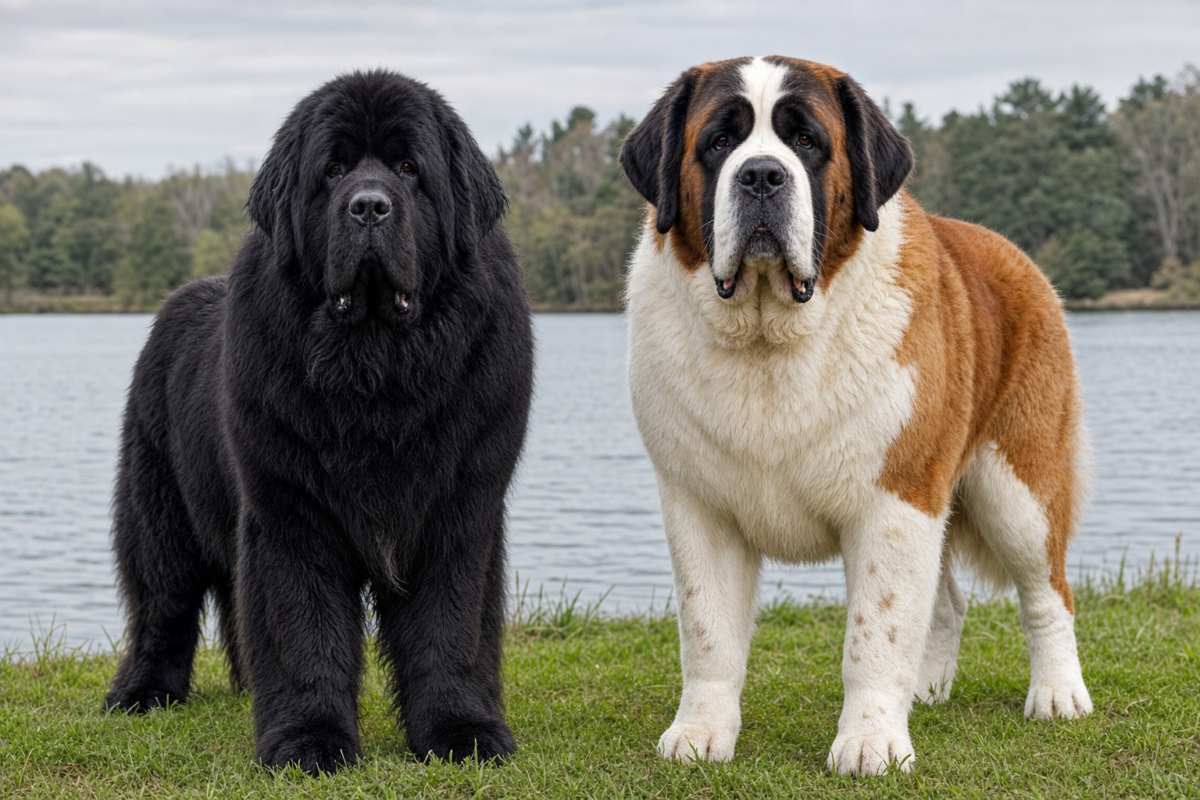
The Newfoundland and the Saint Bernard are both giant working breeds, and the clearest differences are size, coat and original job. The Saint Bernard is the heavier of the two, with males typically 140 to 180 pounds and 28 to 30 inches at the shoulder. A Newfoundland male usually reaches 130 to 150 pounds and around 28 inches. Newfoundlands were bred for water rescue and carry a dense, water repellent coat with webbed feet. Saint Bernards were bred for alpine rescue in Switzerland, come in a short or a long coat, and drool considerably more. Both are gentle, patient family dogs that finish growing at roughly 24 to 30 months.
If you are trying to choose between a Newfoundland and a Saint Bernard, you are comparing two of the most affectionate giants in the dog world. Both were bred to save human lives, both are famous for patience with children, and both will take up a genuinely surprising amount of your sofa. The differences that matter in daily life are not obvious from a photograph, so this guide walks through size, coat care, temperament, energy, drool, cost and the growth years, so you can picture what each breed actually feels like to live with.
What is the difference between a Newfoundland and a Saint Bernard?
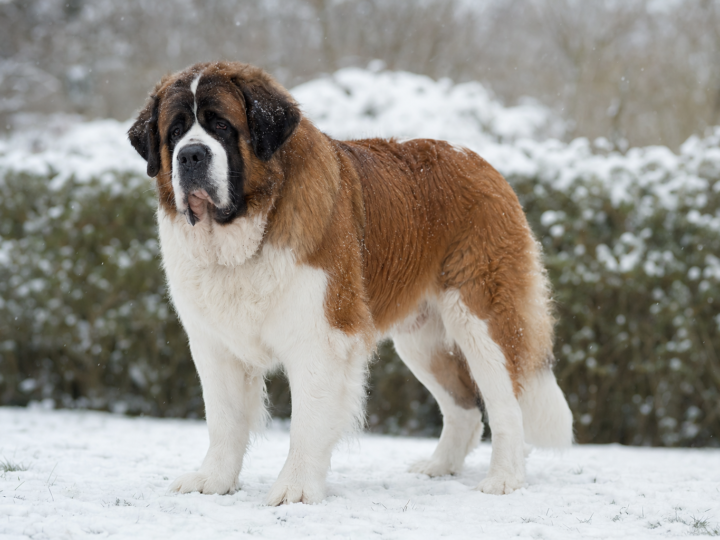
The main difference between a Newfoundland and a Saint Bernard is that the Newfoundland is a water dog and the Saint Bernard is a mountain dog, and their bodies and coats reflect those two jobs. The Newfoundland has a dense, oily, water repellent double coat, webbed feet and a powerful swimming stroke, and it is usually black, brown, grey or the white and black Landseer pattern. The Saint Bernard is broader and heavier through the head and chest, comes in red and white or brindle and white, and is found in both a smooth coat and a rough coat. Saint Bernards carry looser lips and deeper jowls, which is why they are the messier drinker of the two.
In temperament the two breeds are closer than they are different. Both are calm, devoted and remarkably tolerant, and neither is a high energy dog once past adolescence. If you want a breed that swims, choose the Newfoundland. If you want the largest possible dog with a famously soft nature and you can live with drool, the Saint Bernard is hard to beat.
Newfoundland vs Saint Bernard at a glance
Use this table as a practical starting point rather than a rulebook. Individual dogs vary a great deal, and a lightly built Saint Bernard can easily weigh less than a heavy Newfoundland.
| Trait | Newfoundland | Saint Bernard |
|---|---|---|
| Male weight | 130 to 150 lb | 140 to 180 lb |
| Female weight | 100 to 120 lb | 120 to 140 lb |
| Male height | 27 to 29 in | 28 to 30 in |
| Origin | Newfoundland, Canada | Swiss Alps |
| Original job | Water rescue and hauling | Alpine rescue and hauling |
| Coat | Dense water repellent double coat | Smooth or rough double coat |
| Colours | Black, brown, grey, Landseer | Red and white, brindle and white |
| Drool | Moderate | Heavy |
| Energy level | Low to moderate, loves water | Low to moderate |
| Grooming | High, heavy seasonal shedding | Moderate to high |
| Typical lifespan | 9 to 10 years | 8 to 10 years |
| Done growing | About 24 to 30 months | About 24 to 30 months |
The American Kennel Club’s Chief Veterinary Officer, Dr. Jerry Klein, DVM, has written extensively on the slower growth and development timeline of large and giant breeds. Read more from the AKC’s guidance on caring for large-breed dogs.
Size and growth, month by month
Both breeds are true giants, and both take a long time to finish. Growth is fastest between four and nine months, then slows into a long filling out phase that carries on well past the first birthday. A giant breed puppy that looks lanky and unfinished at a year old is completely normal.
| Age | Newfoundland male | Saint Bernard male |
|---|---|---|
| 2 months | 20 to 25 lb | 22 to 30 lb |
| 3 months | 33 to 40 lb | 38 to 48 lb |
| 4 months | 45 to 55 lb | 50 to 65 lb |
| 6 months | 70 to 85 lb | 80 to 100 lb |
| 9 months | 90 to 110 lb | 100 to 125 lb |
| 12 months | 105 to 125 lb | 120 to 145 lb |
| 18 months | 120 to 140 lb | 135 to 165 lb |
| 2 years plus | 130 to 150 lb | 140 to 180 lb |
Females of both breeds usually run roughly 20 to 25 pounds lighter than the male figures above at every stage. The pattern to watch is not the number itself but the shape of the curve. A steady climb is what you want. A sudden jump, especially between four and eight months, usually means portions have crept up and are worth reviewing with your veterinarian.
When do Newfoundlands and Saint Bernards stop growing?
Both breeds reach most of their adult height between 18 and 24 months, then continue adding chest, shoulder and muscle until roughly 30 months. Saint Bernards, being the heavier breed, often take the longer end of that range. Neither breed is truly finished at a year, which surprises many first time giant breed parents who are used to seeing medium breeds mature by ten months.
Why the growth window matters more in giant breeds
A giant breed puppy multiplies its birth weight far more than a medium breed does, and it does that over a longer period. During that time the cartilage, bone and connective tissue that will carry 150 pounds for a decade is still forming. The growth plates at the ends of the long bones stay open through much of the first year and beyond, so heavy impact and extra body weight ask a great deal of a frame that is not yet finished. Feeding lean and keeping exercise moderate through this window is the single highest value habit for either breed.
Growing Too Fast
Pushing size early is the most common mistake in both breeds. A slower, even curve supports comfortable movement later.
Excess Weight
Every extra pound travels through young joints on a giant frame. Lean is kind at this age.
Heat Sensitivity
Both carry heavy double coats. Warm days need shade, water and shorter outings for either breed.
Slippery Floors
Hard flooring gives a heavy puppy nothing to grip. Runners and rugs make a real difference indoors.
Coat and grooming, the daily reality
This is where the two breeds genuinely diverge in day to day effort. The Newfoundland has an oily outer coat designed to shed water, over a thick woolly undercoat. It needs brushing several times a week all year and daily during the two heavy seasonal sheds, and mats form fast behind the ears, in the trousers and under the collar if you skip a week.
Saint Bernards come in two coat types. The smooth coated Saint is the easier of all four options here, needing a thorough weekly brush and more during shedding. The rough coated Saint sits close to the Newfoundland for effort, with feathering on the legs and tail that traps debris. Both breeds shed enough that a good vacuum stops being optional.
- Budget for a proper undercoat rake and a slicker brush rather than a single household brush.
- Dry the coat thoroughly after swimming or rain, especially at the base of the ears.
- Check and wipe facial folds and jowls on a Saint Bernard so the skin stays clean and dry.
- Trim the hair between the toes on both breeds to help them grip smooth floors.
Temperament and family life
Both breeds have a deserved reputation for sweetness. The Newfoundland is often described as having a soft, almost dreamy nature. It is deeply people focused, calm indoors, slow to take offence, and it wants to be in the room with you rather than off doing its own thing. The breed also has a real instinct toward water and will find any pond, puddle or paddling pool you own.
The Saint Bernard is similarly gentle, slightly more watchful, and often a touch more independent in how it thinks. Both breeds are sensitive to harsh handling and respond far better to patient, positive training. Neither is a guard dog in the working sense, though the sheer size of either is a deterrent all by itself.
The important point for both is early training while the dog is still liftable. A 40 pound puppy that pulls is charming. A 150 pound adult that pulls is a genuine problem, and it is far easier to teach loose lead walking at five months than at fifteen.
Exercise needs compared
Neither breed is a running partner, and that is a feature rather than a flaw for many families. Both are content with moderate daily activity and long naps in between. As adults, two sensible walks a day plus some play satisfies most dogs of either breed.
- Newfoundlands love to swim, and swimming is a wonderful low impact outlet for a heavy frame at any age.
- Saint Bernards enjoy steady walking and cool weather, and both breeds tire quickly in heat.
- Keep repeated jumping, long runs and hard sprints moderate while the frame is still developing.
- Use short, frequent outings rather than one long weekend hike for a growing puppy of either breed.
- Let both breeds rest fully between activity. Recovery is part of the plan, not a gap in it.
Feeding a giant breed puppy of either breed
Feeding is where Dog Parents have the most influence over how comfortably either breed moves at seven years old. The goal for both is steady, moderate growth rather than fast growth.
- Choose a complete food formulated for large breed puppies, which controls calories, calcium and phosphorus for a slower growth curve.
- Split the daily amount into three meals while young, then two as an adult. Both breeds are deep chested, so smaller, calmer meals are sensible.
- Avoid free feeding. A giant breed puppy with unlimited access to food will usually grow faster than is ideal.
- Confirm portions with your veterinarian at each visit, since the correct amount changes quickly during the first year.
How to check body condition in ten seconds
The scale tells you weight. Body condition tells you whether that weight is right for the dog in front of you, and it takes seconds to check under all that coat.
- Ribs. Run your hands along the sides. You should feel the ribs easily under a thin layer. If you have to press through the coat and then press again, ease back on portions.
- Waist. Look down from above. There should be a visible narrowing behind the ribs, even on a heavily coated dog.
- Tuck. From the side, the belly should rise toward the back legs rather than running level.
Check every couple of weeks through the growth years and adjust portions gently with your veterinarian guiding the changes.
Supporting joints in a giant frame
Both breeds carry a lot of weight on joints that take two and a half years to finish forming, so daily habits that support healthy joint development matter more here than in almost any other group of dogs. Lean feeding, sensible surfaces, moderate exercise and steady joint support all pull in the same direction.
Alongside those habits, many giant breed parents add a daily joint chew made specifically for large and giant breeds. MoveGuard Growth is built for the growing years. It combines nine actives, including New Zealand Green Lipped Mussel, glucosamine, chondroitin, MSM and hyaluronic acid, to support the developing joints of young large breed dogs across the roughly 8 to 30 month growth window. You dose by expected adult weight, so a Newfoundland or a Saint Bernard puppy sits at three chews a day. It ships as 90 chews in a chicken liver flavour, is made in the USA in an NSF facility, and is backed by a 60 day guarantee. Once your dog is fully mature, MoveGuard Adult carries the same idea into adulthood.
Support A Giant Frame
Give your growing Newfoundland or Saint Bernard daily joint support built for large and giant breeds. Explore MoveGuard Growth.
Which breed is right for your home?
Both breeds need space, both shed heavily, and both cost real money to feed and to insure. The deciding factors usually come down to four things.
Choose a Newfoundland if you have access to water and would enjoy a dog that swims, you want the softer and slightly more biddable of the two temperaments, and you are willing to commit to serious weekly grooming for the life of the dog.
Choose a Saint Bernard if you want the largest possible companion, you prefer a slightly more watchful presence in the house, and you can genuinely live with heavy drool on walls, trousers and visitors. The smooth coat also gives you a lower grooming option that the Newfoundland simply does not offer.
Reconsider both if you live somewhere consistently hot, you are away from home for long stretches, or a short lifespan would be especially hard on your household. These are eight to ten year breeds, and that is part of the decision.
A simple growth game plan, stage by stage
The plan below works for either breed. The emphasis shifts as the puppy develops.
8 weeks to 4 months. Foundation stage. Complete large breed puppy food in three calm meals, early socialisation while the puppy is still easy to carry, rugs down on slippery floors, and short bursts of free play on soft ground. Start handling the coat, feet and ears daily now so grooming is never a fight later.
4 to 8 months. The fastest growth of the whole timeline. Keep feeding lean even as the appetite grows, keep exercise moderate, and teach loose lead walking properly while you still outweigh the puppy. This is the natural point to begin a daily joint support routine that runs through the growth window.
8 to 18 months. Height nears its peak and adolescence arrives. Match portions to body condition rather than to the bag. Add structured activity gradually and favour soft surfaces and swimming over hard impact.
18 to 30 months. The frame fills out into a genuinely giant adult. Growth slows while chest and muscle continue to develop. Build activity up as your veterinarian advises, keep the body lean, and many parents carry the joint routine straight into adulthood.
Common mistakes with both breeds
- Feeding for size. A heavier giant puppy is not a healthier one. Extra weight loads a frame that is still forming.
- Skipping large breed puppy food. Standard puppy formulas are richer than a giant breed puppy needs. Confirm the right food with your veterinarian.
- Delaying training. Manners are easy to build at 40 pounds and hard to retrofit at 150.
- Underestimating grooming. A neglected double coat mats to the skin, which is uncomfortable and expensive to put right.
- Ignoring heat. Both breeds overheat far faster than their owners expect. Plan walks around the cool parts of the day.
- Waiting for a problem before supporting joints. The growth window is the time to support developing joints, not after signs appear.
Frequently asked questions
Which is bigger, a Newfoundland or a Saint Bernard?
The Saint Bernard is generally bigger. Males typically weigh 140 to 180 pounds and stand 28 to 30 inches, while Newfoundland males usually weigh 130 to 150 pounds and stand 27 to 29 inches. Individual dogs overlap, and a large Newfoundland can outweigh a lightly built Saint Bernard.
Which breed drools more?
The Saint Bernard drools considerably more. Its looser lips and deeper jowls hold water and saliva, which then lands on floors, walls and clothing. Newfoundlands drool too, but noticeably less, and the smooth coated Saint is the messiest drinker of the group.
Are Newfoundlands and Saint Bernards good with children?
Both breeds are famous for patience and gentleness with children, which is why the Newfoundland earned its nanny dog nickname. Size alone means supervision is still sensible around small children, since a happy giant can knock over a toddler without any intent at all.
At what age is a Newfoundland or Saint Bernard fully grown?
Both reach most of their adult height between 18 and 24 months, then keep adding chest and muscle until roughly 30 months. Saint Bernards, as the heavier breed, often take the longer end of that range.
Which breed is easier for a first time owner?
Neither is a beginner breed because of size, cost and grooming, but the smooth coated Saint Bernard asks the least grooming time, while the Newfoundland is often the more biddable of the two in training. Choose based on which demand your household can meet consistently.
The bottom line
The Newfoundland and the Saint Bernard are two versions of the same wonderful idea, a huge, gentle dog bred to help people in difficult places. The Saint Bernard is the larger and the messier, with a smooth coat option that saves real grooming time. The Newfoundland is the swimmer, with a coat that demands attention and a temperament many people find slightly softer. Whichever you choose, feed for lean and steady growth, keep exercise moderate while that giant frame finishes, support the joints through the growth window, and start training while you can still pick your puppy up.
Want the Simple Roadmap in One Place?
Grab our free Big Dog Growth Blueprint for the growth window checklist, feeding framework and joint safe exercise limits, all written for large and giant breeds.
This article is for general educational purposes only and is not veterinary advice. It is not intended to diagnose, treat, cure or prevent any disease. Always consult your veterinarian about your dog’s individual health, nutrition and supplement needs. These statements have not been evaluated by the Food and Drug Administration.
Support Big Breed Joints from Day One
Large and giant breeds carry more load through every growth stage. MoveGuard Growth supports developing joints in young big dogs (8 to 30 months); MoveGuard Adult keeps grown big dogs moving comfortably.
Leave a Reply