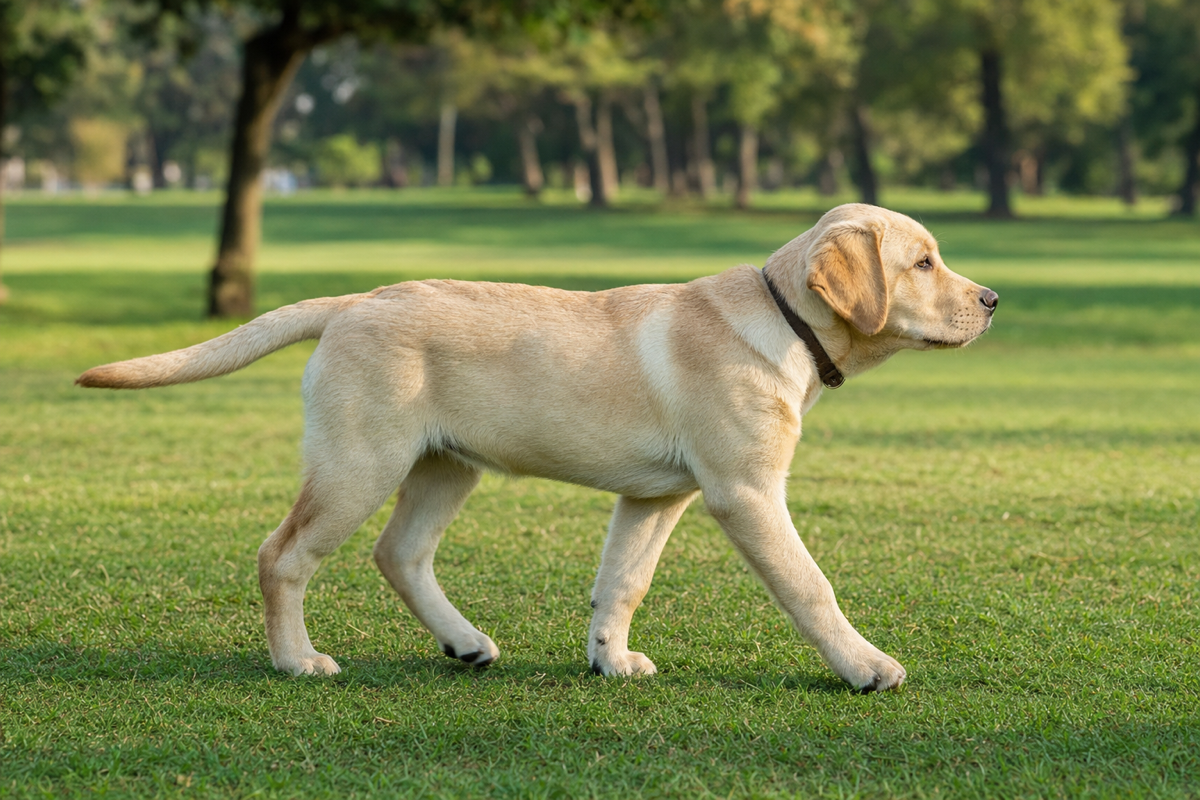
A useful starting point for a large breed puppy is about five minutes of structured exercise for every month of age, offered up to twice a day. That means roughly ten minutes twice daily at two months and about thirty minutes twice daily at six months, with free play and sniffing time on top. Most large breeds can build toward adult style exercise between 18 and 24 months, once growth plates have closed and your veterinarian gives the go ahead.
If you have a big puppy at home who seems to have two speeds, full tilt and fast asleep, you have probably wondered how much running around is actually good for those long legs. Large breed puppies carry a lot of frame on joints that are still forming, so the way you shape movement in the first two years quietly sets up how comfortably your dog moves for the rest of their life. This guide gives you clear age by age numbers, the activities that are ideal while your puppy is growing, and a simple stage by stage plan.
How much exercise is safe for a large breed puppy?
A widely used guideline is five minutes of structured exercise per month of age, up to twice a day. A three month old large breed puppy would get about fifteen minutes twice daily, a six month old about thirty minutes twice daily. Structured exercise means walks on lead, controlled trotting or a training session, rather than the loose play a puppy chooses for themselves.
Treat that as a friendly ceiling rather than a target you must hit. Gentle free play and short bursts of chase followed by long naps are natural and healthy. What large breed puppies do best without is repetitive, forced, high impact movement: long jogs beside a bike, hours of fetch on hard ground, or repeated jumping in and out of a vehicle.
What makes exercise different for a large breed puppy
Small dogs finish growing in under a year. Large and giant breeds take far longer, and they do it while carrying much more weight per stride. A Labrador at six months may already outweigh an adult terrier, yet the ends of those long bones are still growing plates of soft cartilage rather than finished bone. Every landing, every skid on a tiled floor and every leap off the sofa travels through that developing tissue.
Large breed puppies also look grown up long before they are grown up. A ten month old Rottweiler or Great Dane can look like a full adult from across the park, so people naturally start exercising them like one, when that dog may still have six to fourteen months of growth ahead. Matching activity to actual developmental age rather than apparent size is one of the highest value habits you can build.
Large breed puppy exercise chart, month by month
Use this chart as a practical guide rather than a rule book. Weights shown are typical for a puppy heading toward an adult weight of roughly 60 to 100 pounds. Giant breeds run heavier at every line and should sit at the conservative end of the exercise column.
| Age | Typical weight | Structured exercise | Focus |
|---|---|---|---|
| 2 months | 15 to 25 lb | 10 minutes, twice daily | Home and garden exploring |
| 3 months | 25 to 40 lb | 15 minutes, twice daily | Short sniffing walks |
| 4 months | 35 to 55 lb | 20 minutes, twice daily | Lead skills and new surfaces |
| 6 months | 50 to 75 lb | 30 minutes, twice daily | Steady walks on soft ground |
| 9 months | 60 to 90 lb | 40 minutes, twice daily | Longer walks and light hills |
| 12 months | 65 to 100 lb | 45 to 60 minutes, twice daily | Endurance built slowly |
| 18 months | 70 to 110 lb | Approaching adult levels | Gradual return of impact |
| 24 months plus | 70 to 115 lb | Full adult activity | Running, hiking, sport |
The American Kennel Club’s Chief Veterinary Officer, Dr. Jerry Klein, DVM, has written extensively on the slower growth and development timeline of large and giant breeds. Read more from the AKC’s guidance on caring for large-breed dogs.
Notice that the numbers climb steadily. Consistency protects joints far better than occasional big days.
When can a large breed puppy exercise like an adult?
Most large breeds are ready to build toward full adult activity between 18 and 24 months. Giant breeds often need until 24 to 30 months. The milestone that matters is growth plate closure, the point at which those soft areas at the ends of the long bones finish converting to solid bone. Once that happens, the frame can handle repeated impact in a way it could not a few months earlier.
As a rough guide by expected adult weight: 50 to 65 pounds usually finishes around 16 to 18 months, 65 to 80 pounds around 18 to 22 months, 80 to 100 pounds around 20 to 24 months, and 100 pounds and above anywhere from 22 to 30 months. Your veterinarian can confirm where your dog sits.
Why the growth window matters so much
The 8 to 30 month growth window is when your puppy is laying down the cartilage, bone and connective tissue that has to last a lifetime. It is a period of building, not testing. Lean feeding, sensible movement, good footing underfoot and daily joint support all pull in the same direction. You are not holding your puppy back. You are building a frame that can then do everything you want to do together, comfortably, for years.
Repetitive Impact
Long jogs and endless fetch repeat the same load on joints that are still forming.
Jumping And Landing
Leaping from cars and sofas sends sharp force through open growth plates.
Slippery Floors
Tile and laminate cause skids and splayed legs. Runners make a real difference.
Weekend Overload
Five quiet days then one huge hike is harder on a young frame than steady daily activity.
How feeding shapes what your puppy can safely do
Exercise and feeding are the same conversation. Every extra pound your puppy carries travels through those joints on every stride, so a lean body condition is effectively free joint protection.
- Choose a complete food formulated for large breed puppies, which balances calories, calcium and phosphorus for slower, steadier growth.
- Split the daily amount into three meals while young, then two meals as an adult.
- Count treats and training rewards as part of the daily total, since they add up quickly during the puppy months.
- Ask your veterinarian to confirm the right daily amount at each checkup, since the correct portion changes fast in the first year.
How to check body condition in ten seconds
The scale tells you weight, but body condition tells you whether that weight is right for your dog.
- Ribs. Run your hands along the sides. You should feel the ribs easily under a thin layer. If you have to press, ease back on food.
- Waist. Look down from above. You want a clear waist that tucks in behind the ribs.
- Tuck. From the side, the belly should rise toward the back legs rather than hanging level.
Check every couple of weeks through the growth years and adjust portions gently with your veterinarian’s guidance.
Growth safe exercise your puppy will genuinely love
The aim during the growth window is variety, low impact and plenty of choice for your puppy about pace. These activities tire a big puppy properly without pounding the frame.
- Sniffing walks. Let your puppy set the pace and follow their nose. Twenty minutes of scent work tires a young dog more than twenty minutes of jogging.
- Free play on grass. Off lead pottering on soft ground lets your puppy self regulate. They sprint, they stop, they flop. That natural rhythm is exactly right.
- Short training sessions. Five to ten minutes of positive training two or three times a day builds manners and burns real mental energy.
- Puzzle feeders and scatter feeding. Turning a meal into a hunt is a genuine workout for the brain with zero joint cost.
- Gentle swimming. Where it is safe and supervised, swimming builds muscle with the water carrying the weight.
- Proper rest. A puppy who is overtired looks hyperactive, which tempts parents to exercise more when less is what is needed.
Activities worth saving for after the growth window include long distance running, repeated jumping, agility at full height, hard sprinting on pavement and long hikes with steep descents. None are forbidden forever. They are simply better in a year or two.
Supporting the joints that all this movement travels through
Every walk and every enthusiastic charge across the garden passes through your puppy’s joints. Supporting healthy joint development while the frame is still being built sits naturally alongside lean feeding and sensible exercise rather than replacing either.
Many big dog parents add a daily joint support chew made specifically for large and giant breeds. MoveGuard Growth is built for exactly this stage of life. It combines nine actives, including New Zealand Green Lipped Mussel, glucosamine, chondroitin, MSM, krill oil and hyaluronic acid, to support the developing joints of young large breed dogs across the roughly 8 to 30 month growth window. You dose by expected adult weight, so a puppy heading for 50 to 80 pounds takes two chews a day and one heading for 80 to 100 pounds or more takes three. It is made in the USA, ninety chews to the jar, and is backed by a 60 day guarantee.
Support Every Stride
Give your growing puppy daily joint support built for large and giant breeds. Explore MoveGuard Growth.
Signs your exercise plan is working
You do not need a stopwatch to know you have the balance right. A well exercised large breed puppy settles calmly within twenty minutes of coming home, sleeps deeply, moves smoothly the next morning and holds a lean body condition.
The signs of too much are just as readable. Stiffness after rest, lagging behind on walks, lying down partway through a session, sudden reluctance to go out, or limping of any kind. If you notice limping or stiffness, pause the plan and speak with your veterinarian rather than walking through it.
A simple exercise game plan, stage by stage
You do not need a complicated programme. You need the right emphasis at the right time.
8 weeks to 4 months. Foundation stage. Keep movement short, frequent and gentle, and let socialisation do most of the tiring. Put runners down on slippery floors now, before the skidding starts.
4 to 8 months. Growth is quick and your puppy may look leggy and adolescent. Build walks gradually using the five minutes per month guide, favour grass over pavement, and begin lifting your puppy in and out of the car. This is a natural point to begin a daily joint support routine that carries through the whole growth window.
8 to 18 months. Height nears its peak while muscle starts to arrive, and energy can spike. Keep exercise steady and daily rather than saving it for the weekend. Add hills slowly, keep jumping minimal, and lean harder on training and scent work when your adolescent needs an outlet.
18 months to 3 years. With your veterinarian’s confirmation that growth has finished, reintroduce impact gradually across several weeks. Running, hiking and sport can now be built up properly, and many parents keep the joint support routine going into adulthood.
Common exercise mistakes to avoid
Most exercise related problems in big puppies come from a handful of avoidable habits.
- Exercising to size rather than to age. A big looking ten month old is still a puppy underneath. Go by date of birth, not shoulder height.
- Trying to run out the energy. Longer walks rarely calm an over aroused puppy. Mental work and better sleep usually do.
- Endless fetch on hard ground. The repeated sprint, skid and turn is one of the highest load activities a young dog can do.
- Letting the puppy jump out of the car. Lift or use a ramp until adulthood.
- Ignoring the floors at home. Hours of daily skidding on tile adds up quietly. Rugs along the main routes help a great deal.
- Waiting for a problem before supporting joints. The growth window is the ideal time to support developing joints, not after signs appear.
Energy, temperament and the growth years
Large breeds vary enormously in what they need. A working line Labrador or a German Shepherd carries real drive and will genuinely ask for more, while a Great Dane, a Newfoundland or a Bernese Mountain Dog is often content with far less and tires sooner. Both still need the same joint protection during growth. The difference is how you fill the rest of the day.
For the high drive breeds, mental work is the pressure valve. Scent games, obedience, trick training and puzzle feeders let a busy mind work hard while the body stays gentle. For the more laid back giants the job is often the opposite: encouraging enough gentle daily movement to build muscle and keep body condition lean. Whatever breed you have, a puppy who learns that walks mean sniffing and steady pace, that cars mean a ramp, and that settling calmly indoors is the default becomes an adult who is easy to live with.
Frequently asked questions
How long should I walk a large breed puppy?
A common guideline is five minutes of structured walking per month of age, up to twice a day. That is about fifteen minutes twice daily at three months and thirty minutes twice daily at six months, with free play and sniffing time on top.
When can a large breed puppy start running with me?
Most large breeds are ready to begin building toward running between 18 and 24 months, and giant breeds may need 24 to 30 months. The milestone is growth plate closure, so confirm with your veterinarian first, then increase distance gradually.
Can large breed puppies play fetch?
Short fetch sessions on soft grass are fine. The concern is volume and surface, because repeated sprinting, skidding and turning on hard ground is one of the highest load activities a young dog can do. Keep it to a few throws and stop before your puppy is tired.
Is it bad for a large breed puppy to climb stairs?
Occasional careful stair use is a normal part of life, but repeated daily climbing and fast descents are worth limiting while growth plates are open. Carry very young puppies where practical and teach a slow, controlled pace as your puppy gets bigger.
How do I tire out a big puppy without over exercising them?
Use the nose and the brain instead of the legs. Scatter feeding, puzzle toys, scent games and short positive training sessions all tire a large breed puppy properly with very little joint load. Most puppies who seem endlessly wired are short on sleep rather than short on walking.
The bottom line
Safe exercise for a large breed puppy is not about doing less for the sake of it. It is about doing the right things while the frame is still being built. Follow the five minutes per month guide, let free play and sniffing fill the rest, keep impact low until your veterinarian confirms growth has finished, feed to a lean body condition, and support those developing joints daily through the 8 to 30 month window.
Want the Simple Roadmap in One Place?
Grab our free Big Dog Growth Blueprint for the growth window checklist, feeding framework and joint safe exercise limits, all written for large and giant breeds.
This article is for general educational purposes only and is not veterinary advice. It is not intended to diagnose, treat, cure or prevent any disease. Always consult your veterinarian about your dog’s individual health, nutrition and supplement needs. These statements have not been evaluated by the Food and Drug Administration.
Support Big Breed Joints from Day One
Large and giant breeds carry more load through every growth stage. MoveGuard Growth supports developing joints in young big dogs (8 to 30 months); MoveGuard Adult keeps grown big dogs moving comfortably.
Leave a Reply