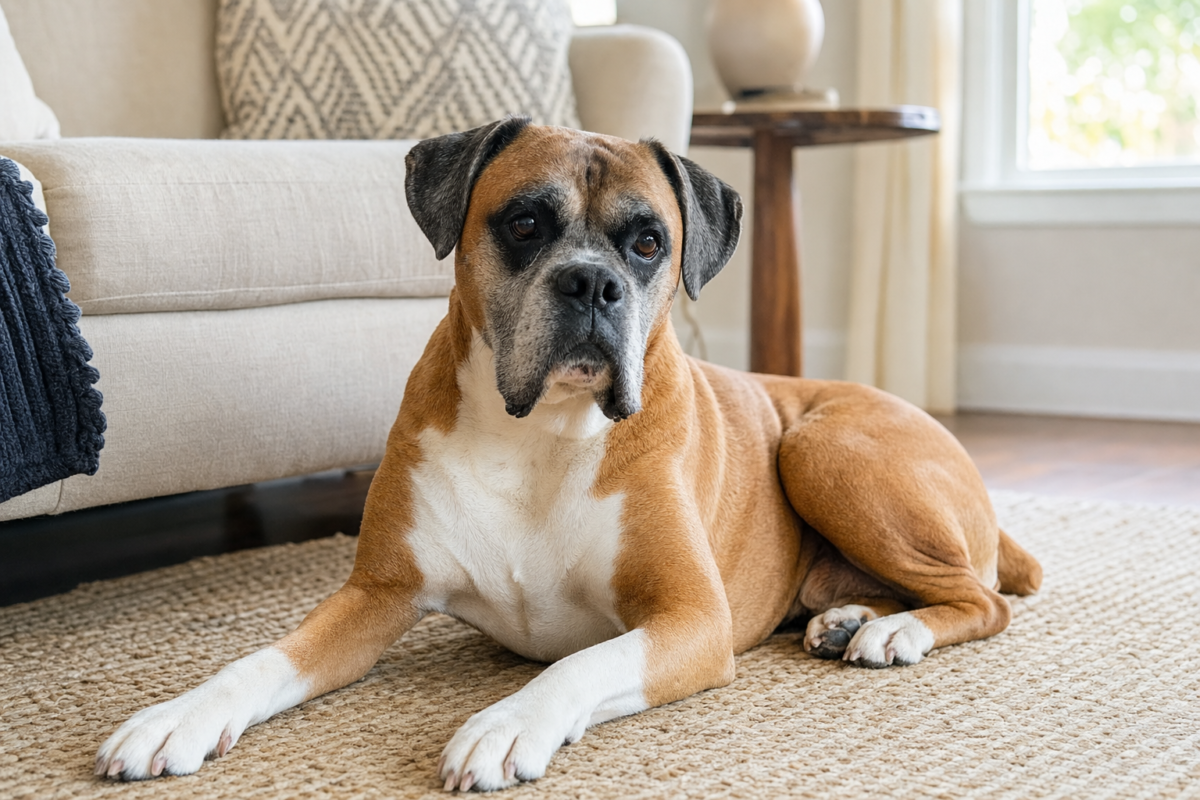
The earliest signs a large dog is slowing down are usually small changes in willingness rather than obvious limping: a slower rise from the floor, hesitation at the car or the stairs, shorter play sessions, sleeping in a different spot, lagging on the back half of a walk, or a dog who sits instead of standing while waiting. Big breeds show these changes earlier than small dogs, often from around seven years and sometimes from five in giant breeds. Any new or sudden change deserves a veterinary check.
Nobody notices the day their big dog slows down. What you notice is a Tuesday six months later, when you realise the walk you always did now ends early. Large and giant breeds age on a shorter clock than the rest of the dog world, and the first signals they give are quiet ones. Knowing what those signals look like means you can act while there is plenty of room to act, and it means a slower dog gets a comfortable, well managed second half rather than a surprised one.
What are the signs a large dog is slowing down?
A large dog that is slowing down usually shows changes in how it moves and what it chooses to do, well before anything looks dramatic. The common early signs are taking longer to stand up after a nap, stiffness in the morning that loosens off after a few minutes, hesitating before jumping into the car or climbing stairs, walking behind you rather than ahead, sitting down during pauses on a walk, shorter bursts of play, sleeping more, choosing soft ground over hard, and using a ramp or the bottom step rather than launching. Weight changes in either direction and a quieter greeting at the door belong on the list too.
None of these is a diagnosis. They are prompts to look closer and to book a conversation with your veterinarian, because several are worth ruling things out for while they are still small.
Why big dogs slow down sooner
Size sets the clock. A 40 pound dog is often considered middle aged at seven, while a 130 pound dog may already be in its senior years by five or six. Large and giant breeds simply age on a compressed timeline, and every joint in the body has carried more weight for every year of the way.
There is a mechanical reality behind that. A big dog’s joints move more load with each stride, each turn and each rise from the floor. Over years of ordinary living, that accumulated work shows up first in the movements that take the most effort, which is why the earliest signs cluster around standing up, stairs, jumping and the last mile of a walk rather than around walking itself. That predictability is useful: because you know where to look, you can spot the change early and adjust the routine while your dog still has plenty of comfortable years ahead.
When large breeds reach each life stage
Use this as a general map rather than a rule. Individual dogs vary a great deal, and a well kept, lean dog often tracks younger than the table suggests.
| Adult weight | Adult years | Mature | Senior from |
|---|---|---|---|
| 50 to 65 lb | 2 to 6 years | 6 to 8 years | about 8 years |
| 65 to 80 lb | 2 to 5 years | 5 to 7 years | about 7 years |
| 80 to 100 lb | 2 to 5 years | 5 to 7 years | about 7 years |
| 100 to 130 lb | 2 to 4 years | 4 to 6 years | about 6 years |
| 130 lb and above | 2 to 4 years | 4 to 5 years | about 5 years |
Cornell University’s College of Veterinary Medicine covers how growth rate, nutrition, and exercise interact with joint development in large breed dogs. Read more from Cornell’s canine hip dysplasia overview.
If your dog is in the mature column, this is the point to start paying attention rather than the point to worry. Most of what helps is habit, and habits are easiest to build before they are urgently needed.
The signs, grouped by where they show up
Slowing down is easier to spot when you know which part of the day to watch.
- Getting up. A longer pause before rising, a shuffle of the back feet to get organised, or a dog that leans on furniture to stand.
- The first five minutes. Stiffness after a nap or first thing in the morning that eases as the dog moves around.
- Height changes. Hesitation at the car boot, the sofa, the bed or the stairs. Many big dogs stop jumping long before they stop walking.
- Walks. Falling behind on the way home, stopping to sit, sniffing longer as a rest, or turning for home earlier than usual.
- Play. Shorter sessions, less interest in rough games, or a dog that watches rather than joins.
- Rest. Sleeping more, changing favourite spots, or moving off hard floors onto carpet and soft bedding.
- Grooming and posture. Licking at one joint, a shifted stance, or standing with the weight distributed unevenly.
Excess Weight
Every extra pound is carried through the joints on every step. Body condition is the single biggest lever you hold.
Weekend Warrior Exercise
Nothing all week then a long hike is hard on a mature big dog. Steady daily movement suits them far better.
Slippery Floors
Smooth flooring makes rising and turning harder work. Runners and rugs change a mature dog’s day more than most gadgets.
Waiting To Act
Quiet signs are easy to explain away. Noticing early gives you and your veterinarian the widest set of options.
How to tell aging from something that needs a vet today
Gradual, symmetrical and better after moving is the pattern of ordinary aging. Sudden, one sided or getting worse is the pattern that needs a call.
- A limp that appears suddenly, or that lasts more than a couple of days.
- Reluctance to bear weight on one leg, or yelping when getting up or being touched.
- Visible swelling around a joint, or heat in one area.
- A dog that cannot rise unaided, or whose back legs slide out from under it.
- Loss of appetite, unexplained weight change, laboured breathing, or a change in toilet habits alongside the slowing.
- Confusion, pacing at night, or getting stuck in corners, which are worth discussing in their own right.
None of that means the worst. It means the information is worth having, and a mature big dog benefits from a check up twice a year rather than once.
How to check body condition in ten seconds
Weight is where most of the improvement lives, and you can assess it at home without a scale.
- Ribs. Run your hands along the sides. You should feel the ribs easily under a thin layer. If you have to press, ease the portions back.
- Waist. From above, look for a clear waist that tucks in behind the ribs.
- Tuck. From the side, the belly should rise toward the back legs rather than hanging level.
A lean mature dog moves more comfortably, gets up more easily and stays interested in walks for longer. If your dog has gained while activity has dropped, adjust the food downward with your veterinarian rather than waiting for the number to correct itself.
Daily habits that support comfortable movement
Once you have noticed the signs, the response is rarely dramatic. It is a set of small daily choices that stack up.
- Two or three shorter walks instead of one long one, kept regular rather than occasional.
- Soft ground where you can find it, and runners across slippery floors at home.
- A supportive, generously sized bed that is easy to get out of, away from draughts.
- A ramp for the car and a hand under the chest on the way up rather than a jump down.
- Nails kept short and paw hair trimmed, both of which change how a dog grips the floor.
- Gentle warm ups before activity, and a slow first few minutes rather than straight into a run.
- A lean body condition, held steady, checked every couple of weeks.
Many big dog parents also add a daily joint support chew as part of that routine, which is a habit worth starting in the mature years rather than the late ones. If you are weighing up the options, our guide to hip and joint supplements covers what the common ingredients actually do.
MoveGuard Adult is formulated for adult and senior medium and large breed dogs, and is built around clinically studied eggshell membrane and New Zealand Green Lipped Mussel alongside glucosamine, chondroitin, MSM, hyaluronic acid and vitamins C and E, to support healthy joints, cartilage and comfortable movement. The daily amount is printed on the jar and set by weight: one chew for dogs 25 to 50 pounds and two chews for dogs 50 to 75 pounds and above, with senior dogs of seven years and older using the higher amount for their weight and allowing six to eight weeks. It ships as 60 soft chews in a chicken liver flavour, is made in the USA in an NSF facility, and carries a 60 day guarantee.
Support Comfortable Movement
Daily joint support built for adult and senior large breed dogs. Explore MoveGuard Adult.
How to keep a slowing dog interested
The mistake most Dog Parents make is treating slower as done. A mature big dog usually wants the same involvement and simply needs it delivered differently. Swap distance for variety. A twenty minute sniffing walk somewhere new tires a mature dog more thoroughly than a brisk mile on the same route, and it costs the joints very little. Add short training sessions, food puzzles and gentle scent games, and where it is safe and supervised, swimming keeps fitness up with almost no impact. Keep the dog involved in the household rhythm, because withdrawal from company is one of the sadder and more avoidable parts of a big dog getting older.
A stage by stage plan for the second half
Mature years. This is the window where habits pay best. Lock in a lean body condition, steady daily movement, a good bed, floor traction and a daily joint support routine. Move to twice yearly veterinary checks.
Early senior. Expect the height related signs first. Add a car ramp, block off the stairs where you can, and shift to shorter, more frequent walks. Keep a simple note of what your dog can do easily, since month to month comparison is far more useful than memory.
Full senior. Comfort becomes the organising principle. Bedding, warmth, footing, nail length and portion control all matter more than mileage. Keep the mind busy and the routine predictable, and discuss any new sign with your veterinarian promptly rather than at the next scheduled visit.
Late senior. Small adjustments, made often. Raised bowls if your dog prefers them, help with rising, more rest between activity, and a close eye on weight in both directions. The aim is a dog that still enjoys its day, at whatever pace that day now runs.
Common mistakes to avoid
- Calling it just old age. Aging is real, but it is also the easiest label to put on something that deserved a closer look.
- Stopping exercise altogether. Movement maintains muscle, and muscle is what supports a joint. Less at a time, more often, is the goal.
- Letting weight creep. Activity drops but portions rarely follow, and the extra load lands on the exact structures already doing the most work.
- Only noticing the good days. Mature dogs vary day to day. Judge on the trend across a month, not on this morning.
- Waiting for a limp. Willingness changes before gait does. The hesitation at the car is the earlier signal.
- Adding anything without asking. Talk to your veterinarian before starting a supplement, especially alongside prescribed medication.
The emotional side of a slower dog
There is a particular ache to watching a big dog get older, and it is worth naming. Large breeds pack a full life into fewer years, and the dog who cleared the sofa in one bound at three is often thinking twice about it at seven. That is a short runway by any measure, and noticing it can feel like the beginning of a countdown.
It helps to reframe what you are actually seeing. A dog that hesitates at the car is not unhappy. It is a dog telling you, clearly and usefully, what it needs from you next. Big dogs are generally magnificent at aging gracefully when the environment cooperates, and the small adjustments in this guide are exactly the kind of cooperation they respond to. Most Dog Parents find the mature years are the closest ones: less charging about, more company, and a dog who is entirely content to be near you. Slowing down is not the end of the good part. Handled well, it often is the good part.
Frequently asked questions
What are the first signs a large dog is slowing down?
The earliest signs are usually a slower rise from the floor, morning stiffness that eases with movement, hesitation at stairs or the car, lagging on the second half of a walk, and shorter play sessions. Willingness changes before gait does.
At what age do large dogs start to slow down?
Many large breeds show early changes from around seven years, while giant breeds may show them from five or six. Smaller large breeds of 50 to 65 pounds often track a year or two later than that.
Is slowing down just normal aging?
Some of it usually is, but not all of it. Gradual changes on both sides of the body that improve after moving fit ordinary aging, while sudden, one sided or worsening changes deserve a veterinary appointment rather than a wait and see week.
How much exercise does a slowing large dog need?
Regular, moderate and daily beats occasional and long. Two or three shorter walks a day on soft ground usually suits a mature big dog better than one big outing, and keeping movement in the routine helps maintain the muscle that supports the joints.
When should I call the veterinarian about my dog slowing down?
Call promptly for a sudden limp, reluctance to bear weight, swelling or heat around a joint, yelping, an inability to rise, or slowing that comes with appetite, breathing or toilet changes. For gradual changes, raise it at a check up and ask about moving to twice yearly visits.
The bottom line
Big dogs give you plenty of warning that they are slowing down, but they give it quietly. Watch how your dog stands up, how it approaches the car and the stairs, and how the last third of a walk goes, and you will see the change months before a limp would show it. Keep the weight lean, keep the movement daily and moderate, sort the floors and the bedding, support those joints as a habit rather than a rescue, and take the sudden changes to your veterinarian promptly. That is how a large dog gets a long, comfortable, well attended second half.
Want the simple roadmap in one place? Grab our free Big Dog Mobility Guide for the home setup checklist, the mature years exercise framework and the signs worth acting on, all written for large and giant breeds.
This article is for general educational purposes only and is not veterinary advice. It is not intended to diagnose, treat, cure or prevent any disease. Always consult your veterinarian about your dog’s individual health, nutrition and supplement needs. These statements have not been evaluated by the Food and Drug Administration.
Support Big Breed Joints from Day One
Large and giant breeds carry more load through every growth stage. MoveGuard Growth supports developing joints in young big dogs (8 to 30 months); MoveGuard Adult keeps grown big dogs moving comfortably.

Leave a Reply