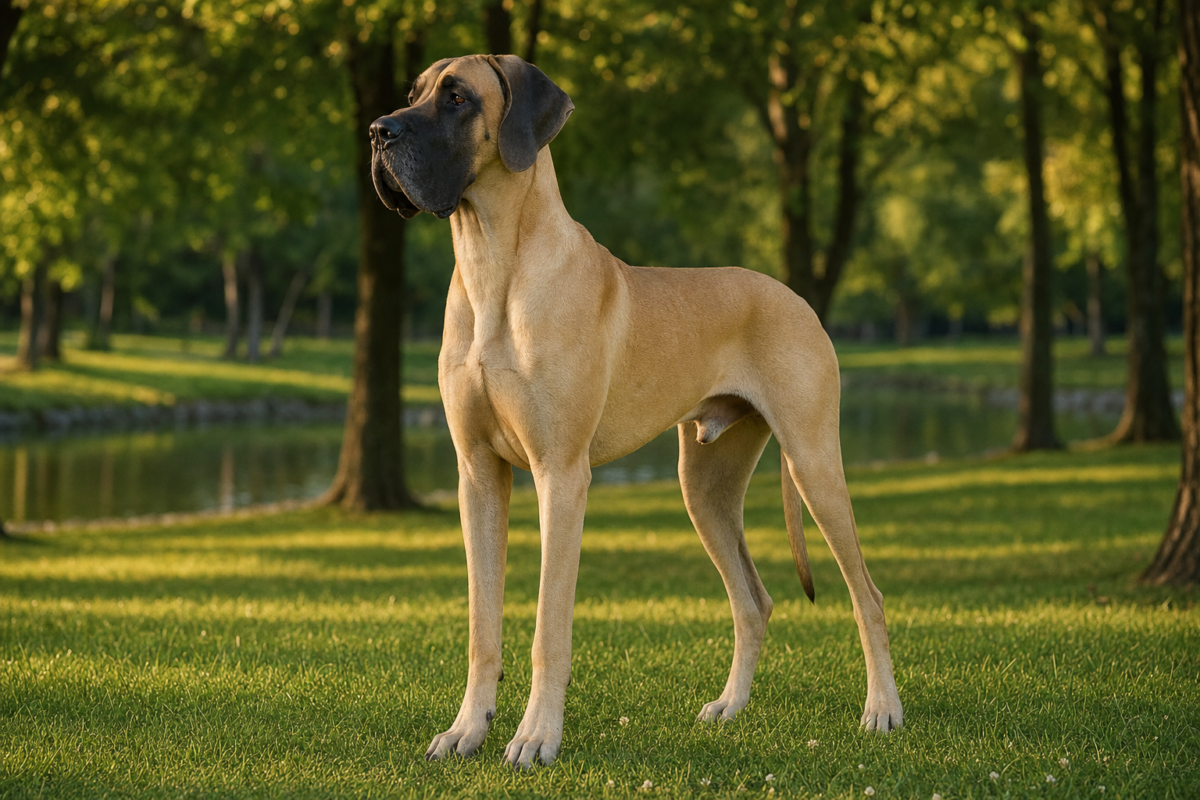
A fully grown male Great Dane usually stands 30 to 32 inches at the shoulder and weighs 140 to 175 pounds. Females typically reach 28 to 30 inches and 110 to 140 pounds. Most Danes reach full height by around 18 months, then keep filling out through the chest and muscle until roughly two to three years of age.
If you are watching your Great Dane puppy shoot up week after week and wondering just how big this gentle giant will get, take a breath. You are about to raise one of the tallest dog breeds on earth, and knowing what is coming makes the whole journey calmer and more joyful. This guide gives you clear size expectations, a month by month growth picture, and the simple daily habits that help your Dane grow into a strong, comfortable, sound adult who moves well for years.
How big will a Great Dane get?
A fully grown male Great Dane usually stands 30 to 32 inches at the shoulder and weighs 140 to 175 pounds. Females typically reach 28 to 30 inches and weigh 110 to 140 pounds. Standing on their back legs, many Danes are taller than the adults who love them.
Every Dane is an individual. Genetics, sex, nutrition and overall health all shape the final number, so treat these ranges as a well mapped road rather than a fixed destination. What matters far more than the exact adult figure is that your Dane gets there slowly and evenly, because steady growth is what protects a frame this large.
What makes Great Danes grow the way they do
Great Danes are true giants, and giants play by different rules. A Dane can go from a two pound newborn to a hundred pound adolescent in under a year, one of the fastest growth trajectories in the entire dog world. That single fact explains almost everything about how you should raise one.
Because so much bone and tissue is being laid down so quickly, a Dane puppy often looks out of proportion. Long legs, a narrow chest, big paws and a slightly awkward gait are all completely normal for a breed on this timeline. The elegant, deep chested silhouette you see in adult Danes is the result of two to three years of steady development, not a fast finish. Understanding this keeps you patient, and patience is the single most valuable trait a Great Dane parent can have.
It also explains why lean feeding and gentle movement matter more for Danes than for almost any other breed. When a frame is being built this fast and will eventually carry so much weight, the smoothest possible growth curve gives every joint the best start.
Great Dane growth chart, month by month
Use this chart as a friendly guide, not a report card. Even, unhurried progress matters more than hitting an exact figure on any given week. A Dane who tracks a little above or below these numbers while looking lean and bright is usually doing just fine.
| Age | Male weight | Female weight |
|---|---|---|
| 2 months | 18 to 26 lb | 16 to 22 lb |
| 3 months | 30 to 45 lb | 28 to 40 lb |
| 4 months | 50 to 65 lb | 45 to 58 lb |
| 6 months | 75 to 100 lb | 65 to 85 lb |
| 9 months | 100 to 130 lb | 85 to 110 lb |
| 12 months | 110 to 150 lb | 95 to 120 lb |
| 18 months | 140 to 170 lb | 105 to 135 lb |
| 2 years plus | 140 to 175 lb | 110 to 140 lb |
The American Kennel Club’s Chief Veterinary Officer, Dr. Jerry Klein, DVM, has written extensively on the slower growth and development timeline of large and giant breeds. Read more from the AKC’s guidance on caring for large-breed dogs.
When do Great Danes stop growing?
Great Danes grow in two overlapping phases. The dramatic upward stretch in height happens fast and is mostly finished by 18 months. After that, the body keeps maturing. Your Dane broadens through the chest, gains muscle and grows into that famous deep frame until about two to three years old. So the puppy who looks lanky and all legs at ten months is completely normal. The substance comes later.
Because Danes sit at the very top of the size scale, their growth window stretches longer than almost any other breed. As a rough guide, dogs with an expected adult weight of 130 to 180 pounds or more keep developing for roughly 24 to 30 months. That long runway is exactly why the habits you build early matter so much.
Why the growth window matters so much for giants
During this window your Dane is laying down the cartilage, bone and soft tissue that will carry serious weight for the rest of its life. Growth plates, the soft areas at the ends of long bones, stay open longer in giant breeds. While they are open, the frame is still being built, which is why lean feeding and gentle exercise carry extra weight for a dog this size.
Fast Growth
Pushing a giant puppy to grow quickly asks a great deal of joints that are already carrying heavy loads. Slow and steady is kinder.
Excess Weight
Extra pounds on a growing frame add load to developing joints. A lean giant is a comfortable giant.
Hard Impact
Repeated jumping and hard sprints on open growth plates are best kept to a minimum during the fast growth months.
Unbalanced Minerals
Too much calcium during growth can work against steady development. A complete large breed formula keeps minerals in balance.
How much should a Great Dane eat while growing?
Large breed puppies do best with steady, moderate growth rather than fast growth. A calm, even growth curve supports comfortable movement now and for years to come. A few practical habits make a real difference:
- Choose a complete food formulated for large breed puppies, which balances calories, calcium and phosphorus for slower, steadier growth.
- Split the daily amount into three meals while young, then two meals as an adult, to keep energy even and reduce the risk of a bloated belly.
- Feed to a lean, athletic body condition. You should feel the ribs easily under a light layer. If you cannot, ease back on portions.
- Ask your veterinarian to confirm the right daily amount at each checkup, since the correct portion changes quickly during the first year.
How to check your Dane’s body condition in ten seconds
The scale tells you weight, but body condition tells you health. You can check it at home in a few seconds, and it is the single most useful skill a giant breed parent can build.
- Ribs. Run your hands along your Dane’s sides. You should feel the ribs easily under a thin layer, a little like feeling the back of your hand. If you have to press to find them, ease back on food.
- Waist. Look down from above. You want to see a clear waist that tucks in behind the ribs, not a straight or bulging outline.
- Tuck. From the side, the belly should rise up toward the back legs rather than hanging level.
Check this every couple of weeks as your Dane grows. Adjust portions gently and involve your veterinarian at checkups. Keeping a giant lean through the growth years is one of the most protective habits there is.
Growth safe exercise for a Great Dane puppy
Great Dane puppies love to run, and gentle play is wonderful. During the fast growth months, the goal is regular, moderate activity rather than repeated hard impact. Soft grass beats hard pavement, free play beats forced jogging, and short and frequent beats long and exhausting.
- Favor free play and exploring on soft ground.
- Keep repeated jumping from height to a minimum while the growth plates are still open.
- Let your puppy set the pace and rest when tired. Giant puppies need a lot of sleep.
- Introduce stairs slowly and calmly rather than racing up and down.
Protecting those fast growing joints
Here is the reassuring truth. The same body that grows so quickly is also carrying real weight through every joint, every single day. Supporting healthy joint development early is one of the kindest things you can do for a breed this size.
Alongside lean feeding and sensible exercise, many big dog parents add a daily joint support chew made for large and giant breeds. MoveGuard Growth is built for exactly this stage. It combines nine actives, including New Zealand Green Lipped Mussel, glucosamine, chondroitin, MSM and hyaluronic acid, to support the developing joints of young large breed dogs across the roughly 8 to 30 month growth window. You dose by expected adult weight rather than current puppy weight, so a Dane on track for well over 100 pounds sits at the top of the range. It is made in the USA and is backed by a 60 day guarantee.
“It is specifically designed for puppies. Chondroitin, glucosamine, MSM, green lipped mussel, hyaluronic acid and vitamin C all combine to help keep hips and joints lubricated and strong. You can even crumble it and mix it with food.”
Lobo, Verified Buyer
Support the Growth Window
Give your growing Dane daily joint support built for large and giant breeds. Explore MoveGuard Growth.
Signs your Great Dane is growing on track
You do not need a scale reading every day to know things are going well. Look for a bright, curious puppy with a lean waist you can see from above, ribs you can feel with light pressure, smooth easy movement, and a healthy appetite at mealtimes. Even, unhurried growth is exactly what you want to see.
If you ever notice limping, reluctance to move, stiffness after rest, or growth that seems suddenly very fast, a quick chat with your veterinarian brings peace of mind and lets you adjust food or activity early.
A simple growth game plan, stage by stage
You do not need a complicated program to raise a sound Dane. You need the right emphasis at the right time. Here is how the priorities shift as your puppy grows.
8 weeks to 4 months. This is the foundation stage. Focus on a complete large breed puppy food, three calm meals a day, gentle socialisation, and short bursts of free play on soft ground. Resist the urge to compare your puppy to friends with smaller breeds. Your Dane is on a longer timeline by design.
4 to 8 months. Your puppy grows fast now and can look gangly and out of proportion. Keep feeding lean, keep exercise gentle, and start building calm habits around stairs and car entry so your growing giant learns to move carefully rather than leaping. This is also a natural point to begin a daily joint support routine that carries through the whole growth window.
8 to 18 months. Height is reaching its peak and the frame is filling in. Keep portions matched to a lean body condition, since appetite can outpace need. Gradually add structured activity as your Dane matures, always favouring soft surfaces and steady movement over hard impact.
18 months to 3 years. The tall puppy becomes a deep, substantial adult. Growth slows, muscle and chest continue to develop, and you can build activity up as your veterinarian advises. Many parents keep a joint support routine going right through this stage and into adulthood.
Common growth mistakes to avoid
Most growth problems in giant breeds come from a handful of avoidable habits. Steer clear of these and you are already ahead.
- Feeding for size. A chunky giant puppy is not a healthy one. Extra weight loads developing joints. Feed to a lean, athletic condition and let the size come on its own timeline.
- Using adult or all life stage food too casually. Large breed puppy formulas exist because they control calcium and calories for steady growth. Confirm the right food with your veterinarian.
- Too much hard exercise, too young. Long runs, repeated jumping and rough play on hard ground are a lot to ask of open growth plates. Keep it gentle while the frame is still building.
- Waiting for a problem before supporting joints. The growth window is the ideal time to support developing joints, not after signs appear. Early, steady habits pay off for years.
- Skipping veterinary checkups. Fast growing giants change quickly. Regular checkups let your veterinarian catch small things early and keep portions and activity on track.
How the Great Dane compares with similar breeds
The Dane is usually weighed against the English Mastiff, and the split is height against mass. A Great Dane male stands 30 to 32 inches and weighs 140 to 175 pounds, making it the taller, leaner and springier of the two. An English Mastiff male stands 30 inches and up but weighs 160 to 230 pounds, and moves like it. Both keep growing well past their first birthday. Great Dane vs English Mastiff has the detail, and our big dog breed comparisons page has the rest.
Frequently asked questions
At what age is a Great Dane full grown?
Most Great Danes reach their full height by around 18 months, then continue to fill out in muscle and chest depth until roughly two to three years of age. Height comes first, substance comes later.
How much does a full grown Great Dane weigh?
A fully grown male Great Dane usually weighs 140 to 175 pounds and a female weighs 110 to 140 pounds, though individual dogs vary with genetics, sex and body condition.
How big is a Great Dane at 6 months?
At 6 months a male Great Dane often weighs around 75 to 100 pounds and a female around 65 to 85 pounds. They still have a lot of filling out to do, so a lanky look at this age is normal.
Are Great Danes prone to joint issues?
As a giant breed, Great Danes carry more weight through their joints than smaller dogs, so steady growth, a lean body condition, gentle exercise and daily joint support during the growth window are all sensible ways to support long term comfort. Speak with your veterinarian about your individual dog.
What should I feed a Great Dane puppy?
A complete food formulated for large breed puppies is the safest choice, because it balances calories and minerals for slow, steady growth. Feed to a lean body condition and confirm portions with your veterinarian at each visit.
The bottom line
Your Great Dane will very likely grow into a 110 to 175 pound companion who reaches full height by around 18 months and fills out by two to three years. Feed for lean, steady growth, keep exercise gentle while those joints develop, and support the long growth window with the right daily habits. Do that, and you set your gentle giant up for a lifetime of comfortable, happy movement.
Want the Simple Roadmap in One Place?
Grab our free Big Dog Growth Blueprint for the growth window checklist, feeding framework and joint safe exercise limits, all written for large and giant breeds.
This article is for general educational purposes only and is not veterinary advice. It is not intended to diagnose, treat, cure or prevent any disease. Always consult your veterinarian about your dog’s individual health, nutrition and supplement needs. These statements have not been evaluated by the Food and Drug Administration.
Support Big Breed Joints from Day One
Large and giant breeds carry more load through every growth stage. MoveGuard Growth supports developing joints in young big dogs (8 to 30 months); MoveGuard Adult keeps grown big dogs moving comfortably.
Leave a Reply